Français (France)
  Nederlands (nl-NL)
 00:00 • intro | 00:31 • the palace park | 00:58 • the frescoes recounting the sultan's wars | 02:29 • the richly decorated walls
Personal creation from visual material collected during my trip Unknown India • Ladakh, Karnataka, Telangana (2022)
Map of places or practices in Srirangapatna on this site
• Use the markers to explore the content •
The Summer Palace of Tipu Sultan in Srirangapatna
Located in Srirangapatna, in the state of Karnataka, the summer palace of Tipu Sultan remains one of the most important monuments associated with the Kingdom of Mysore during the late eighteenth century. Built within a former fortified capital surrounded by branches of the Kaveri River, the palace reflects both the artistic refinement of Tipu Sultan’s court and the political tensions that marked southern India during the conflicts with the British East India Company.
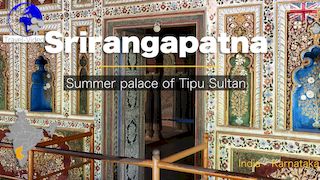
The video offers a gradual exploration of the monument through the palace gardens, the painted murals depicting the sultan’s military campaigns and the richly decorated walls that cover much of the building’s interior. The images highlight both the refined decorative character of the palace and its historical importance within the history of Karnataka and southern India.
A Royal Residence Within the Fortified Capital
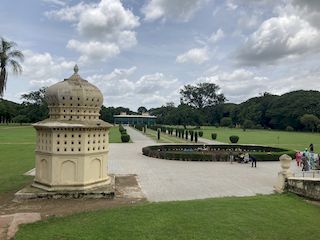
The first sequences devoted to the palace grounds reveal the relatively peaceful setting in which the monument stands today. Unlike the massive military fortifications associated with the Mysore kingdom, the summer palace was designed primarily as a residential and ceremonial structure intended for comfort, prestige and courtly life.
The architecture relies largely on wooden elements supported by elegant columns and open galleries adapted to the warm climate of southern India. This lighter architectural style contrasts with the heavier stone constructions found in many other historic Indian capitals.
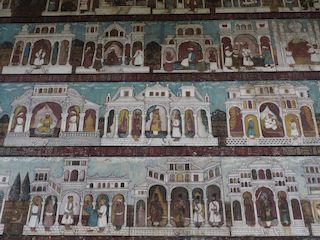
The murals visible inside the palace are among the most remarkable features of the monument. Several scenes illustrate the wars fought by Tipu Sultan against British forces and their Indian allies. These paintings carry a strong political and symbolic dimension, celebrating the military achievements of the Mysore ruler and reflecting his efforts to resist British expansion in the region.
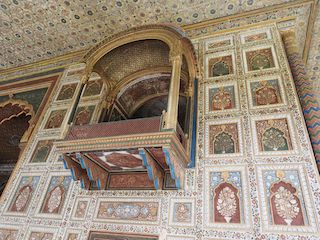
The richly ornamented walls further reveal the influence of Indo-Islamic artistic traditions developed in southern India during this period. Floral motifs, geometric decorations and vivid colours create an elaborate decorative environment in which almost every surface contributes to the visual identity of the palace.
Tipu Sultan and the Kingdom of Mysore
The palace is closely connected to the historical figure of Tipu Sultan, who ruled Mysore after his father Haidar Ali during the final decades of the eighteenth century. He remains one of the most significant rulers in the history of southern India because of his military resistance to British colonial expansion.
Under his reign, Srirangapatna became a major political and military centre. The fortified city played a strategic role during the Anglo-Mysore Wars, which opposed the Mysore kingdom to the British East India Company and its allies. After the fall of Srirangapatna in 1799 and the death of Tipu Sultan, the palace retained strong symbolic importance linked to this decisive period of Indian history.
The monument itself reflects a combination of local Karnataka traditions, Indo-Persian artistic influences and architectural adaptations designed for the tropical climate.
What the Videos on This Site Make Particularly Clear
The videos published on travel-video.info frequently use animated photographs and progressive transitions that allow detailed observation of historical monuments. This visual approach makes it easier to understand architectural organisation, decorative elements and spatial relationships without relying exclusively on moving footage.
In the case of Tipu Sultan’s summer palace, the movements within the image emphasise the painted murals, the wooden columns, the decorated ceilings and the open perspectives created by the galleries surrounding the building. The gradual transitions also help viewers better understand the balance between residential architecture and ceremonial spaces within the palace complex.
A Major Legacy of the Mysore Kingdom
Through its painted decorations, refined architecture and direct connection with the history of Tipu Sultan, the summer palace of Srirangapatna remains one of the most important historical monuments in Karnataka. The video offers a visual reading of this remarkable residence while revealing the artistic sophistication developed at the Mysore court shortly before British domination reshaped southern India.
Links to related pages






Audio Commentary Transcript
The Wodeyar dynasty reigned over the Mysore region for almost 6 centuries but internal dissension and the appetite of neighboring sultanates weakened it considerably towards the end of the 18th century. A talented general in the Wodeyar army, Hyder Ali, took the opportunity to oust the dynasty from the throne at a time when British imperialism was beginning to threaten all the states in the region. Unlike the Wodeyar, Hyder Ali and then his son, Tipu Sultan courageously stood up to the invaders. However, Tipu Sultan would succumb in the Fourth Anglo-Mysorean War in 1799. The sultan's palace was destroyed, and the Wodeyars were returned to the throne, but as vassals of the British Empire. Sultan Tipu's summer palace is the last witness of this era.
Tipu Sultan's Summer Palace is famous for the quality and state of preservation of the many frescoes adorning its walls, which depict scenes from the Anglo-Mysorian wars as well as scenes from the Sultan's life.

Music:
- - YouTube video library - Dissappointment, (© Dissappointment by Kevin MacLeod is licensed under a Creative Commons Attribution 4.0 license. https://creativecommons.org/licenses/by/4.0/
- Source: http://incompetech.com/music/royalty-free/index.html?isrc=USUAN1100481
- Artist: http://incompetech.com/)
- - YouTube video library - Heavy Interlude, (© Heavy Interlude by Kevin MacLeod is licensed under a Creative Commons Attribution 4.0 license. https://creativecommons.org/licenses/by/4.0/
- Source: http://incompetech.com/music/royalty-free/index.html?isrc=USUAN1100515
- Artist: http://incompetech.com/)
Disclaimer: Despite its appropriateness, copyright issues prevent the use of indian traditional music in "Srirangapatna, Tippu Sultan's summer palace • India, Karnataka", hence the use of royalty-free music. Despite our careful selection, some might regret this decision, which is necessary to avoid potential lawsuits. Although difficult, this decision is the only viable solution.