Français (France)
  Nederlands (nl-NL)
 00:00 • intro | 00:48 • Buddhism and Animism in Synergy | 01:33 • Kurphuk Gompa | 02:24 • Maitreya Buddha | 04:35 • Royal Palace
Personal creation from visual material collected during my trip Unknown India • Ladakh, Karnataka, Telangana (2022)
Map of places or practices in Stok on this site
• Use the markers to explore the content •
Stok: Royal Heritage and Buddhist Devotion in Ladakh
A Himalayan settlement shaped by landscape and culture
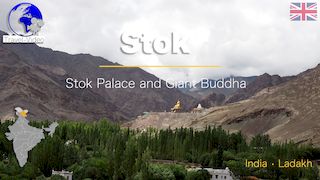
Located in the Indus Valley near Leh, Stok offers a distinctive synthesis of high-altitude environment and cultural heritage. This Ladakhi village is defined by the coexistence of religious institutions and a former royal residence, both set against a stark yet luminous mountain landscape. The arid slopes, wide skies, and seasonal contrasts create a setting in which human settlement appears both fragile and deeply rooted.
The video highlights this balance by presenting a sequence of religious sites, monumental sculptures, and architectural structures that together form a coherent cultural landscape. Rather than isolating individual monuments, it reveals how spiritual practices, political history, and environmental adaptation intersect within a relatively compact territory.
Sacred spaces and emblematic structures
One of the defining features of Stok lies in the interaction between Buddhist traditions and older belief systems often associated with animistic practices. This coexistence is visible in ritual spaces, symbolic markers, and the broader organization of sacred geography. Kurphuk Gompa exemplifies this dimension, standing in relative isolation and reinforcing the idea of retreat, contemplation, and spiritual discipline within the Himalayan context.
The presence of the Maitreya Buddha adds another layer of meaning. Representing the future Buddha, this large-scale figure embodies a central concept in Buddhist thought related to cyclical time and renewal. Its prominent placement within the landscape transforms it into both a spiritual focal point and a visual landmark, linking doctrinal symbolism with spatial perception.
Nearby, the Stok Palace reflects a different aspect of local identity. Serving as the residence of the Ladakhi royal family after the loss of Leh in the nineteenth century, the palace combines domestic and ceremonial functions. Its architecture, characterized by layered volumes and thick walls, responds to climatic constraints while maintaining a formal presence that conveys continuity and authority.
Historical and cultural context
Stok occupies a specific place in Ladakh’s political history, particularly following the Dogra conquest in the nineteenth century. The relocation of the royal household to this village marked a shift in power while preserving elements of dynastic identity. The palace thus became both a practical residence and a symbol of legitimacy in a transformed political landscape.
Architecturally, the buildings of Stok illustrate long-standing strategies of adaptation to altitude and climate. The use of locally available materials such as earth and stone ensures thermal efficiency and structural resilience. Monastic constructions and monumental statues follow a symbolic logic in which elevation, orientation, and visibility reinforce their religious significance.
The coexistence of Buddhist doctrine with earlier belief systems further enriches the cultural fabric of the region. Elements related to local deities, natural forces, and seasonal cycles continue to coexist with monastic traditions, creating a layered system of meaning that remains perceptible in both rituals and spatial organization.
A visual approach that clarifies complex environments
The videos on this site offer a particularly effective way to understand such environments. Built largely from carefully selected and animated photographs, they allow for a slower and more deliberate observation of architectural details, surface textures, and sculptural elements. This approach avoids the fragmentation often associated with rapid moving footage.
The sequencing of images also helps situate each monument within its broader context. By progressively revealing viewpoints, alignments, and spatial relationships, the video enables a clearer reading of how the palace, religious sites, and surrounding landscape interact. This method enhances both visual comprehension and cultural interpretation.
A coherent interplay of power and spirituality
Stok emerges as a place where political history, religious expression, and environmental adaptation converge. Its monuments and spatial organization reflect a continuity that bridges periods of transformation without losing coherence.
Further exploration through the dedicated pages on individual monuments provides deeper insight into their historical development and architectural characteristics, extending the understanding initiated by the video.
Links to related pages

Audio Commentary Transcript
Stok was an agricultural hamlet like so many others in Ladakh until the early 19th century. Around 1820, following incursions by the Dogras who ruled the neighboring state of Jammu, King Tsewang Namgyal II decided to move his residence and all state services from Leh to Stok.
The choice of Stok can be explained by its proximity to Leh and the strategic advantages offered by this isolated and relatively inaccessible village.
This royal choice gave special importance to the village. A monastery named Kurphuk Gompa was established there, and recently, a giant statue of Maitreya Buddha, (the future Buddha), was erected.
The numerous stupas and the few altars scattered along the path leading to the monastery and the statue reflect the Ladakhi spirituality, mixing Buddhism and animism.
This gigantic statue with a height of 32 meters, inaugurated in 2016 during a ceremony presided over by the Dalai Lama, represents Maitreya Buddha, that is to say the Buddha of the future. The Buddhist religion is not fixed, and while the current Buddha has been Siddhartha Gautama for over 2,500 years, the next Buddha stands ready to teach Buddhist teachings again the day these precepts are forgotten by humanity. This next Buddha is known as Maitreya Buddha.
But the main attraction of Stok is the royal palace built at the beginning of the 19th century to serve as the residence of the Namgyal dynasty after their move from the Leh Palace. Nowadays, part of this palace is still occupied by the descendants of the royal family and another part has been turned into a museum. Unfortunately, it is forbidden to photograph the exhibited works. The rest of the palace has been converted into a luxury hotel.
This yak skull placed at the foot of a prayer flag in one of the palace courtyards is another testimony to the complexity of Ladahki culture, harmoniously mixing Buddhism and animism.

Music:
- - YouTube video library - Argonne - Zachariah Hickman
- - YouTube video library - Not without the rest, (© Not Without the Rest by Twin Musicom is licensed under a Creative Commons Attribution 4.0 license. https://creativecommons.org/licenses/by/4.0/
- Artist: http://www.twinmusicom.org/)
- - YouTube video library - Wonder
Disclaimer: Despite its appropriateness, copyright issues prevent the use of indian traditional music in "Stok: Royal Splendours and Buddhist Devotion, Ladakh • India", hence the use of royalty-free music. Despite our careful selection, some might regret this decision, which is necessary to avoid potential lawsuits. Although difficult, this decision is the only viable solution.