

 Français (France)
  Nederlands (nl-NL)
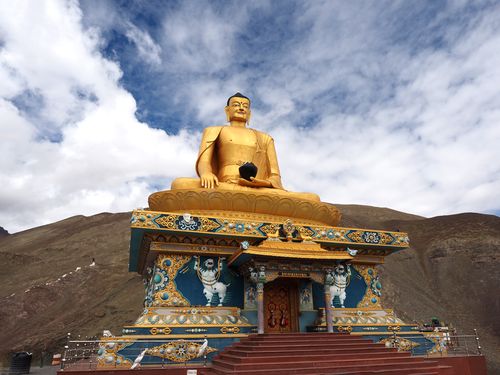
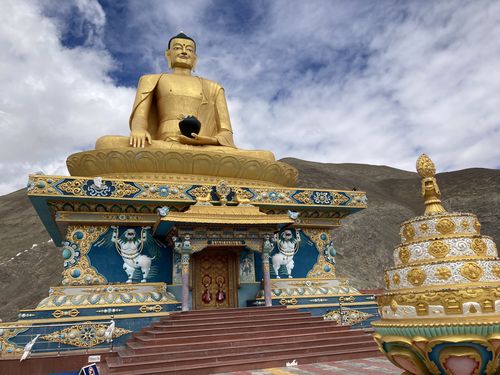
 The Maitreya Buddha of Stok in Ladakh is a large contemporary statue depicting the future Buddha in Buddhist tradition. Built near the village of Stok, it stands within the open landscape typical of the Indus Valley. The structure is notable for its scale and its symbolic role, associated with themes of peace and compassion. Visible from a considerable distance, it serves as a visual landmark in the region and as a gathering place for religious ceremonies and practices. The site also draws visitors interested in present-day expressions of Buddhism in Ladakh.

Monument profile
Buddha statue
Monument category: Giant Statues
Monument family: Giant statues or set of statues
Monument genre: Religious
Cultural heritage: Buddhist
Geographic location: Stok • Ladakh • India
Construction period: 21th century AD
• Links to •
• List of videos about Stok on this site •
Stok: Royal Splendours and Buddhist Devotion, Ladakh • India
Maitreya Buddha of Stok: Development and Historical Role of a Contemporary Monument in Ladakh
Foundation and project context
The Maitreya Buddha statue at Stok was conceived in the early twenty-first century as part of a locally initiated religious project in the Indus Valley, Ladakh. Its construction reflects a deliberate effort by regional Buddhist authorities and monastic networks to establish a large-scale representation of Maitreya, the future Buddha, in an accessible open setting. The choice of Stok, historically associated with Ladakhi royal presence, provided both symbolic continuity and geographic visibility.
The initiative relied on coordinated funding from local communities and external Buddhist organizations. The project was not tied to a single monastic institution but rather to a broader religious objective, aiming to create a focal point for devotion outside traditional monastery structures. Construction proceeded over several years, involving specialized artisans familiar with large-scale religious statuary.
Religious function and intended role
The statue was designed to serve as a visible manifestation of Maitreya within the regional religious landscape. Its function is directly linked to devotional practices centered on the expectation of a future Buddha and the associated renewal of spiritual teachings. The monument supports ritual gatherings organized at specific times, reinforcing its role as a site of collective religious activity.
Unlike interior cult images found within monasteries, this statue operates in an open environment, altering patterns of interaction. Its placement allows both individual and group practices to occur without the spatial constraints of enclosed religious architecture. The monument thus expands the scope of ritual space into the surrounding landscape while maintaining its doctrinal significance.
Evolution of use and local integration
Since its completion, the Maitreya Buddha of Stok has not undergone major structural alterations. Changes relate primarily to its patterns of use and integration into local and regional circuits. The site has gradually become part of visitor itineraries due to its scale and visibility, leading to an increase in non-local presence.
This shift has prompted limited adjustments to the surrounding area, including basic arrangements to manage access and movement. These interventions remain secondary and do not alter the monument itself. The statue continues to function as an active religious site, with its original devotional role maintained alongside its growing visibility as a landmark.
Its presence also corresponds to a broader pattern of contemporary religious construction in Ladakh, where new monuments are introduced into historically established environments. In this context, the statue does not replace existing monastic institutions but complements them by extending religious expression into new spatial formats.
Global historical context
The construction of the Maitreya Buddha of Stok in the early twenty-first century coincides with a period of increased global circulation of religious ideas and cultural initiatives. During the same timeframe, several large-scale religious statues were erected in different parts of Asia, reflecting renewed interest in monumental representations. This phase also corresponds to expanding infrastructure and mobility in Himalayan regions, facilitating both construction projects and access to remote sites.
Current status and preservation
The Maitreya Buddha of Stok remains a recent monument with no significant conservation challenges documented to date. Maintenance is limited to routine care of the structure and its immediate surroundings. The durability of the statue depends primarily on the integrity of its construction materials and periodic upkeep.
Its current status reflects a dual function: it operates simultaneously as a religious site and as a visual landmark within the Ladakhi landscape. The monument’s continued use for ritual purposes confirms its integration into contemporary religious life, while its scale ensures a lasting presence in the spatial organization of the area.
Structural design and spatial configuration of the Maitreya Buddha at Stok
Site placement and spatial organization
The Maitreya Buddha statue at Stok stands on a slightly elevated platform overlooking the Indus Valley, establishing a direct visual link with the surrounding terrain. No intermediate structures interrupt this relationship, allowing the monument to be read clearly from a frontal axis that defines its primary perspective.
The setting remains deliberately uncluttered, enabling the base platform and the statue to function as a unified architectural entity. The platform outlines the spatial footprint of the monument with a compact and regular geometry, forming a stable horizontal plane that contrasts with the vertical rise of the figure. The absence of surrounding constructions concentrates attention entirely on the central volume.
Structural system and load distribution
The statue is supported by an internal framework designed to sustain a large vertical mass under variable climatic conditions. This core, generally made of reinforced concrete, forms a continuous load-bearing system extending from the foundation to the upper sections. It ensures resistance to wind, temperature variations, and long-term structural stress.
The seated posture determines the distribution of weight. The lower section, formed by the folded legs, creates a broad and stable base. Above it, the torso rises as a compact volume that maintains vertical continuity while limiting lateral spread. The head and upper elements are proportionally lighter, reducing structural strain at higher levels.
Transitions between these sections are achieved through gradual variations in volume rather than abrupt shifts. This continuity reinforces both mechanical stability and visual coherence. The structural system remains concealed beneath the outer surface, allowing the statue to appear as a single sculptural form.
Materials and surface treatment
The exterior surface is composed of a layered system applied over the structural core. This includes a modeling material that allows precise shaping of facial features, drapery, and symbolic elements. The surface is then treated with pigments and finishes that define the monument’s visual identity.
Color contributes significantly to the architectural reading. Bright tones and metallic finishes, especially gold accents, highlight key elements such as the head, ornaments, and parts of the attire. These finishes improve visibility under strong light and enhance legibility from a distance.
Material selection balances durability and expressive capacity. The outer layer must resist environmental exposure while preserving the precision of its modeled details. Maintenance therefore addresses both structural preservation and the upkeep of surface finishes.
Formal composition and sculptural articulation
The figure of Maitreya follows a clearly structured composition. The seated posture creates a symmetrical arrangement around a central vertical axis. The legs form a stable base, while the torso and head align vertically, reinforcing the upward emphasis of the monument.
The arms are integrated into the mass through a controlled gesture that avoids excessive projection. This restraint maintains the compactness of the overall form. Drapery is expressed through measured reliefs that follow the body’s contours, producing a rhythmic surface without disrupting the volume.
The face acts as the focal point. Its proportions are adjusted for visibility from a distance, with simplified yet distinct features. The headdress and associated elements extend the vertical line, contributing to the overall silhouette.
Decorative elements remain subordinate to the main structural lines. Their distribution reinforces the hierarchy of forms rather than competing with it, ensuring a clear and coherent visual organization.
Visual perception and architectural reading
The monument is conceived to be read at multiple scales. From afar, the silhouette dominates through its vertical outline and contrasting base. At intermediate distances, the relationship between platform and sculptural volume becomes more evident. Close views reveal the detailed modeling and transitions between structural components.
The absence of surrounding complexity allows uninterrupted observation of these shifts in perception. Movement toward the statue follows a linear progression aligned with its orientation, reinforcing the frontal reading while permitting lateral views of the volume.
The continuity of surfaces and controlled transitions between forms produce a unified architectural reading. The statue functions as a coherent whole rather than an assembly of parts, emphasizing clarity of structure, stability of mass, and legibility within an open spatial setting.