Français (France)
  Nederlands (nl-NL)
 00:00 • Introduction | 00:18 • Sultanhani caravanserai
Personal creation from visual material collected during my trip Turkey • Cappadocia (2014)
Map of places or practices in Sultanhani on this site
• Use the markers to explore the content •
Sultanhani: a caravanserai on the Silk Road in Anatolia
A monumental stop within a landscape of movement
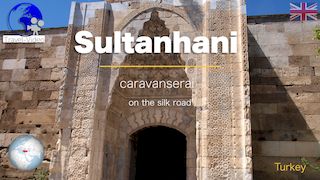
Located in the open plains of central Anatolia, the Sultanhani caravanserai stands as one of the most significant surviving examples of the infrastructure that supported long-distance trade in the medieval period. Positioned along a major route linking Central Asia to the Mediterranean, it formed part of a network often associated with the Silk Road. In a landscape defined by wide horizons and long distances, such a structure appears as a clearly defined point of arrival and shelter.
The site reflects a system designed to organize movement rather than a settlement in itself. It functioned as a protected stop for merchants, animals, and goods, offering a controlled environment within a region shaped by travel and exchange. The video presents this monument through its spatial organization, emphasizing both its scale and its functional logic.
A structured space for protection and circulation
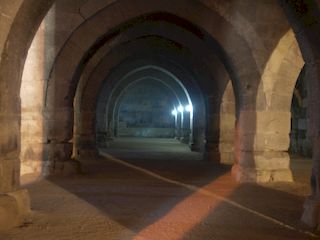
The images reveal a building organized around a large central courtyard, which serves as the main area for circulation and activity. Entry is marked by a monumental portal, often richly decorated, that defines a clear threshold between the outside environment and the enclosed space. This transition underlines the protective function of the caravanserai.
Within the courtyard, the layout is carefully arranged to accommodate different needs. Arcaded galleries, resting areas, and spaces for animals are distributed around the central open space. The architecture emphasizes durability and clarity, with thick walls and simple geometric volumes designed to withstand both climate and potential threats.
Covered areas complement the open courtyard, allowing the structure to function in different seasons. This combination of open and enclosed spaces reflects a pragmatic approach, where each element contributes to the efficiency of the whole. The building operates as an integrated system, ensuring both movement and security.
A legacy of the Seljuk period
Sultanhani dates from the Seljuk period, when Anatolia played a strategic role in the exchange networks connecting East and West. During this time, rulers invested in the construction of caravanserais to facilitate trade and to provide safe passage for merchants across long distances.
These structures were essential to the functioning of commercial routes, offering places to rest, store goods, and prepare for the next stage of a journey. They also contributed to the organization of the territory, creating a network of reliable stopping points that structured movement across the region.
Architecturally, Seljuk caravanserais combine robust construction with concentrated decorative effort, particularly at the entrance. Sultanhani illustrates this approach, with a contrast between the simplicity of its overall volumes and the refinement of specific elements such as the portal.
A clearer understanding through visual sequencing
The videos on this site rely largely on carefully selected and animated photographs, allowing complex architectural spaces to be explored in a gradual and structured way. In the case of Sultanhani, this method highlights the internal logic of the building.
The progression of images moves from the monumental entrance into the courtyard and then through the surrounding spaces. This sequence clarifies how the structure is organized and how its different parts relate to one another. The viewer can follow the spatial hierarchy without losing the overall sense of scale.
Changes in viewpoint also make it easier to perceive proportions and volumes, which can be difficult to grasp within such an extensive enclosure. Architectural details, including carved decoration and material textures, are presented in a way that supports an understanding of the building as a whole.
A witness to historical networks of exchange
The Sultanhani caravanserai stands as a material reminder of the trade networks that once crossed Anatolia. It reflects not only the movement of goods but also the circulation of ideas and cultural influences across vast distances.
Exploring this monument provides insight into the infrastructure that made such exchanges possible and into the organization of travel in a pre-modern context. For a more detailed understanding of its history, architecture, and function, the dedicated pages linked to Sultanhani offer additional information and analysis.
Links to related pages



Audio Commentary Transcript
Built in the 13th century, Sultanhani is the largest caravanserai in Turkey. Caravanserais were places of rest and safety for the Silk Road caravans that transported their precious cargoes from the Mediterranean to China and vice versa. These caravans have considerably enriched their owners as well as the cities on their way.

Muziek:
- - YouTube video library - Clouds
- - YouTube video library - Outcast
Let op: Ondanks de toepasselijkheid, voorkomen auteursrechten het gebruik van turkse traditionele muziek in "Sultanhani, karavanserai op de Zijderoute • Turkije", vandaar het gebruik van rechtenvrije muziek. Ondanks onze zorgvuldige selectie, kunnen sommigen deze beslissing betreuren, die noodzakelijk is om mogelijke rechtszaken te vermijden. Hoewel moeilijk, is deze beslissing de enige haalbare oplossing.