

 Français (France)
  Nederlands (nl-NL)
 The Sultanhani caravanserai, located along the former trade route between Konya and Aksaray, is one of the largest and best-preserved in Turkey. Built in the 13th century during the Seljuk period, it functioned as a fortified stopover for caravans crossing Anatolia. Its monumental stone architecture and grand proportions reflect the region’s strategic role along Silk Road trade routes. The site features an open courtyard, covered shelters for travelers and animals, as well as ancillary facilities. Today, it stands as a prominent example of Seljuk caravanserai infrastructure and remains a popular destination for those exploring Anatolia’s medieval heritage.
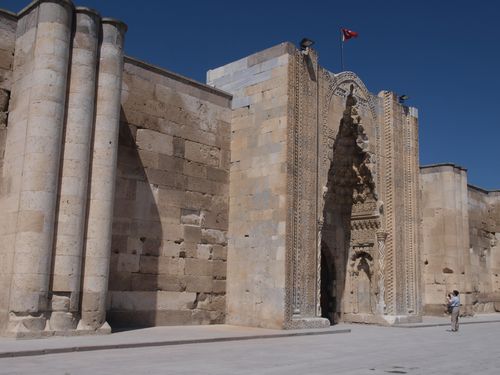
Sultanhani • Sultanhani Caravanserai
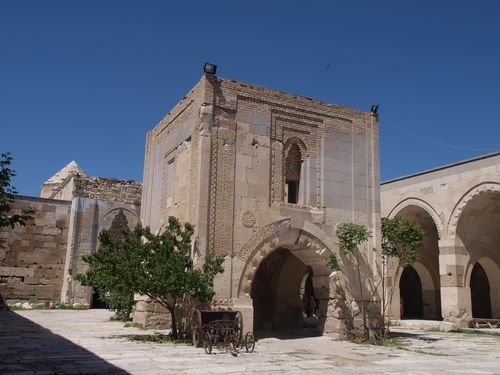
Sultanhani • Sultanhani Caravanserai: mosque
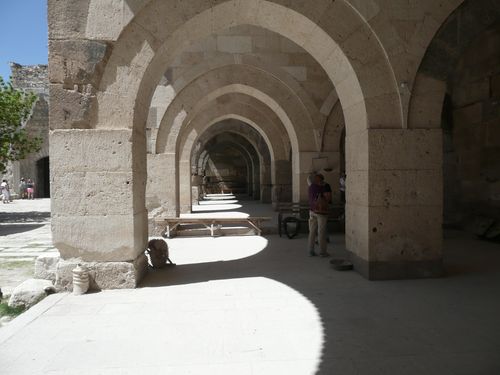
Sultanhani • Sultanhani Caravanserai
Monument profile
Sultanhani Caravanserai
Monument category: Caravanserai
Monument family: Fort, Fortifications or Citadel
Monument genre: Military
Cultural heritage: Islamic
Geographic location: Sultanhani • Turkey
Construction period: 13th century AD
• Links to •
• List of videos about Sultanhani on this site •
Sultanhani, caravanserai on the Silk Road • Turkey
• References •
Wikipedia EN: Sultan Han
Historical Analysis of the Sultanhani Caravanserai (Turkey)
The Sultanhani Caravanserai, located in the town of Sultanhani in central Turkey, stands as one of the most imposing and best-preserved examples of Seljuk civil architecture in Anatolia. Built in 1229 under the reign of Sultan Alaeddin Kayqubad I and later restored in 1278, this monument reflects both the geopolitical dynamics of the 13th century and the Seljuk ambition to dominate and secure trade routes across their expanding empire.
Political and Social Context of Construction
The construction of the caravanserai occurred during a period of growing Seljuk influence in Anatolia. Alaeddin Kayqubad I, ruling the Sultanate of Rum from 1220 to 1237, sought to consolidate control over key commercial and military routes. The caravanserai was commissioned as part of a vast program of infrastructure designed to promote safe and efficient trade along the Silk Road and to project royal authority into the hinterland.
Its location between Aksaray and Konya was strategic, connecting the Anatolian plateau to both eastern trade centers and Mediterranean ports. The caravanserai was not only a logistical node but also a symbol of state power and religious patronage, integrating a mosque within its grounds. The sultan’s objective was twofold: to ensure the prosperity of commerce and to signal Seljuk dominance in the region.
The building’s construction was likely funded through a waqf (pious endowment), a common practice in Islamic governance that linked religious merit with civic utility. The endowment system guaranteed both the financial sustainability of the facility and its management, while also reinforcing the sultan’s legitimacy as a benefactor of Islam and the public good.
Historical Events and Transformations
Over the centuries, the caravanserai experienced numerous episodes of damage and renewal. After its initial construction in 1229, it was severely damaged by fire or conflict — the precise cause remains uncertain — and underwent major restoration in 1278 under the Ilkhanid governor Seraceddin Ahmed, during the Mongol-dominated phase of Anatolian history.
Throughout the 14th and 15th centuries, as the Seljuk state declined and successor principalities rose, the caravanserai continued to function as a commercial rest stop, though with diminished strategic relevance. During the Ottoman period, it was occasionally used but largely fell into disrepair as new roads diverted traffic away from older routes. Unlike many similar buildings, it was not converted into military use or private property, which likely contributed to its long-term preservation.
In the 20th century, the Turkish Republic initiated efforts to catalog and restore historic monuments. Sultanhani was recognized for its exceptional state of conservation and underwent partial restorations to stabilize its walls and highlight its decorative elements. These interventions aimed to balance preservation with accessibility to scholars and tourists.
Global Context at the Time of Construction
The 13th century saw a widespread surge in the construction of monumental architecture across Eurasia, driven by both state expansion and religious ambition. In the same decades that Sultanhani was built, Gothic cathedrals were rising in Western Europe, while Mongol conquests were reshaping cities in Central Asia.
In the Islamic world, especially under Seljuk and later Mamluk patronage, caravanserais served both as commercial infrastructure and instruments of territorial control. The Seljuk system of state-sponsored ribats, khans, and caravanserais formed a dense network enabling safe travel and cultural transmission across Anatolia, Iran, and beyond. The Sultanhani Caravanserai thus exemplifies a broader architectural and administrative model, one that linked commerce, mobility, and religious endowment in the Islamic world.
Architectural Changes and Urban Integration
The structure has remained remarkably intact, with few substantial modifications to its original plan. The main alterations occurred during the 1278 restoration, which preserved the original layout while reinforcing the vaults and reworking some decorative elements. Later modifications were minor, mostly focused on functional repairs rather than structural transformations.
The monument’s surroundings have evolved significantly. Once situated on an open steppe road, the caravanserai is now enveloped by the small urban fabric of the town of Sultanhani, which developed in part due to the historic importance of the building. This urban context has led to new challenges, particularly in managing traffic, environmental exposure, and commercial activities near the heritage site.
Contemporary Role and Cultural Significance
Today, the Sultanhani Caravanserai is recognized as a landmark of Turkish heritage and Islamic architecture. It plays an important role in national identity, symbolizing the ingenuity and reach of the Seljuk civilization. The site attracts both domestic and international visitors and is featured in academic studies, documentaries, and tourist literature.
In the modern era, the building has been repurposed as a cultural venue. It occasionally hosts exhibitions and performances, and serves as an educational site for understanding medieval trade and architecture. There is no longer a religious function, but the mosque structure remains intact, providing a glimpse into the integrated spiritual dimension of such facilities.
The monument is often featured in celebrations of Seljuk history and in regional tourism campaigns. It also appears in school curricula and university programs focusing on Anatolian history, architecture, and Islamic civilization.
Conservation Status and Preservation Challenges
The Sultanhani Caravanserai is among the best-preserved caravanserais in Turkey and is actively maintained by the Turkish Ministry of Culture and Tourism. While not yet classified as a UNESCO World Heritage Site in its own right, it forms part of Turkey’s broader dossier of Seljuk monuments considered for inscription.
Preservation challenges persist, especially regarding air pollution, erosion of limestone carvings, and fluctuations in temperature and humidity. The influx of tourists, while economically beneficial, raises concerns about structural wear and visual degradation. Conservationists face the complex task of maintaining authenticity while enabling safe access.
Restoration efforts have been mostly conservative, focusing on cleaning, repairing damaged sections, and protecting key architectural details. Interpretive materials have been added to guide visitors without disturbing the historical fabric of the building.
Architectural Analysis of the Sultanhani Caravanserai
The Sultanhani Caravanserai, constructed in 1229 under the reign of Sultan Alaeddin Kayqubad I, represents one of the most accomplished examples of Seljuk architectural ingenuity in medieval Anatolia. Situated along the historic trade route between Konya and Aksaray, this monument demonstrates not only the technological and aesthetic capabilities of its time, but also the political will to combine utility with monumental expression.
Technological and Architectural Innovations
The Sultanhani Caravanserai reflects a high level of architectural planning and craftsmanship characteristic of the Seljuk period. The layout is based on a carefully proportioned geometric plan, divided into open and covered areas to accommodate seasonal conditions. The builders employed advanced knowledge of vaulting techniques, weight distribution, and climatic adaptation.
The inclusion of both an open courtyard and a covered hall was a deliberate innovation, ensuring usability during both summer and winter. The inner covered space is supported by barrel vaults and pointed arches, distributing structural loads evenly and reducing the risk of collapse—essential in a building intended to house large caravans and heavy loads.
Ventilation shafts and small upper windows were strategically placed to regulate air circulation in the covered sections. This attention to internal climate management is particularly noteworthy given the continental climate of Central Anatolia, characterized by hot summers and cold winters.
Urbanistically, the monument was not isolated. It was built as part of a larger network of waystations, spaced at intervals of approximately 30 to 40 kilometers—roughly one day’s travel by caravan—demonstrating a logistical sophistication in Seljuk planning. The Sultanhani site, in particular, became a hub due to its scale and strategic location.
Materials and Construction Techniques
The caravanserai was constructed primarily from finely dressed ashlar stone (limestone and volcanic tuff), quarried locally and carefully selected for its durability and thermal properties. The precision of stone cutting, the tight fit of joints, and the limited use of mortar reveal a high standard of masonry, enabling the structure to withstand centuries of exposure and minor seismic activity.
In decorative elements, especially around the monumental entrance, craftsmen employed both stone carving and muqarnas (stalactite vaulting) to emphasize symbolic thresholds. The intricate geometrical and floral patterns carved into the entrance portal testify to the fusion of artistic expression with structural function.
Roofing methods also reflected contemporary advancements. The large central hall is covered by a barrel vault supported by transverse arches, with side aisles arranged in a basilica-like layout. These methods, while rooted in Roman and Byzantine traditions, were adapted and refined by Seljuk architects to suit the scale and purpose of commercial architecture.
Artistic and Cultural Influences
The architecture of the Sultanhani Caravanserai illustrates a blend of local Anatolian building practices and broader Islamic artistic traditions. The grand iwan-style portal, with its muqarnas decoration and carved calligraphy, draws directly from Persian models, while the internal organization borrows from Central Asian designs adapted for Anatolian conditions.
Motifs found on the façade—such as eight-pointed stars, interlaced arabesques, and inscriptions in Kufic and Naskh scripts—reflect both symbolic intent and cultural hybridity. These decorations were not merely ornamental but conveyed messages of protection, abundance, and divine guidance to the travelers entering the complex.
The inclusion of a small mosque within the courtyard, elevated on a platform with a domed roof, is a particularly distinctive feature. This integration of religious and commercial functions embodies the Seljuk ideal of uniting piety and public service in a single architectural gesture.
Spatial Organization and Structural Features
The spatial organization of the caravanserai is highly structured and symmetrical. Upon entering through the monumental portal—framed by a high niche and twin turrets—visitors pass into a large open courtyard, approximately 44 by 58 meters, lined with stables and storage rooms. At its center stands the mosque, a domed square pavilion elevated on four arches.
Beyond the courtyard lies the covered hall, accessed through another decorated archway. This hall measures approximately 42 by 26 meters and is divided into five naves by thick stone pillars. The central nave, wider and higher, forms the axis of circulation and is topped by an oculus to admit light and facilitate air movement.
Architectural elements such as ribbed vaults, transverse arches, and domed bays reinforce the structure’s stability and create visual rhythm. The fortress-like outer walls, rising to a height of around 12 meters, are punctuated with buttresses and merlons, enhancing both defense and aesthetics.
Dimensions and Notable Facts
The total surface area of the caravanserai is approximately 4,900 square meters, making it one of the largest Seljuk caravanserais in Anatolia. The entrance portal alone rises nearly 13 meters high and is among the most ornate of its kind.
According to local tradition, the caravanserai was built in just one year, an extraordinary feat considering its complexity. Though likely exaggerated, this legend underscores the monument’s significance and the urgency with which its construction was carried out to secure trade and political influence.
Another unusual feature is the inscription above the portal, which names not only the sultan but also the architect, Muhammad bin Havlan el-Dimiski—a rare acknowledgment of authorship in Islamic architecture of the time, pointing to the high esteem afforded to builders and designers.
Recognition and Conservation
The architectural value of the Sultanhani Caravanserai contributes significantly to its international importance. As one of the most intact examples of Seljuk commercial architecture, it serves as a reference point for scholars and conservators alike. It is included in Turkey’s tentative list for UNESCO World Heritage nomination as part of a broader network of Seljuk caravanserais.
The main conservation challenges stem from environmental wear, tourism impact, and urban encroachment. Though situated in a small town, modern infrastructure projects and increased visitor traffic necessitate careful planning to balance preservation with accessibility.
Restoration campaigns led by the Turkish Ministry of Culture and Tourism have focused on stabilizing the stonework, cleaning facades, and improving drainage. Lighting and signage have been added discreetly to facilitate public engagement without compromising the historical fabric.
Today, the Sultanhani Caravanserai remains not only a testament to medieval engineering and aesthetics but also a living part of Turkey’s cultural landscape, anchoring both local identity and scholarly discourse on the legacy of Islamic architecture in Anatolia.