

 Français (France)
  Nederlands (nl-NL)
 Of Hindu tradition, (with additional Buddhist and Jain influence), the Rashtrakuta dynasty ruled for approximately 229 years, ± between 753 and 982 over all or part of South India and West India, during the Classical Period.
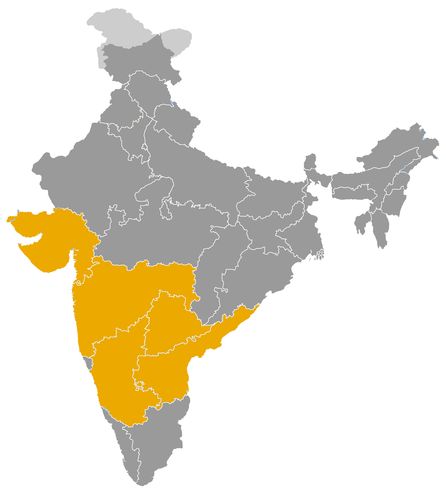
This map illustrates the maximum territory that the Rashtrakuta Dynasty had reached at its height, covering the current regions of Goa, Karnataka, Maharashtra and Telangana in India. Its main purpose is to provide a visual aid to understand the geographical extent of this dynasty. However, it's important to note that the contemporary borders of these regions may not necessarily coincide with the historical territories.
The Rashtrakuta Dynasty and the Imperial Role of the Deccan in Indian History
A Deccan power with subcontinental influence
The Rashtrakuta dynasty was one of the most important imperial powers of medieval India. From the eighth to the tenth century, it ruled from the Deccan and transformed this plateau region into a major centre of political authority. The dynasty succeeded the Chalukyas of Badami and established its power over large parts of present day Karnataka, Maharashtra and neighbouring regions. Its capital at Manyakheta became a prominent political and cultural centre.
The Rashtrakutas were not merely a regional dynasty. Their armies intervened in northern India, their influence reached into the south, and their authority affected the political balance between several major powers. They competed with the Gurjara Pratiharas in western and northern India, with the Palas in the east, and with the Pallavas, Cholas, Eastern Chalukyas and Western Gangas in the south. Their position in the Deccan allowed them to act as a bridge between northern and southern political worlds.
The formation of an imperial state in the western Deccan
The rise of the Rashtrakutas began with Dantidurga, who challenged and eventually displaced the Chalukyas of Badami in the mid eighth century. His successor Krishna I consolidated the new dynasty and strengthened its authority across the western Deccan. This transition marked the emergence of a new imperial house capable of controlling a wide range of territories, vassals and strategic routes.
The empire reached great military prominence under Dhruva Dharavarsha and Govinda III. These rulers led campaigns both northward and southward, showing that the Rashtrakutas could project power far beyond their core region. Their involvement in the struggle for Kanauj was especially significant. Kanauj held symbolic importance as a centre of sovereignty in northern India, and the Rashtrakuta intervention in this contest placed them among the greatest powers of the period.
Their imperial authority depended on a combination of direct administration, subordinate rulers, military campaigns and political prestige. Like many Indian empires of the medieval period, the Rashtrakuta state was not uniformly centralised. It operated through networks of governors, feudatories, allied dynasties and regional elites.
Relations with neighbouring dynasties and political rivals
The Rashtrakutas played a central role in the triangular contest with the Gurjara Pratiharas and the Palas. This rivalry shaped northern Indian politics for several generations. Although the Rashtrakutas did not permanently occupy the Gangetic plain, their campaigns gave them prestige and demonstrated the reach of Deccan military power.
In the south, they were involved in changing relations with the Pallavas, Cholas, Eastern Chalukyas and Western Gangas. The Western Gangas often functioned as important allies or subordinates in southern Karnataka. The Eastern Chalukyas of Vengi were strategically significant because their territory connected the Deccan with the eastern coast. Control over or influence in Vengi affected the balance between the Deccan and the Tamil region.
The later campaigns of Krishna III against the Cholas showed the continuing ability of the Rashtrakutas to intervene in southern India. These successes, however, also revealed the difficulty of sustaining authority over distant regions. The empire was powerful, but its wide reach depended on military energy and the loyalty of regional subordinates.
Cultural patronage and monumental architecture
The cultural impact of the Rashtrakutas was exceptional. Their most famous architectural achievement is the Kailasa temple at Ellora, generally associated with the reign of Krishna I. Carved from living rock, this monument is one of the most remarkable achievements of Indian rock cut architecture. It reflects both royal ambition and technical mastery, presenting the dynasty as a major patron of sacred art.
The Rashtrakutas supported Hindu traditions, especially Shaivism and Vaishnavism, but they also patronised Jainism. This religious plurality was characteristic of many medieval Indian courts, where rulers supported different religious communities to strengthen legitimacy and maintain elite networks. Amoghavarsha I is particularly remembered for his association with Jain learning and literary culture.
The dynasty also contributed to the development of literature in Sanskrit and Kannada. The Rashtrakuta court became an important environment for intellectual production, religious scholarship and poetic composition. Kannada gained increased literary prestige during this period, while Sanskrit remained a major language of royal expression and learned culture.
Economic foundations of imperial power
The Rashtrakuta economy was based on agricultural revenue, control of land, regional taxation, trade routes and temple endowments. The Deccan plateau provided a broad agrarian base, while routes across the western Deccan linked the interior to the western coast. These connections allowed the dynasty to benefit from inland trade and from wider commercial exchanges linked to the Arabian Sea and the Indian Ocean.
Land grants formed an important part of the political economy. Rulers donated villages and revenue rights to Brahmins, temples and Jain institutions. Such grants were religious acts, but they also helped integrate local elites, expand agrarian control and reinforce royal authority in provincial areas. Temples and religious institutions often functioned as economic centres, managing land, labour, gifts and redistribution.
The empire also depended on the cooperation of feudatories and local chiefs. These subordinates provided military support and helped administer distant territories. This system allowed imperial expansion, but it also contained long term risks. Powerful feudatories could become rivals, as happened when Tailapa II of the Western Chalukyas overthrew the last effective Rashtrakuta ruler in the late tenth century.
A lasting role in the history of medieval India
The Rashtrakutas occupy a major place in Indian history because they demonstrated the imperial potential of the Deccan. They connected northern, western and southern India through warfare, diplomacy, trade, religion and culture. Their power altered the balance between the Gurjara Pratiharas, Palas, Chalukyas, Pallavas and Cholas, while their patronage left enduring monuments and literary traditions.
Their legacy was political, cultural and economic. Politically, they made the Deccan a decisive imperial centre. Culturally, they supported some of the greatest works of Indian architecture and encouraged Sanskrit, Kannada and Jain intellectual traditions. Economically, they linked agrarian resources, trade routes and religious institutions into a wider imperial system. Even after their fall, the structures they strengthened influenced later Deccan powers, especially the Western Chalukyas.
The Geographical Expansion of the Rashtrakuta Dynasty in India
A Deccan empire with influence beyond its core region
The Rashtrakuta dynasty emerged as one of the leading imperial powers of medieval India between the eighth and tenth centuries. Its geographical base lay in the western Deccan, especially in regions corresponding to present day Karnataka and Maharashtra. From this central position, the Rashtrakutas extended their influence across much of the Deccan plateau and projected military power toward Gujarat, Malwa, northern India, Andhra and parts of the Tamil region.
Their expansion was not a uniform occupation of all these territories. Like many medieval Indian empires, Rashtrakuta power combined direct rule, subordinate kingdoms, vassal chiefs, military campaigns, tribute networks and symbolic claims of supremacy. The dynasty’s geographical reach was therefore both territorial and political. It controlled a strong core in the Deccan while influencing distant regions through warfare, diplomacy and the submission of neighbouring rulers.
The western Deccan as the imperial heartland
The main territorial base of the Rashtrakutas lay in the western Deccan. After replacing the Chalukyas of Badami, the early Rashtrakuta rulers consolidated their authority over areas of northern Karnataka, southern Maharashtra and adjacent plateau regions. This heartland gave the dynasty access to agricultural resources, fortified centres and routes linking northern and southern India.
Manyakheta, in present day Karnataka, became the principal capital and one of the most important political centres of the empire. Its location helped the Rashtrakutas administer a wide zone of influence across the Deccan. From this base, they could direct campaigns northward toward Malwa and Gujarat, eastward toward Vengi, and southward toward the Tamil and Kannada regions.
The western Deccan was strategically valuable because it connected inland trade routes with the western coast. Control over this region gave the Rashtrakutas access not only to land revenue, but also to commercial routes associated with the Arabian Sea and the wider Indian Ocean.
Northern campaigns and the struggle for Kanauj
One of the most important features of Rashtrakuta expansion was their intervention in northern India. Under Dhruva Dharavarsha and Govinda III, Rashtrakuta armies moved beyond the Deccan and entered the political contest for Kanauj. This city, located in the Gangetic plain, had great symbolic importance as a centre of sovereignty in northern India.
The struggle for Kanauj involved three major powers: the Rashtrakutas from the Deccan, the Gurjara Pratiharas from western and northern India, and the Palas from Bengal and eastern India. The Rashtrakutas did not permanently annex the Gangetic plain, but their campaigns demonstrated the military reach of the Deccan empire. Their victories and interventions enhanced imperial prestige and forced northern dynasties to recognise their power.
Gujarat and Malwa were especially important in this northern expansion. These regions formed corridors between the Deccan, Rajasthan, central India and the Ganges basin. By asserting influence there, the Rashtrakutas could challenge the Gurjara Pratiharas and maintain pressure on the political frontier between northern and central India.
Eastern and southern zones of influence
The Rashtrakutas also extended their authority toward the eastern Deccan and southern India. The region of Vengi, ruled by the Eastern Chalukyas, was strategically important because it linked the Deccan plateau with the eastern coast. Control over Vengi, or at least influence over its rulers, was essential for any power seeking dominance between the western Deccan and the Bay of Bengal.
In southern Karnataka, the Western Gangas were often connected to the Rashtrakutas as allies or subordinates. This relationship helped secure the southern frontier of the empire. Farther south, the Rashtrakutas entered into conflict with the Pallavas and later with the Cholas. These conflicts reflected the importance of the Tamil region and its connections to temple networks, agrarian wealth and maritime trade.
Under Krishna III, Rashtrakuta military power reached deep into southern India. His campaigns against the Cholas showed the continuing strength of the dynasty in the tenth century. However, such southern expansion was difficult to maintain permanently because these regions were far from the imperial heartland and had their own strong political traditions.
Relations with neighbouring dynasties shaped by geography
The geographical position of the Rashtrakutas made them rivals and intermediaries between several political zones. To the north and northwest, they confronted the Gurjara Pratiharas and sought influence over Gujarat, Malwa and Kanauj. To the east, they dealt with the Eastern Chalukyas of Vengi. To the south, they interacted with the Western Gangas, Pallavas and Cholas.
This position gave the Rashtrakutas unusual strategic flexibility. They could intervene in northern politics without abandoning their Deccan base, and they could campaign in the south while maintaining connections to western trade routes. At the same time, their wide reach created administrative challenges. Distant territories often depended on vassals, governors and allied rulers, whose loyalty was not always stable.
The empire’s relations with neighbouring dynasties were therefore shaped by both strength and vulnerability. Rashtrakuta power was strong enough to influence much of India, but its territorial structure required continuous military and diplomatic effort.
Vassalage, routes and the limits of imperial control
The Rashtrakuta empire depended heavily on subordinate rulers and regional chiefs. This system allowed the dynasty to govern a vast and varied space without direct administration everywhere. Feudatories helped collect revenue, provide troops, control local territories and maintain order on the frontiers.
This structure also contained risks. Powerful subordinates could become independent or challenge imperial authority. The fall of the Rashtrakutas at the end of the tenth century illustrates this weakness. Tailapa II, founder of the Western Chalukya power, overthrew the last effective Rashtrakuta ruler and established a new Deccan dynasty from within the political world the Rashtrakutas had dominated.
A territorial legacy linking north, west and south India
The geographical expansion of the Rashtrakuta dynasty made the Deccan one of the decisive centres of medieval Indian politics. Their empire linked Karnataka, Maharashtra, Gujarat, Malwa, Andhra and parts of Tamil country within a broad zone of political interaction. Their authority was strongest in the western Deccan, but their influence extended far beyond it.
The Rashtrakutas changed the balance between northern and southern India. They challenged the Gurjara Pratiharas and Palas in the north, intervened in the politics of Vengi and the Tamil region, and shaped the development of later Deccan powers. Their geographical reach was not permanent everywhere, but it gave the dynasty a central place in the history of medieval India.
Dantidurga’s rise to power began around 735, but the independent imperial assertion of the Rashtrakutas is generally placed around 753 or 756. The effective rule of the main line ended in 973 with the fall of Karka II; Indra IV then preserved a nominal dynastic claim until 982.
Rise to power before imperial independence
- Dantidurga (c. 735–756) • A Rashtrakuta chief who became an independent ruler, he gradually overthrew the supremacy of the Badami Chalukyas in the Deccan.
Rashtrakuta emperors of the Deccan
- Krishna I (756–774) • He consolidated the empire and is associated with the great Kailasa temple at Ellora.
- Govinda II (774–780) • His reign was weakened by internal tensions and by the opposition of his brother Dhruva.
- Dhruva Dharavarsha (780–793) • He asserted Rashtrakuta power in both northern and southern directions and intervened in the rivalries of northern India.
- Govinda III (793–814) • He brought the empire to one of its military peaks, with campaigns toward northern India and the southern Deccan.
- Amoghavarsha I (814–878) • A long-reigning ruler, he founded or developed Manyakheta and patronised literature, Jainism and court culture.
- Krishna II (878–914) • He maintained imperial authority despite conflicts with the Eastern Chalukyas and other regional powers.
- Indra III (914–929) • He restored Rashtrakuta military prestige and led a famous campaign against Kanauj.
- Amoghavarsha II (929–930) • His very short reign belongs to a period of unstable succession.
- Govinda IV (930–936) • His rule provoked opposition from nobles and dynastic relatives, leading to his deposition.
- Amoghavarsha III (936–939) • Installed after the fall of Govinda IV, he ruled briefly as a figure of dynastic restoration.
- Krishna III (939–967) • The last great Rashtrakuta emperor, he led successful campaigns against the Cholas and extended his influence southward.
- Khottiga Amoghavarsha (967–972) • His reign was marked by Paramara pressure and by the sack of Manyakheta.
- Karka II (972–973) • The last effective emperor of the main line, he was overthrown by Tailapa II, founder of the Western Chalukyas.
Final dynastic claim after the loss of effective power
- Indra IV (973–982, claimant or nominal ruler) • He preserved a dynastic claim after the loss of effective power and died without restoring the empire.