

 Français (France)
  Nederlands (nl-NL)
 The Elephanta Caves are located on Elephanta Island, approximately ten kilometers from Mumbai, in the Indian state of Maharashtra. This archaeological site consists of a group of rock-cut chambers dating from the early medieval period. It holds cultural, religious, and artistic significance within the Hindu tradition. The site is accessible by boat and attracts visitors interested in historical heritage. Recognized as a UNESCO World Heritage Site since 1987, the Elephanta Caves are regarded as an important example of Indian rock-cut art developed in the western region of the subcontinent.
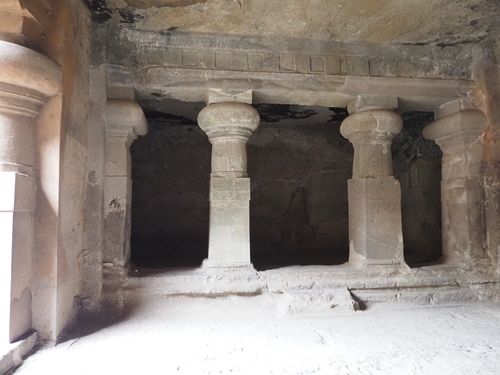
Mumbai • Elephanta caves
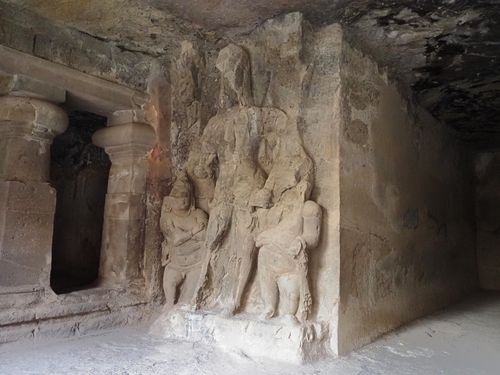
Mumbai • Elephanta caves
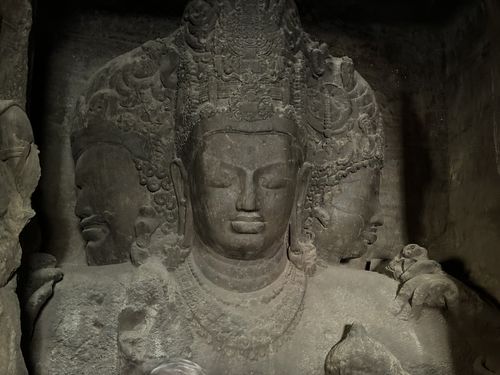
Mumbai • Elephanta caves
Monument profile
Elephanta caves
Monument category: Rock Sanctuary
Monument family: Rock Sanctuary and Monumental Bas-reliefs
Monument genre: Religious
Cultural heritage: Hindu
Geographic location: Elephanta • Maharashtra • India
Construction period: 5th century AD
This monument in Elephanta is inscribed on the UNESCO World Heritage List under the name Elephanta caves since 1987.See the UNESCO monuments featured on this site
• Links to •
• Dynasties that contributed to the construction of the monument •


• This monument illustrates the following theme •
Architecture • Rock-cut monuments : Rock-cut temples and caves in India
• List of videos about Elephanta on this site •
Elephanta • Rock-Cut Sanctuary in the Bay of Mumbai
• Sources •
Sources
- UNESCO World Heritage Centre – Elephanta Caves : https://whc.unesco.org/en/list/244/
- Ghosh, A. (éd.), An Encyclopaedia of Indian Archaeology, Munshiram Manoharlal Publishers, 1989
- Dehejia, Vidya, Indian Art, Phaidon Press, 1997
Books and publications
- Desai, Devangana – The Elephanta Caves: Artistic Vision in Stone, Marg Publications, 1996
- Michell, George – The Hindu Temple: An Introduction to Its Meaning and Forms, University of Chicago Press, 1988
- Spink, Walter M. – Ajanta: History and Development, Brill Academic Publishers, 2005
The Historical Significance of the Elephanta Caves: Power, Devotion, and Endurance
Located on Elephanta Island in the Arabian Sea, about 11 kilometers from Mumbai, the Elephanta Caves are a remarkable group of rock-cut temples primarily dedicated to the Hindu god Shiva. These caves, carved between the mid-5th and early 6th centuries CE, are among the most important examples of early medieval Indian art and architecture. Their history reflects broader political, religious, and cultural shifts in the subcontinent, as well as enduring global legacies of monumental religious architecture.
Political and Social Context of Construction
The creation of the Elephanta Caves occurred during a period of political fragmentation following the decline of the Gupta Empire. This vacuum of centralized authority enabled the rise of regional powers such as the Kalachuris of Mahishmati, who are widely believed to have been the patrons of the site. Although no inscriptions confirm their direct involvement, stylistic and regional similarities point to their influence.
The Kalachuris sought to assert their political legitimacy and religious authority by promoting Shaivism, the worship of Shiva, as a unifying ideological force. In commissioning a monumental cave temple complex, they aligned themselves with the Gupta legacy of temple patronage while expressing regional distinctiveness through rock-cut architecture. The caves served not only as spiritual sanctuaries but also as instruments of statecraft, symbolizing royal protection of dharma (cosmic law) and divine endorsement of rule.
The strategic location of Elephanta—at the confluence of maritime routes between the Deccan, Gujarat, and foreign trading powers—added symbolic weight to the site. Establishing a sacred center here reinforced control over trade corridors and offered a visual expression of sovereignty in a key geopolitical zone.
Major Historical Events and Dynastic Shifts
Over the centuries, the Elephanta Caves were exposed to periods of neglect, transformation, and violence. Following the decline of the Kalachuris, the region came under the control of successive dynasties such as the Chalukyas and later the Rashtrakutas. These powers contributed to the maintenance or reinterpretation of religious institutions, although no major expansions of the cave complex are known.
In the 16th century, Portuguese colonial forces arrived in the region. The island was renamed “Elephanta” after a large basalt sculpture of an elephant near the shore, now relocated to Mumbai’s Bhau Daji Lad Museum. During Portuguese occupation, the site suffered considerable damage—some sculptures were defaced or destroyed by gunfire, and no effort was made to preserve the sanctity of the space.
Despite these degradations, the caves retained a sense of spiritual importance and were never fully abandoned. Local communities continued to associate the site with Shiva, and minor religious observances persisted. During the British colonial period, interest in Indian antiquities revived the scholarly and preservationist attention to Elephanta, culminating in partial restorations and documentation in the 19th and 20th centuries.
Global Context of Monumental Religious Architecture
The construction of Elephanta coincided with a global flowering of religious architecture in stone. In the Mediterranean, Byzantine basilicas like Hagia Sophia (completed in 537) exemplified imperial Christian architecture, while in China, Buddhist cave complexes such as Longmen and Yungang featured sculpted sanctuaries of similarly grand scale. In Central America, the Maya were erecting ceremonial pyramids, and in Ethiopia, early Christian monolithic churches would appear shortly thereafter.
Elephanta fits into this larger pattern as an expression of sacred space carved into natural geology, requiring immense planning and labor. Like its global counterparts, it reflects a synthesis of state patronage, religious ideology, and technical mastery—an assertion of permanence and transcendence amidst shifting political landscapes.
Transformations and Evolution of the Site
Over the centuries, the Elephanta Caves experienced periods of both decay and resilience. The caves’ religious function diminished under colonial rule, replaced by a growing status as a cultural landmark. Restoration efforts were sporadic in the early modern period, but the post-independence government of India initiated more systematic preservation through the Archaeological Survey of India (ASI).
The site’s transformation from an active place of worship to a historical monument was gradual. While some local devotional practices persist—particularly during the annual festival of Maha Shivaratri—Elephanta is now primarily a tourist and heritage destination. Modern infrastructure, such as the regular ferry service from Mumbai, reflects this shift from sacred pilgrimage to cultural visitation.
Urban expansion around Mumbai has not yet encroached physically upon the island, but environmental pressures—particularly salt-laden humidity, monsoon erosion, and visitor foot traffic—continue to threaten the integrity of the sculptures and stone surfaces.
Cultural Role and Modern Perception
Today, the Elephanta Caves are celebrated as a symbol of India’s ancient heritage and its capacity for artistic and spiritual expression. As a UNESCO World Heritage Site (since 1987), the complex enjoys international recognition and is integrated into narratives of Indian national identity, especially in the context of postcolonial heritage discourse.
The caves serve educational, cultural, and touristic functions. They are featured in academic syllabi, travel literature, and visual media. Cultural festivals on the island occasionally bring contemporary performances into dialogue with historical settings, although these remain limited to designated areas to avoid damage.
In popular imagination, the image of the Trimurti—the three-faced sculpture of Shiva—is emblematic of Elephanta’s grandeur and metaphysical depth. It has become an icon of Indian religious art, reproduced in museums, textbooks, and art history publications.
Conservation Challenges and Institutional Protections
The preservation of Elephanta faces multiple challenges. The basalt material, though durable, is vulnerable to chemical weathering exacerbated by pollution from Mumbai’s industrial activity. Tourist numbers, while beneficial economically, place stress on the delicate floors and sculptural surfaces. Improper lighting, humidity fluctuations, and invasive plant growth further complicate conservation efforts.
To address these issues, the ASI has implemented controlled pathways, signage, limited restoration work, and periodic studies of structural stability. International collaboration through UNESCO has helped fund some of these efforts, but conservation remains a complex, ongoing process.
Legal protections under Indian heritage law and UNESCO listing ensure that unauthorized alterations are prohibited. However, climate change, urban encroachment, and the pressures of mass tourism require constant vigilance and adaptation.
The Architecture of the Elephanta Caves: A Masterpiece of Ancient Indian Rock-Cut Art
Located on Elephanta Island, about ten kilometers off the coast of Mumbai in the state of Maharashtra, the Elephanta Caves form a remarkable complex of Hindu sanctuaries carved into solid rock. Attributed to the post-Gupta period and dated approximately to the 5th or 6th century, the site showcases exceptional mastery of basalt stone carving and reflects the deep religious and symbolic vision centered on the worship of Shiva.
A Feat of Rock-Cut Engineering
Unlike structures built with added materials, the Elephanta Caves were entirely hewn from the basalt bedrock of the island. This monolithic technique, inherited from older Indian rock-cut traditions, reaches a high level of sophistication here. The dense and resistant basalt rock was skillfully shaped into spacious volumes, ornamented pillars, and high-relief figures.
Creating such spaces required meticulous planning. Once carving began, no major modifications were possible. Every step demanded close coordination between sculptors, stonemasons, and religious planners, with a strong grasp of architectural proportions and spatial organization.
Structural Mastery and Spatial Design
The interior of the caves, especially that of the main cave (Cave 1), demonstrates a solid understanding of architectural constraints. The columns are strategically placed to distribute the ceiling’s weight and prevent cracks or collapse. There is a clear balance between decorative detail and structural integrity.
The entrance of the main cave leads into a large hypostyle hall (mandapa), with rows of regularly spaced pillars directing visitors toward a central sanctuary (garbhagriha) accessible from all four sides. This axial plan ensured smooth circulation while emphasizing the centrality of the deity. Side openings provide natural ventilation, and the ceiling height helps limit heat and humidity accumulation.
Material Qualities of Basalt
The choice of local basalt — a hard but relatively homogeneous volcanic rock — offered a suitable surface for fine carving, though the work was physically demanding. Iron tools of high quality and skilled labor were essential. The absence of added materials such as wood or stucco enhances the site’s durability in a tropical climate, though the sculptures remain vulnerable to natural erosion, especially from the saline humidity of the Arabian Sea.
Artistic Style and Regional Influences
The iconography and artistic style of Elephanta’s sculptures reflect the refined aesthetics of post-Gupta art, visible in the fluidity of drapery, the proportions of the bodies, and the grace of the compositions. Elements typical of western Deccan art appear in the monumental scale of the figures and the expressive features of their faces. While parallels exist with other Indian rock-cut sites — in the use of mandapas, guardian figures (dvarapalas), and narrative reliefs — Elephanta asserts a distinct identity, centered on the multiple aspects of Shiva.
The arrangement of sculptures around the central shrine reflects a cosmic symbolism, with each wall portraying a different aspect of the god: destroyer, ascetic, consort, dancer, and so on.
Layout and Ornamentation of the Main Cave
Cave 1 covers an area of approximately 800 m², with 26 columns arranged in regular bays. The square-shaped central shrine is surrounded by a circumambulatory path accessible from four cardinal points. A rock-cut staircase and portico mark the entrance from outside.
The great Trimurti sculpture on the eastern wall is the spiritual and visual focal point of the sanctuary. It depicts Shiva in three aspects — creator, preserver, and destroyer — and is flanked by narrative panels illustrating scenes from the Shiva-Purana. The other smaller caves, located on the island’s slopes, follow a simpler version of this layout and were likely intended for secondary rituals or ascetic retreat.
The Cave Complex and Its Legends
The site includes seven main caves, of which five are of Hindu tradition. The remaining two, unfinished or of uncertain function, may have been intended for other uses — possibly Buddhist — though this remains debated. The scale of the complex and the artistic quality of the sculptures make Elephanta one of the most important rock-cut sites in western India.
A local legend attributes the construction of the main cave to supernatural beings (asuras) who carved it in a single night. Although mythical, the tale underscores the awe inspired by such monumental craftsmanship. The exact origin of the site remains uncertain due to the absence of inscriptions, though some evidence suggests involvement by the Kalachuris of Mahishmati.
Recognition and Conservation
Listed as a UNESCO World Heritage Site since 1987, Elephanta has gained international recognition. It is now the subject of ongoing conservation efforts by the Archaeological Survey of India, aimed at stabilizing the structures, managing visitor impact, and mitigating damage from vegetation, pollution, and saline erosion.
Conclusion
The architecture of the Elephanta Caves stands as a unique synthesis of technical skill, religious vision, and symbolic artistry. As both a spiritual sanctuary and an artistic achievement carved into stone, the site marks a defining moment in the evolution of Indian rock-cut architecture. It continues to captivate visitors through the depth of its iconography and the silent grandeur of its sculpted forms.