

 Français (France)
  Nederlands (nl-NL)
 Cave 16, also known as the Kailasa Temple, is one of the most impressive structures in the Ellora complex, located in Maharashtra, India. This monolithic temple, dedicated to the Hindu god Shiva, was carved from a single mass of basalt rock. The Kailasa Temple stands out for its monumental proportions, intricate sculptures, and unique architectural design. Symbolizing Mount Kailash, the sacred abode of Shiva, it attracts visitors for its religious and artistic significance. It is one of the masterpieces of Indian rock-cut architecture.

Ellora • Cave 16, Kailasa temple
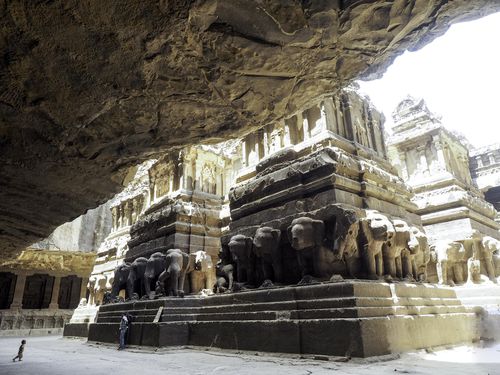
Ellora • Cave 16, Kailasa temple
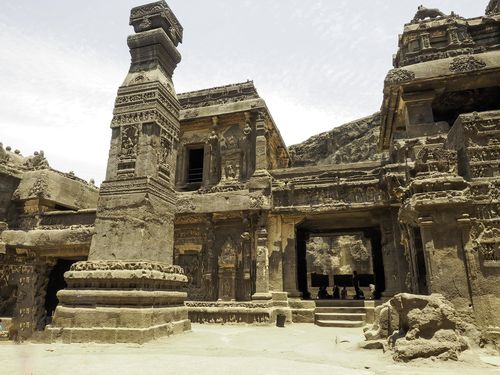
Ellora • Cave 16, Kailasa temple
Monument profile
Cave 16, Kailasa temple
Monument categories: Hindu Temple, Rock Sanctuary
Monument families: Temple • Rock Sanctuary and Monumental Bas-reliefs
Monument genres: Religious
Cultural heritage: Hindu
Geographic location: Ellora • Maharashtra • India
Construction period: 8th century AD
This monument in Ellora is inscribed on the UNESCO World Heritage List since 1983 and is part of the serial property "Ellora Caves".See the UNESCO monuments featured on this site
• Links to •
• Dynasties that contributed to the construction of the monument •

• This monument illustrates the following theme •
Architecture • Rock-cut monuments : Rock-cut temples and caves in India
• List of videos about Ellora on this site •
Ellora Caves, troglodyte treasure • Maharashtra, India
• References •
UNESCO: Ellora Caves
The Political and Social Motivations Behind the Construction of Cave 16, Kailasa Temple at Ellora: Historical Context and Modern Preservation Challenges
Political and Social Motivations for the Construction
The Kailasa Temple, located in Cave 16 at Ellora, Maharashtra, India, is one of the most extraordinary rock-cut structures in the world. Its construction dates back to the 8th century, during the reign of King Krishna I of the Rashtrakuta dynasty. The political motivations behind the temple's construction were closely tied to the Rashtrakutas' desire to solidify their authority, assert their divine connection, and demonstrate their power through monumental religious architecture. By commissioning this grand temple dedicated to the Hindu god Shiva, the Rashtrakutas sought to legitimize their rule by associating themselves with one of the most important deities in the Hindu pantheon.
Socially, the temple played a crucial role in uniting various classes within the kingdom. It provided a space for religious worship and community gatherings, and its construction required the expertise of thousands of artisans, masons, and laborers. The temple not only symbolized the king’s piety but also showcased the kingdom’s prosperity and its ability to undertake such a massive project. Furthermore, by building this temple, the Rashtrakutas aimed to create a lasting legacy, as the temple was not only a place of worship but also a symbol of cultural and political continuity.
Historical Events and Their Influence on the Region
The 8th century was a period of intense political rivalry in India, with the Rashtrakutas, Chalukyas, and Pallavas competing for dominance in the Deccan region. The construction of the Kailasa Temple can be seen as part of this competition, with each dynasty attempting to outdo the other in terms of religious patronage and architectural innovation. By building such an extraordinary temple, the Rashtrakutas were making a bold statement about their cultural and religious dominance.
The temple was also constructed during a time when Hinduism, Buddhism, and Jainism coexisted in the region. Ellora itself is a testament to this religious pluralism, as it houses caves dedicated to all three religions. The construction of Kailasa marked the Rashtrakutas' commitment to Hinduism, but its location in a site with Buddhist and Jain monuments suggests a degree of religious tolerance and integration.
Global Context and Comparison with Other Regions
The Kailasa Temple's construction coincided with monumental architectural projects elsewhere in the world. During the same period, the Abbasid Caliphate was flourishing in the Middle East, with grand structures such as the Great Mosque of Samarra being built. In Europe, the early Carolingian Renaissance saw the construction of significant religious structures, such as Charlemagne’s Palatine Chapel in Aachen. While these projects also symbolized religious and political authority, what distinguishes Kailasa is its monolithic nature—carved from a single piece of rock—a technique that had no true parallel in other parts of the world.
In China, during the Tang Dynasty, the construction of Buddhist cave complexes, such as the Longmen Grottoes, mirrored the Indian tradition of rock-cut architecture. However, the scale, ambition, and complexity of Kailasa Temple make it unique even among these global peers. Its blend of religious devotion, political power, and architectural innovation places it among the greatest achievements of ancient world architecture.
Major Transformations Over the Centuries
Over the centuries, the Kailasa Temple has undergone various transformations, both in terms of use and perception. During the later Islamic invasions of India in the 12th century, many Hindu temples were destroyed or repurposed, but Kailasa largely survived intact. While the region changed political hands multiple times—from the Delhi Sultanate to the Mughal Empire—the temple remained a significant religious and cultural site.
By the time of British colonial rule in the 19th century, Ellora had become an object of fascination for European scholars and explorers. The temple's monumental size and intricate carvings captivated visitors, and it became a symbol of India's ancient architectural and artistic prowess.
Cultural Importance and Current State of Conservation
The cultural significance of Kailasa Temple extends beyond its religious function. It is a representation of the technological and artistic capabilities of ancient India, as well as a reflection of the Rashtrakutas’ ambition and vision. Its inclusion as part of the Ellora Caves UNESCO World Heritage site in 1983 has helped secure its place on the global stage as a masterpiece of human achievement. This designation has brought international attention to the temple, highlighting the need for its preservation and ensuring that it remains a site of global cultural importance.
Preservation Challenges and Modern Threats
Despite its historical importance and UNESCO status, Kailasa Temple faces several modern preservation challenges. The temple’s rock-cut structure is vulnerable to erosion caused by weather conditions, particularly during the monsoon season when heavy rains accelerate the deterioration of the basalt rock. The intricate carvings, which are the temple’s most delicate and impressive feature, are especially susceptible to wear.
In addition to natural forces, tourism presents a significant challenge. The increased foot traffic from thousands of visitors each year puts additional strain on the temple's structure, leading to physical wear and tear. While tourism provides economic benefits to the region and funds for conservation efforts, it also poses a threat to the long-term preservation of the site.
The Indian government, along with UNESCO and other international organizations, has implemented various conservation initiatives to protect the site. These include restricting access to vulnerable areas, implementing more effective drainage systems to mitigate water damage, and using modern technology to monitor the stability of the structure. However, ongoing efforts are necessary to ensure that the temple remains preserved for future generations.
Conclusion
The Kailasa Temple at Ellora is not only a remarkable feat of ancient engineering and artistry, but also a powerful symbol of the Rashtrakutas' political and religious ambition. Its construction during a time of intense competition for regional dominance illustrates the use of monumental architecture as a tool for asserting authority and piety. Over the centuries, the temple has endured political changes, natural wear, and the pressures of modern tourism, yet it remains a crucial cultural and religious site in India. Its recognition as a UNESCO World Heritage site has helped secure its future, but continued efforts are needed to protect this architectural marvel from the threats it faces in the modern era.
Architectural Innovation and Technological Advancements of the Kailasa Temple, Cave 16 at Ellora: A Masterpiece of the Rashtrakuta Era
Technological Advancements and Construction Techniques of the Rashtrakuta Period
The Kailasa Temple, located in Cave 16 at the Ellora complex in Maharashtra, India, stands as a monumental example of technological advancement and innovation during the reign of the Rashtrakuta dynasty in the 8th century. The temple’s construction reflects the unparalleled ingenuity of ancient Indian artisans, who utilized monolithic rock-cut architecture to create an entire temple complex from a single piece of basalt rock.
One of the most remarkable construction techniques employed was the top-down carving method. Artisans began at the top of the rock formation and meticulously worked their way downward. This approach was crucial in preventing structural collapse and allowed for the precise execution of intricate designs. Unlike traditional stone architecture, where blocks are assembled, the Kailasa Temple was sculpted directly out of the natural rock, making it one of the largest monolithic structures in the world.
The primary material used was basalt, a volcanic rock abundant in the Deccan region. Basalt’s durability made it an ideal choice for creating large-scale architectural works, but its hardness also presented challenges. Specialized tools such as iron chisels and hammers were essential for shaping both the massive exterior and the fine details of the sculptures.
A Unique Blend of Artistic Traditions and Foreign Influences
The Kailasa Temple exemplifies a fusion of artistic traditions from various regions and time periods. The overall architectural style is primarily Dravidian, influenced by the temple designs of southern India. The towering Shikhara (spire) over the sanctum and the tiered pyramidal structure are characteristic features of southern Indian temple architecture.
However, the temple also incorporates influences from northern India and beyond. The intricate motifs and sculptures reflect the artistic styles of the Gupta period, with detailed depictions of mythological scenes, deities, animals, and floral patterns. There are also elements inspired by Persian and Greco-Roman art, which reached India through trade routes such as the Silk Road. This cultural exchange can be seen in the decorative elements that adorn the temple’s pillars and walls, as well as in the stylistic treatment of certain figures, which show an appreciation for realism and naturalism.
The sculptures of divine figures and scenes from Hindu epics such as the Ramayana and Mahabharata are among the temple’s most notable features. The temple’s walls are covered with carvings that illustrate these stories, making the temple not only a religious site but also a narrative space that conveys important cultural and spiritual lessons.
Notable Structure and Layout
The layout of the Kailasa Temple is symbolic and intricate. The entire structure was designed to represent Mount Kailash, the mythical abode of the Hindu god Shiva, to whom the temple is dedicated. The temple is laid out around a central courtyard with a massive pillar at the entrance, symbolizing cosmic order and the connection between heaven and earth.
One of the most significant features of the temple is the central Mandapa (assembly hall), which is supported by large columns. This space leads to the Garbhagriha (sanctum), where the Shiva Lingam is enshrined. Surrounding the sanctum are numerous smaller shrines dedicated to other deities, which further emphasize the interconnectedness of the Hindu pantheon.
The temple also has an impressive courtyard, which houses several life-sized statues of animals, including a remarkable sculpture of an elephant. The layout of the temple was designed not only for spiritual purposes but also to accommodate large gatherings for religious festivals and rituals.
Fascinating Statistics and Anecdotes
The sheer scale of the Kailasa Temple is staggering. It is estimated that 200,000 to 400,000 tons of rock were removed during its construction, and the entire process likely took several decades to complete. The temple is approximately 60 meters long, 30 meters wide, and 30 meters high, making it one of the largest structures of its kind in the world.
A well-known anecdote from the time of its construction suggests that King Krishna I, who commissioned the temple, did so after being inspired by a vision of Mount Kailash, the heavenly abode of Shiva. The temple was intended not only as a place of worship but also as a testament to the Rashtrakuta dynasty’s devotion and power. Its construction was meant to rival and surpass other monumental temples of the time, particularly those built by rival dynasties such as the Chalukyas and Pallavas.
Recognition and UNESCO World Heritage Status
The architectural and artistic grandeur of the Kailasa Temple has earned it global recognition. In 1983, the Ellora Caves complex, including the Kailasa Temple, was inscribed as a UNESCO World Heritage site, acknowledging its cultural and historical significance. This recognition has played a critical role in bringing international attention to the temple, securing its preservation, and promoting scholarly research on its construction and artistry.
The temple’s recognition as a UNESCO site has also contributed to its conservation. However, the structure faces modern challenges. Natural forces such as erosion, particularly during the monsoon season, threaten the integrity of the rock, while increased tourism has raised concerns about the impact of foot traffic on the delicate carvings. Efforts have been made to protect the temple, including restricting access to certain areas and implementing conservation programs to mitigate the effects of environmental wear.
Conclusion
The Kailasa Temple at Ellora is a stunning example of the technological and artistic prowess of the Rashtrakuta period. Its monolithic construction, intricate carvings, and symbolic design reflect both the engineering genius of its creators and the cultural wealth of ancient India. By blending regional architectural styles with foreign artistic influences, the temple stands as a testament to the dynamic exchange of ideas during the period.
Today, the Kailasa Temple’s recognition as a UNESCO World Heritage site has solidified its status as a global treasure, ensuring its preservation for future generations. Despite the challenges it faces, the temple remains a symbol of spiritual devotion, political power, and architectural innovation, continuing to captivate scholars, visitors, and worshippers alike.