Français (France)
  Nederlands (nl-NL)
 00:00 • intro | 00:39 • Ho Chi Minh Mausoleum Complex | 01:51 • The One Pillar Pagoda | 02:26 • The Temple of Literature | 05:04 • Vietnam National Museum of Fine Arts | 06:44 • in the streets of Hanoi | 08:44 • The Red Bridge and the Jade Mountain temple | 09:41 • the water puppet show
Personal creation from visual material collected during my trip Vietnam & Cambodia (2014)
Map of places or practices in Hanoi on this site
• Use the markers to explore the content •
Hanoi, Historic and Cultural Capital of Vietnam
A City Where National Memory Meets Ancient Traditions
Hanoi holds a central place in the history of Vietnam. As the political capital of the country, it is also the heir to more than a thousand years of urban development. Established near the Red River and shaped by successive dynasties, foreign influences, colonial rule, revolution and modern growth, the city preserves a layered identity rarely found in such a compact space. Official monuments, ancient sanctuaries, lively streets, lakeside temples and cultural institutions coexist within a capital that remains both historical and dynamic.
This video offers a balanced introduction to that diversity. It moves through places associated with modern Vietnamese statehood, presents some of the city’s most emblematic religious and scholarly monuments, observes everyday life in busy streets, then reaches Hoan Kiem Lake and its famous Red Bridge before ending with the traditional water puppet theatre. Hanoi emerges not as a single image, but as a city of many dimensions: ceremonial, intellectual, spiritual, artistic and intensely alive.
Major Monuments and Urban Life
The Ho Chi Minh Mausoleum Complex is one of the symbolic centres of contemporary Vietnam. Located within a broad monumental setting, it combines formal architecture, open perspectives, landscaped grounds and spaces of remembrance. It reflects the political importance of Hanoi and the enduring national role of Ho Chi Minh in twentieth-century Vietnamese history.
Nearby stands the One Pillar Pagoda, one of Hanoi’s best-known monuments. Rebuilt several times through history, it takes the form of a small pavilion rising from a single support above water. Its elegant simplicity gives it strong visual identity, while its lotus-inspired symbolism links it to Buddhist traditions deeply rooted in Vietnamese culture.
The Temple of Literature reveals another essential aspect of the city. Founded in the eleventh century and dedicated to Confucius, it later became an important centre of learning. Its successive courtyards, ceremonial gates, pavilions and stone stelae honour scholars who succeeded in imperial examinations. The complex reflects the historical prestige of education and administrative merit.
The Vietnam National Museum of Fine Arts adds an artistic perspective. It helps visitors understand continuities between traditional forms, regional creativity, modern movements and external influences. Hanoi is not only a political capital, but also a major cultural centre.
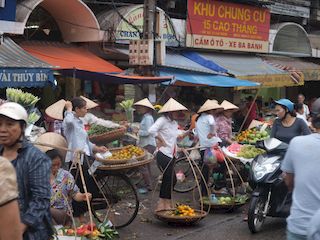
The city streets show a different reality. Dense traffic, narrow façades, local shops, cafés and constant movement form an urban fabric full of energy. Hanoi is experienced as much through its daily rhythms as through its monuments.
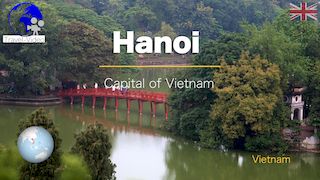
At Hoan Kiem Lake, the Red Bridge leading to the Temple of the Jade Mountain belongs to the city’s most recognisable images. Crossing toward the island sanctuary creates a symbolic transition from urban activity to a calmer spiritual space.
A Capital Shaped by Centuries
The history of Hanoi extends back more than a millennium. Under the name Thang Long, often translated as “Ascending Dragon,” it became a major political centre of Vietnamese kingdoms. Its strategic position in the Red River delta favoured growth as an administrative, military and commercial capital.
Chinese influence was significant for many centuries, particularly in state organisation, classical writing and Confucian thought. The Temple of Literature illustrates a period when scholarly achievement shaped access to public office and prestige.
During the French colonial era, Hanoi was profoundly transformed. Broad avenues, villas, administrative buildings and planned districts were added to older neighbourhoods. This coexistence of indigenous and colonial urban forms remains visible today.
The twentieth century gave Hanoi a new historical role as a centre of independence movements and later as the capital of modern Vietnam. The monumental spaces associated with Ho Chi Minh reflect this national memory and political continuity.
Culturally, Hanoi has also preserved strong popular traditions. Water puppet theatre, originally developed in the flooded rice-growing regions of northern Vietnam, combines music, storytelling, humour and technical skill. Its continued presence in the capital shows the enduring relationship between rural traditions and urban cultural life.
What the Videos on This Site Make Especially Clear
A video built from carefully selected and animated photographs is particularly effective for a city such as Hanoi, where many sites reward slow observation. Gentle movement across still images allows viewers to appreciate the scale of the mausoleum, the geometry of ceremonial spaces and the formal balance of official architecture.
For the One Pillar Pagoda or the Temple of Literature, this method highlights details that may otherwise pass quickly: rooflines, columns, ponds, gateways, successive courtyards and the relationship between buildings and gardens become easier to understand.
Street scenes benefit in a different way. Animated still images help reveal the density of the urban fabric, the layering of signs and façades, the movement of traffic and the contrast between traditional and modern forms of life.
At Hoan Kiem Lake, the visual progression toward the Red Bridge and the island temple strengthens the perception of the site as a threshold between busy city life and reflective space.
The sequence devoted to water puppetry also gains clarity. Costumes, stage setting, gestures and decorative details become more legible when the viewer is given time to observe them.
Finally, the progression of scenes creates a coherent reading of Hanoi itself. National memory, learned heritage, spirituality, daily life and living traditions appear not as separate subjects, but as connected aspects of one capital city.
A Concentration of Historical and Living Vietnam
Hanoi brings together many of the essential dimensions of Vietnam: political identity, scholarly heritage, religious traditions, artistic life and vibrant urban energy. This video offers an accessible and thoughtful introduction to the city. To continue the journey, the detailed pages linked to the featured monuments and cultural sites provide further insight into one of Southeast Asia’s most significant capitals.
Links to related pages
Audio Commentary Transcript
The history of Vietnam is a long series of tragic events, the most recent of which is the Vietnam War between the Vietnamese Communists and the United States. No wonder their capital has monuments to commemorate this painful history.
One of these monuments is the Ho Chi Minh Mausoleum. It is certainly not a monument that shines with its aesthetics, but it is there to commemorate a recent past.
And at some distance from there, rises its museum. The Presidential Palace is also close by.
Very close to the Presidential Palace is a very old Buddhist pagoda, the One Pillar Pagoda. Partially destroyed during the Indochina War by French troops, Ho Chi Minh ordered its reconstruction in 1959.
The Temple of Literature is the most important Confucius mausoleum in Vietnam. Dedicated to the teaching of the elite for more than 1000 years, this temple, which is not a strictly speaking religious temple, contains relics of Confucius. It now houses part of the University of Hanoi.

Music:
- - YouTube video library - AchillesIn Memory of Jean Talon - The Mini Vandals, (© Alchemists Tower - Strings by Kevin MacLeod is licensed under a Creative Commons Attribution 4.0 license. https://creativecommons.org/licenses/by/4.0/
- Source: http://incompetech.com/music/royalty-free/index.html?isrc=USUAN1100632
- Artist: http://incompetech.com/)
- - YouTube video library - Argonne - Zachariah Hickman
- - YouTube video library - Carol of the Bells
- - YouTube video library - Claim of Thrones
- - YouTube video library - Constancy Part 3 - The Descent, (© Constancy Part 3 - The Descent by Kevin MacLeod is licensed under a Creative Commons Attribution 4.0 license. https://creativecommons.org/licenses/by/4.0/
- Source: http://incompetech.com/music/royalty-free/index.html?isrc=USUAN1100774
- Artist: http://incompetech.com/)
- - YouTube video library - Lurking
- - YouTube video library - Monuments
Disclaimer: Despite its appropriateness, copyright issues prevent the use of vietnamese traditional music in "Hanoi, the capital • Vietnam (EN)", hence the use of royalty-free music. Despite our careful selection, some might regret this decision, which is necessary to avoid potential lawsuits. Although difficult, this decision is the only viable solution.
Due to Vimeo's copyright control system, which does not correctly filter content, and their rigid policy, we have decided to transfer all our videos to YouTube. While we have appreciated our collaboration with Vimeo for many years, this decision is necessary to ensure the continuous and uninterrupted availability of our content. Thank you for your understanding and continued support.