

 Français (France)
  Nederlands (nl-NL)
 The Ho Chi Minh Mausoleum is a commemorative monument located in Hanoi, Vietnam, on Ba Dinh Square. It houses the embalmed body of Ho Chi Minh, leader of the Vietnamese independence movement and a central figure in the establishment of the Democratic Republic of Vietnam. The structure serves as an important national memorial and a site for official ceremonies. Since its opening to the public in the 1970s, it has received numerous official delegations as well as Vietnamese citizens and international visitors. The mausoleum forms part of a broader monumental complex that includes governmental buildings, ceremonial spaces and locations associated with Vietnam’s modern political history.

Monument profile
Ho Chi Minh Mausoleum
Monument category: Mausoleum
Monument family: Tomb, Necropolis, Mausoleum or Cenotaph
Monument genre: Funerary
Geographic location: Hanoi • Vietnam
Construction period: 20th century AD
• Links to •
• List of videos about Hanoi on this site •
Hanoi, the capital • Vietnam (EN)
History of the Ho Chi Minh Mausoleum
Death of Ho Chi Minh and decision to preserve the body
The Ho Chi Minh Mausoleum in Hanoi was conceived following the death of Ho Chi Minh on 2 September 1969. As president of the Democratic Republic of Vietnam and a central figure in the Vietnamese independence movement, Ho Chi Minh occupied a major symbolic position within the political system of North Vietnam. In his testament, he expressed the wish to be cremated and to have his ashes distributed in different regions of the country.
The leadership of the Vietnamese Workers’ Party decided not to follow these instructions. Instead, they chose to preserve his body and construct a monumental mausoleum that would serve as a permanent memorial. This decision reflected the political importance attributed to Ho Chi Minh as a unifying national figure during a period when the country remained divided and the Vietnam War was still ongoing.
After his death, Ho Chi Minh’s body was embalmed with technical assistance from Soviet specialists. The preservation process required controlled facilities, and the body was temporarily kept in secure locations while preparations were made for the future mausoleum.
The site selected for the monument was Ba Dinh Square in Hanoi. This location held particular symbolic significance because Ho Chi Minh had proclaimed the independence of the Democratic Republic of Vietnam there on 2 September 1945.
Planning and construction of the mausoleum
The construction of the mausoleum officially began on 2 September 1973. The project involved extensive cooperation between the Vietnamese government and the Soviet Union. Soviet engineers and technical experts contributed to the architectural planning of the structure and to the design of the climate-controlled chamber required to preserve the embalmed body.
The building process occurred during the final phase of the Vietnam War, which created logistical and economic challenges. Despite these conditions, the Vietnamese authorities prioritized the completion of the monument. Materials were collected from numerous provinces throughout the country. This decision was intended to symbolize the participation of the entire nation in the creation of the memorial.
The mausoleum was completed and inaugurated on 29 August 1975, several months after the end of the war and the reunification of Vietnam following the fall of Saigon in April of the same year. The inauguration transformed the building into a central site of political memory within the newly unified Socialist Republic of Vietnam.
From the moment of its opening, the mausoleum functioned as a place where citizens could pay tribute to Ho Chi Minh and where official ceremonies could be organized.
Function of the mausoleum and evolution of its use
The mausoleum was designed to house the preserved body of Ho Chi Minh and to serve as a ceremonial and commemorative space. Visitors follow a controlled circulation route through the building that leads to the central chamber where the embalmed body is displayed in a glass sarcophagus.
The monument quickly became one of the most significant symbolic sites in Hanoi. Vietnamese citizens regularly visit the mausoleum, particularly during national commemorations linked to the life of Ho Chi Minh. Official delegations, foreign leaders, and diplomatic representatives also participate in ceremonial visits.
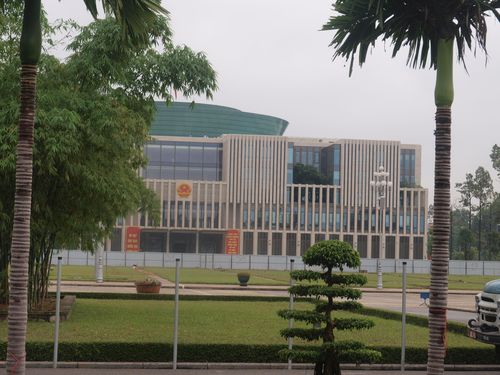
The mausoleum forms part of a broader commemorative complex surrounding Ba Dinh Square. Nearby structures include the Presidential Palace, Ho Chi Minh’s stilt house, and administrative buildings associated with the Vietnamese government. The spatial organization of this ensemble reinforces the role of the mausoleum as a focal point in the political landscape of the capital.
Public access to the mausoleum is regulated, and visitors are required to follow specific protocols during their passage through the interior spaces. Military guards maintain a permanent ceremonial presence within the monument.
Global historical context during the construction period
The construction of the Ho Chi Minh Mausoleum during the 1970s took place within the broader geopolitical environment of the Cold War. The Vietnam War was approaching its conclusion as the United States gradually withdrew military forces from Southeast Asia. In Europe, the period was characterized by diplomatic détente between the Eastern and Western blocs. In China, the Cultural Revolution continued to influence political and social life until the mid-1970s.
Present status and preservation of the monument
Today the Ho Chi Minh Mausoleum remains one of the most prominent memorial sites in Vietnam. The preservation of the embalmed body requires specialized technical procedures and strict environmental control within the building. Vietnamese specialists trained in conservation techniques oversee these operations.
The monument is periodically closed to the public to allow maintenance work and the inspection of the climate-control systems that maintain stable temperature and humidity conditions inside the mausoleum. These procedures ensure the long-term preservation of the remains and the functioning of the interior installations.
The mausoleum continues to play an important role in the political and ceremonial life of Vietnam. National celebrations, military ceremonies, and diplomatic visits frequently take place in the surrounding area of Ba Dinh Square, reinforcing the monument’s position as a central symbol associated with the memory of Ho Chi Minh and the history of the Vietnamese state.
Architecture of the Ho Chi Minh Mausoleum
Location and spatial relationship with Ba Dinh Square
The Ho Chi Minh Mausoleum occupies a central position on Ba Dinh Square in Hanoi, the ceremonial and political space associated with the proclamation of Vietnamese independence in 1945. The monument stands at the western end of the square and dominates the open esplanade that extends toward the main axis of the capital’s governmental district. The building is aligned with the central axis of the square, establishing a clear visual and spatial hierarchy between the mausoleum and the surrounding public space.
The structure is placed on an elevated platform that separates the monument from the level of the square. This raised base creates a monumental approach and reinforces the prominence of the building within the ceremonial landscape. Large stairways lead from the surrounding plaza to the entrance terrace, allowing controlled circulation of visitors and official delegations.
The placement of the mausoleum also establishes a spatial relationship with other structures in the complex, including the Presidential Palace and Ho Chi Minh’s stilt house located nearby. The monument thus functions as the focal point of a broader commemorative ensemble organized around Ba Dinh Square.
Overall composition and volumetric structure
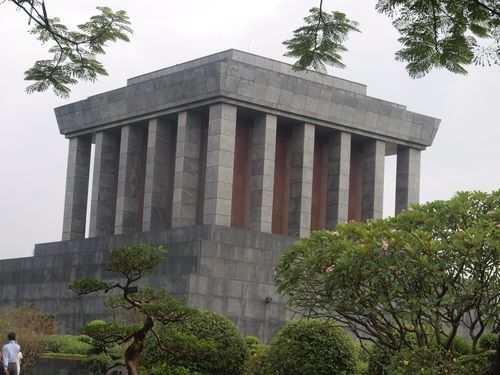
The mausoleum presents a massive rectangular structure composed of several superimposed volumes. The architectural composition is organized in three principal layers: a broad base, a central body articulated by a colonnade, and an upper cubic volume forming the roofed chamber of the monument.
The base consists of a stepped platform built from large stone blocks. This plinth supports the main structure and establishes the monumental scale of the building. The wide terraces surrounding the base accommodate ceremonial activities and allow visitors to circulate around the building.
Above the base rises the central volume of the mausoleum. The façade is characterized by a colonnade of large square pillars that support the horizontal mass of the structure. These columns frame the main entrance and define the architectural rhythm of the exterior elevations.
The upper section of the mausoleum forms a compact cubic block that houses the central chamber containing the preserved body of Ho Chi Minh. This upper structure is visually distinct from the lower colonnaded base, creating a clear hierarchical composition. The inscription “Chủ tịch Hồ Chí Minh” is placed on the front façade above the colonnade, marking the dedication of the monument.
Materials and construction techniques
The construction of the mausoleum incorporated materials sourced from various regions of Vietnam. Granite and stone form the principal materials used for the exterior surfaces of the building. The stone cladding consists of carefully cut blocks assembled to produce smooth and durable façades.
The use of granite contributes to the building’s austere and monumental appearance. The grey tones of the stone surfaces emphasize the geometric clarity of the architectural volumes and reinforce the impression of permanence.
Interior spaces employ a variety of materials, including polished stones and decorative surfaces derived from Vietnamese quarries. These materials appear in flooring, wall finishes, and architectural details throughout the circulation corridors and ceremonial chambers.
The construction of the building required specialized technical solutions in order to maintain controlled environmental conditions inside the central chamber. The preservation of the embalmed body demands stable temperature, humidity, and lighting levels. Climate-control systems and structural insulation were therefore integrated into the architectural framework of the building.
Interior organization and funerary chamber
The interior of the mausoleum is structured around the central funerary chamber where Ho Chi Minh’s preserved body is displayed. The spatial sequence leading to this chamber is carefully organized through a controlled circulation route.
Visitors enter through the main entrance beneath the colonnaded façade and proceed through corridors and transitional spaces that gradually guide movement toward the central chamber. The circulation path is designed as a continuous, one-directional route that regulates visitor flow and ensures orderly passage through the building.
The central chamber occupies the upper portion of the monument and forms the architectural core of the structure. The room is designed with subdued lighting and restrained decorative elements. At the center stands a glass sarcophagus containing the embalmed body of Ho Chi Minh.
The interior surfaces of the chamber incorporate polished stone and dark-toned materials that enhance the solemn atmosphere of the space. Honor guards stand at the corners of the sarcophagus, reinforcing the ceremonial function of the chamber. The spatial arrangement directs attention toward the central display while maintaining a symmetrical architectural composition.
Maintenance, structural preservation and architectural integrity
Since its inauguration in 1975, the Ho Chi Minh Mausoleum has been subject to regular technical maintenance in order to preserve both the architectural structure and the conditions required for the conservation of the body.
Maintenance operations include the inspection of the building’s climate-control systems, structural components, and external stone surfaces. The monument is periodically closed to the public to allow these technical procedures to be carried out.
Exterior conservation efforts focus on preserving the integrity of the stone cladding and structural joints exposed to Hanoi’s humid climate. Interior maintenance concentrates on the environmental systems responsible for temperature and humidity regulation within the funerary chamber.
These interventions aim to maintain the stability of the architectural structure while ensuring that the mausoleum continues to function as a ceremonial and commemorative space. The ongoing preservation of the monument involves both architectural conservation and the continuous operation of the technical infrastructure integrated into the building.