

 Français (France)
  Nederlands (nl-NL)
 The Temple of Literature is a major historical complex located in Hanoi, the capital of Vietnam. It is widely regarded as one of the most significant cultural landmarks in the city and remains an important symbol of Vietnam’s intellectual heritage. The site consists of a series of courtyards, pavilions, and ceremonial structures arranged along a formal axis. Today the complex attracts numerous visitors from Vietnam and abroad who come to explore a place closely associated with the country’s scholarly traditions and educational history. The Temple of Literature also serves as a cultural venue, regularly visited by students, researchers, and participants in commemorative events.
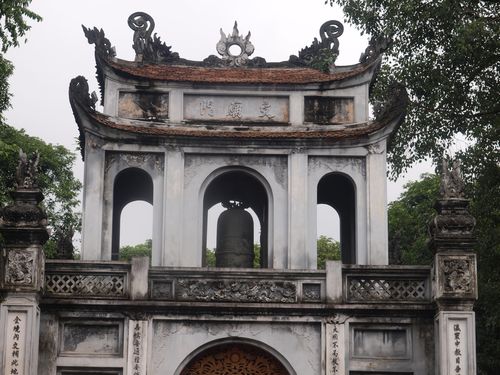
Hanoi • Temple of Literature

Hanoi • Temple of Literature

Hanoi • Temple of Literature
Monument profile
Temple of Literature
Monument categories: Historical university, Buddhist temple
Monument families: Temple • Historic University or Observatory
Monument genres: Religious, Cultural or scientific
Cultural heritage: Buddhist
Geographic location: Hanoi • Vietnam
Construction period: 11th century AD
• Links to •
• List of videos about Hanoi on this site •
Hanoi, the capital • Vietnam (EN)
History of the Temple of Literature in Hanoi
Foundation under the Lý Dynasty
The Temple of Literature (Văn Miếu) was established in 1070 in the imperial capital of Thăng Long, the historical name of present-day Hanoi, during the reign of Emperor Lý Thánh Tông of the Lý dynasty. The foundation of the monument reflected a deliberate political decision by the court to institutionalize the presence of Confucian learning within the royal capital. The complex was dedicated to Confucius and to the scholars regarded as authoritative interpreters of the Confucian classics.
The temple was constructed as a ceremonial and intellectual institution linked to the ideological foundations of royal governance. By establishing a sanctuary devoted to Confucius, the imperial court affirmed the role of moral scholarship in the organization of the state. The site functioned as a place where the principles of Confucian teaching could be symbolically honored within the capital.
The location of the temple within Thăng Long placed it in close proximity to the political center of the kingdom. This placement reinforced the connection between scholarship and state authority. The temple therefore served both a ritual purpose and a symbolic political function associated with the intellectual legitimacy of the ruling dynasty.
Creation of the Imperial Academy and Educational Role
In 1076, six years after the construction of the temple, Emperor Lý Nhân Tông ordered the establishment of the Quốc Tử Giám within the same complex. This institution is considered the first imperial academy of Vietnam. It was initially intended to educate princes and the sons of high-ranking officials of the court.
The academy gradually expanded to include students from elite scholarly families who sought to pursue administrative careers. Instruction focused on the study and interpretation of Confucian texts that formed the intellectual foundation of state administration. The proximity between the temple dedicated to Confucius and the academy created a unified institutional space devoted to learning and scholarship.
Over time, the Temple of Literature and the Quốc Tử Giám became closely associated with the imperial examination system. These examinations were the primary method through which scholars gained entry into the bureaucratic administration of the state. The complex thus became an important location connected to the recognition of scholarly achievement and the training of future officials.
Architectural Additions and Commemorative Stelae
During later dynastic periods, the complex underwent several architectural additions and reorganizations. Under the Lê dynasty, particularly during the fifteenth century, the site was expanded and new structures were introduced to reinforce its ceremonial role.
One of the most significant additions occurred in 1484 when Emperor Lê Thánh Tông ordered the installation of commemorative stone stelae honoring successful candidates of the imperial examinations. Each stele recorded the names, places of origin, and examination dates of the scholars who had achieved the highest academic distinction.
These stelae were placed on sculpted stone bases shaped like turtles and arranged in two symmetrical rows within a courtyard of the complex. The inscriptions created a permanent architectural record of scholarly accomplishment and reinforced the association of the site with the intellectual traditions of the state.
Subsequent dynasties carried out repairs and architectural maintenance within the temple complex. The various courtyards, gates, and ceremonial halls were preserved in order to maintain the ritual and symbolic function of the site.
Transformations during the Colonial Period and Modern Restoration
The role of the Temple of Literature changed significantly during the nineteenth century when the Nguyễn dynasty transferred the imperial capital of Vietnam to Huế. Although the administrative center of the empire moved away from Thăng Long, the temple remained an important historical and cultural landmark associated with the scholarly traditions of the country.
During the French colonial period, the Confucian examination system was gradually abolished. As a result, the educational function historically connected with the Quốc Tử Giám came to an end. Despite these institutional changes, the temple complex continued to be recognized as a significant historical site.
Throughout the twentieth century, restoration campaigns were undertaken to preserve the buildings and stone stelae that form the central elements of the complex. Conservation efforts focused on repairing wooden structures, stabilizing architectural elements, and maintaining the historical layout of the courtyards.
In contemporary Hanoi, the Temple of Literature is regarded as one of the most important cultural monuments of the city. The site continues to receive visitors and remains associated with educational symbolism. Ceremonies linked to academic achievement are occasionally held there, reflecting the long historical association between the monument and scholarly tradition.
Global Historical Context at the Time of Foundation
The foundation of the Temple of Literature in 1070 occurred during the eleventh century. In China, the Song dynasty governed a sophisticated imperial administration that promoted scholarly learning. In Western Europe, cathedral schools and early universities were developing intellectual traditions connected with theology and philosophy. In Japan, the Heian period continued to shape court culture and literary production. Across parts of the Islamic world, regional dynasties maintained centers of learning linked to religious scholarship.
Architecture of the Temple of Literature in Hanoi
Site Layout and Overall Spatial Organization
The Temple of Literature occupies a rectangular walled enclosure in central Hanoi, covering an area of several hectares organized along a north–south axis. The entire complex is enclosed by brick perimeter walls that define a clearly bounded architectural precinct separated from the surrounding urban environment. The principal entrance is located on the southern side of the enclosure and aligns with the main axial path that structures the spatial organization of the complex.
The layout follows a sequence of five courtyards arranged in linear progression from the entrance toward the northern end of the site. Each courtyard is separated from the next by gates, pavilions, or structural thresholds that create distinct architectural zones. This sequential organization establishes a gradual transition from the outer entrance space to the inner ceremonial and educational areas.
Stone pathways and compacted ground surfaces define the circulation routes through the courtyards. The central axis remains visually dominant throughout the site, with buildings positioned symmetrically on either side of this line. Secondary structures, including side pavilions and galleries, extend laterally along the edges of several courtyards while maintaining the axial hierarchy of the overall plan.
Vegetation plays a role in structuring the spatial composition. Trees planted along the courtyards provide shade while reinforcing the linear perspective created by the aligned gates and pavilions. The result is a layered architectural environment in which enclosed courts, porticoes, and open spaces are arranged in a coherent progression.
Gates, Courtyards, and Transitional Structures
The main entrance gate forms the architectural threshold of the complex. Constructed with masonry walls and topped with a tiled roof, the gate establishes the ceremonial approach to the temple. Beyond this gateway, the first courtyard appears as a relatively open landscaped space framed by trees and low vegetation.
The second courtyard is accessed through an additional gate aligned with the central axis. Within this courtyard stands the Khuê Văn Các pavilion, an elevated structure built in 1805 during the Nguyễn dynasty. The pavilion rises on four square brick pillars supporting an upper wooden chamber. The upper level contains a small square room with circular windows cut into its wooden walls. These windows form a distinctive geometric motif and allow light to pass through the structure.
The pavilion serves as a transitional architectural element linking the open entrance courts to the more formal ceremonial spaces of the temple. Its elevated design allows unobstructed views across the courtyard while maintaining the continuity of the axial alignment.
The third courtyard is dominated by a rectangular pond known as the “Well of Heavenly Clarity.” This water basin occupies the center of the courtyard and reflects the surrounding structures. Stone walkways run along both sides of the pond, guiding visitors toward the next gate located at the northern end of the courtyard.
Stone Stelae and Pavilion Structures
Flanking the third courtyard are two parallel rows of stone stelae that record the names of scholars who succeeded in imperial examinations. Each stele stands on a sculpted stone base shaped like a turtle. The stelae are protected by small pavilion structures that form a regular architectural rhythm along the courtyard edges.
These stela pavilions consist of wooden frames supported by columns and covered with tiled roofs. The structures are open on all sides, allowing the inscribed surfaces of the stelae to remain visible. The roofs project outward to protect the stone surfaces from rain while maintaining ventilation around the monuments.
The placement of the stelae in symmetrical rows emphasizes the formal organization of the courtyard. Each pavilion occupies a fixed interval along the path, creating a repetitive architectural pattern that reinforces the geometric layout of the complex.
The stone bases supporting the stelae are carefully carved, with the turtle motif providing both symbolic and structural stability. The stelae themselves are rectangular slabs of stone rising vertically above the bases, forming a series of upright monuments integrated into the architectural composition of the courtyard.
Main Temple Buildings and Structural Elements
The fourth courtyard forms the central ceremonial space of the Temple of Literature. Several wooden halls dedicated to Confucius and prominent scholars stand within this area. These halls rest on raised stone platforms accessed by short flights of steps aligned with the main axis.
The structural framework of the halls consists of wooden columns arranged in rows supporting large timber beams. The columns stand on stone bases that elevate the wooden elements above ground level. This arrangement protects the structural components from moisture while providing a stable foundation for the superstructure.
The roofs of the temple buildings are covered with ceramic tiles arranged in layered rows. The rooflines curve slightly upward at the corners, producing a distinctive silhouette. Decorative ridge ornaments emphasize the central lines of the roofs while reinforcing the symmetry of the structures.
Interior spaces within these halls are organized around altars placed along the central axis of each building. Wooden partitions and decorative panels frame these altars while maintaining an open spatial arrangement that allows movement through the interior.
Imperial Academy Buildings and Architectural Preservation
The fifth courtyard contains the structures associated with the former Imperial Academy, known as the Quốc Tử Giám. These buildings are arranged around open courtyards that once served as circulation and gathering spaces for students. The architecture of this area includes wooden lecture halls and supporting pavilions positioned along the perimeter.
The academy buildings share structural characteristics with the temple halls, including wooden columns, tiled roofs, and stone platforms. Their arrangement creates enclosed academic spaces while maintaining visual continuity with the central axis of the complex.
Over time, various restoration efforts have been undertaken to preserve the architectural elements of the Temple of Literature. Conservation work has focused on repairing timber structures, replacing deteriorated roof tiles, and reinforcing masonry walls.
Maintenance also includes the protection of stone stelae and the stabilization of pavilion roofs that shelter them. Regular inspections ensure the structural integrity of wooden columns and beams exposed to humidity and seasonal weather variations.
Preservation strategies aim to maintain the historical spatial organization of the complex while ensuring the durability of its architectural components. The sequence of courtyards, gates, and ceremonial buildings remains intact, allowing the original architectural layout of the monument to remain clearly legible within the modern urban environment of Hanoi.