

 Français (France)
  Nederlands (nl-NL)
 00:00 • intro | 00:35 • on the Mekong, near Vinh Long | 01:03 • here, boats have eyes | 02:18 • activity on the banks of the Mekong | 03:41 • to the Can Tho market | 04:44 • Can Tho floating market
Personal creation from visual material collected during my trip Vietnam & Cambodia (2014)
Map of places or practices featured in the video
• Use the markers to explore the content •
Mekong Delta and Can Tho: River Landscapes, Floating Trade and Daily Life in Vietnam
A Region Shaped by Water and Human Adaptation
The Mekong Delta is one of the great geographic regions of Southeast Asia. In southern Vietnam, this vast network of distributaries, canals, islands and fertile alluvial land forms a landscape where water has long determined movement, settlement, agriculture and commerce. More than a natural setting, the delta is a lived environment in which communities adapted to seasonal floods, rich sediments and the practical opportunities created by the river.
Can Tho, the principal urban centre of Vietnam’s delta region, occupies a strategic place within this water-based world. It functions as an economic and commercial hub while remaining closely linked to river circulation and rural production. This video offers a gradual introduction to that environment: travel on the Mekong near Vinh Long, traditional boats, activity along the banks, the approach toward Can Tho’s trading zone and the famous floating market that has become one of the best-known symbols of the delta.
Boats with Eyes, Active Riverbanks and Floating Commerce
The opening river scenes near Vinh Long reveal the scale and vitality of the Mekong waterways. Cargo boats, smaller wooden craft, passenger vessels and local transport boats share the same channels. In this region, the river is not a barrier separating communities; it is a principal route that connects them.
One of the most striking details shown in the video is the presence of painted eyes on certain boats. This tradition, found in different forms across parts of maritime and river Asia, carries symbolic and practical meanings. The eyes are often understood as a way of giving the vessel sight, guiding it safely through the water or protecting it from danger. Whether interpreted spiritually or culturally, they demonstrate that transport traditions are often shaped by beliefs as well as by utility.
The scenes of activity along the Mekong banks reveal another essential feature of delta life: the constant interaction between land and water. Houses facing the river, private landing stages, workshops, gardens, small shops and loading areas create a fluid boundary between domestic space and transport space. In many places, the riverbank functions as a street, market frontage and working platform at the same time.
The journey toward Can Tho leads to one of the delta’s most famous institutions: the floating market. Historically, these markets emerged from practical necessity. Before roads became dominant, producers, wholesalers and buyers often met directly on the water. Boats loaded with fruit, vegetables and other goods could trade efficiently without unloading onto land. Although their economic role has evolved in recent decades, floating markets remain powerful symbols of regional identity and continuity.
Historical and Cultural Background of the Delta
The Mekong Delta was formed gradually through centuries of sediment deposition as the river approached the sea. This created rich agricultural land but also an unstable and changing environment. Channels shifted, banks eroded, new islands formed and communities had to adapt continuously. Human intervention through canal digging, embankments, orchards and drainage systems helped shape the productive landscape visible today.
Historically, the region was influenced by several political and cultural spheres of mainland Southeast Asia before becoming firmly integrated into the Vietnamese state. Exchanges with neighbouring Cambodia, internal Vietnamese migration and later French colonial administration all played roles in the transformation of the delta.
During the colonial period, parts of the canal system were expanded and agricultural production intensified, especially rice cultivation. The delta became one of the most important food-producing regions of Vietnam. Can Tho grew in importance because of its position within these transport and trading networks.
Today the city combines administrative functions, education, commerce and services, while maintaining strong ties to surrounding agricultural zones. It represents a meeting point between rural river culture and modern urban development.
Architecturally, the region is less defined by monumental buildings than by practical vernacular forms. Houses are often designed for ventilation in a humid tropical climate, with shaded spaces, lightweight materials or raised construction where flooding is a concern. Everyday structures, docks, warehouses and waterside markets tell the story of the delta more clearly than formal monuments.
The region also faces modern challenges. Urban growth, environmental pressure, riverbank erosion, salinity intrusion and climate change increasingly affect traditional patterns of life. This makes visual records of river culture especially valuable.
What the Videos on This Site Make Especially Clear
A video largely built from carefully selected and animated photographs is particularly effective for a landscape such as the Mekong Delta. Slow movement across still images helps viewers understand the breadth of a river channel, the positioning of boats and the relationship between settlements, vegetation and water.
Details such as painted eyes on the prows of boats become easier to observe than they might in rapid moving footage. This kind of cultural sign can be appreciated more fully when the image gives time for attention and interpretation.
For riverbank scenes, the method reveals how steps, platforms, moorings, gardens and houses connect directly to the water. What might seem informal at first glance appears instead as a coherent spatial system adapted to the environment.
The floating market also benefits from this visual approach. Distances between boats, types of cargo, patterns of circulation and the density of trade become clearer when sequences progress at a measured rhythm. The viewer can understand how water itself becomes a marketplace.
Equally important is the narrative sequence of the journey. Moving from open river scenes near Vinh Long to daily activity, then toward Can Tho and finally into the floating market, the video explains the delta as an organised territory rather than a series of isolated views. It shows how landscape, economy and habitations are linked.
A Major Cultural Landscape of Southern Vietnam
The Mekong Delta and Can Tho bring together nature, commerce and inherited river traditions in a distinctive balance shaped by water. This video offers an accessible way to understand both everyday life and the larger structure of the region. For those wishing to continue the exploration, the detailed pages devoted to floating markets and local traditions provide valuable additional insight into one of southern Vietnam’s most characteristic landscapes.
Links to related pages
Audio Commentary Transcript
On the border between Vietnam and Cambodia, a vast plain has succeeded in calming the flow of one of the largest rivers in the world, the Mekong. The lack of relief in this region has created a Mekong that is very different from what it is upstream. Here, we are no longer dealing with a tumultuous river, but rather with a lazy watercourse which generously irrigates the surrounding lands, preparing its enormous delta in Vietnam, several tens of kilometers wide, through which this river will flow in the China Sea.
The Mekong Delta stretches over more than 40,000 square kilometers between two of its arms. The first, located further north-east, has retained the name of Mekong while the other has taken the name of Bassac. Between the two, a multitude of small natural canals favor irrigation and the navigation of small boats.
There are all kinds of boats on the Mekong. And there really are a lot of them... That's kind of why a lot of boats have eyes. If they are not really able to watch to avoid obstacles, of which there are many, at least they protect against evil spirits that threaten navigation.
But there are also boats that only have eyes for tourists...
Obviously, there are not only tourists on the Mekong. Its banks teem with various activities.
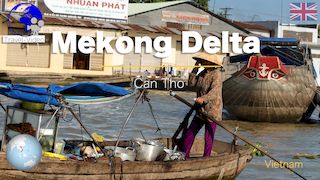
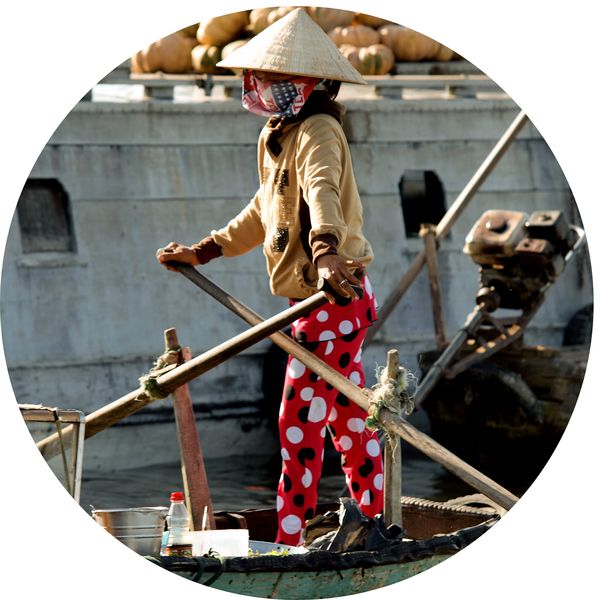
One of the most well-known activities on the river in the Mekong Delta is undoubtedly the Can Tho Floating Market. Dozens of pirogues loaded with fruits and vegetables harvested that very morning are heading towards this market where the peasants hope to sell their goods and make a little money.
It is often the women who come to sell the family produce at the market and when all the goods on offer have found a buyer, it is time to return home to prepare for the next day's sales. The return journey is sometimes long, but the Vietnamese perfectly master the techniques of navigation on the Mekong and their smile never leaves them.
Music:
- - YouTube video library - Gently Onwards
- - YouTube video library - Infados, (© Infados by Kevin MacLeod is licensed under a Creative Commons Attribution 4.0 license. https://creativecommons.org/licenses/by/4.0/
- Source: http://incompetech.com/music/royalty-free/index.html?isrc=USUAN1100449
- Artist: http://incompetech.com/)
Disclaimer: Despite its appropriateness, copyright issues prevent the use of vietnamese traditional music in "Mekong Delta, Can Tho • Vietnam", hence the use of royalty-free music. Despite our careful selection, some might regret this decision, which is necessary to avoid potential lawsuits. Although difficult, this decision is the only viable solution.


