

 Français (France)
  Nederlands (nl-NL)
 00:00 • intro | 00:33 • the temple seen from the outside | 01:06 • the interior deocration of the temple | 02:19 • a ceremony at the temple
Personal creation from visual material collected during my trip Vietnam & Cambodia (2014)
Map of places or practices in Tay Ninh on this site
• Use the markers to explore the content •
Cao Dai Temple in Tây Ninh: Sacred Architecture and Ceremony in Vietnam
A remarkable sanctuary in southern Vietnam
In Tây Ninh, northwest of Ho Chi Minh City, stands one of the most distinctive religious monuments of modern Vietnam: the Great Cao Dai Temple. This impressive sanctuary is the spiritual center of Caodaism, a religion founded in the twentieth century that sought to bring together several religious and philosophical traditions within a single system.
The video offers an engaging introduction to a place that is both monumental and active in daily religious life. Architecture, symbolism and ceremony are closely linked here. The temple is not simply an unusual building to admire from the outside, but a living sacred space where ritual practice continues to give meaning to every hall, color and decorative element.
Monumental façades, rich interiors and ritual life
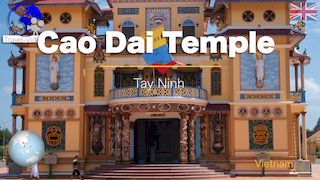
The exterior of the temple immediately attracts attention through its symmetrical composition, tall towers and vivid colors. The design combines elements inspired by East Asian religious architecture with features that recall Western decorative traditions. This unexpected mixture reflects the inclusive spirit of Caodaism itself.
Inside, the decoration is elaborate and highly structured. Painted columns, celestial motifs, symbolic imagery and carefully ordered perspectives create a striking ceremonial environment. The central nave leads the eye toward the most sacred areas of the temple, while repeated architectural rhythms reinforce a sense of order and hierarchy.
The ceremony shown in the video is essential to understanding the monument. Robed participants, coordinated movements, collective prayer and formal arrangements reveal how the building was designed for ritual use. The temple becomes fully intelligible when seen in action, as architecture and worship function together.
Caodaism and its historical background
Caodaism officially emerged in the 1920s, during a period marked by French colonial rule, social change and intellectual debate in Vietnam. Its founders developed a faith that drew inspiration from Buddhism, Taoism, Confucianism, Christianity and other spiritual currents known at the time.
This desire for synthesis was expressed not only in doctrine but also in architecture. The Tây Ninh temple became the principal institutional center of the movement, serving as a place of worship, administrative headquarters and visible symbol of unity for its followers.
One of the best-known sacred emblems is the Divine Eye, prominently represented within the temple. It symbolizes the presence of a supreme power watching over the world. Light, color and carefully aligned interior spaces all contribute to a deliberate spiritual staging intended to inspire reverence and concentration.
What the videos on this site make especially clear
Videos built largely from carefully selected and animated photographs are particularly effective for a monument as visually rich as the Cao Dai Temple. They allow viewers to observe façades, towers, decorative surfaces and architectural proportions with a clarity that can be difficult during a brief visit.
Inside the building, slow visual movement helps explain the depth of the nave, the repetition of columns and the relationship between ornament and space. Colors, symbols and painted details become easier to appreciate when presented progressively rather than in passing.
During ceremonial scenes, this format is equally valuable. It helps the viewer understand how worshippers move through the monumental setting and how symmetry, order and space contribute to the ritual atmosphere. The relationship between people and architecture becomes especially readable.
A unique monument of modern Vietnam
The Cao Dai Temple in Tây Ninh combines ambitious architecture, modern religious identity and living ceremonial traditions. As one of the rare great sanctuaries created by a recent faith, it holds a singular place in Vietnam’s cultural heritage. Visitors wishing to explore further can continue with the detailed pages devoted to the temple and the ceremonies associated with this remarkable site.
Links to related pages


Audio Commentary Transcript
At the beginning of the 20th century, in the Vietnamese city of Tay Ninh, an official had a revelation, a spirit would have appeared to him during a seance of spiritualism, asking him to found a new religion which was to be called Caodaism. This new religion will be a synthesis between Buddhism, Taoism and Confusianism. The founder, however, felt obliged to add a pinch of Christianity..., the religion of the French coloniser.

Music:
- - YouTube video library - Butterflies in Love
- - YouTube video library - Millicent
Disclaimer: Despite its appropriateness, copyright issues prevent the use of vietnamese traditional music in "Cao Dai temple in Tay Ninh • Vietnam", hence the use of royalty-free music. Despite our careful selection, some might regret this decision, which is necessary to avoid potential lawsuits. Although difficult, this decision is the only viable solution.


