Français (France)
  Nederlands (nl-NL)
 The Cao Dai ceremony represents one of the most distinctive religious traditions of southern Vietnam, particularly in the province of Tây Ninh, where the main center of Caodaism is located. Founded in the twentieth century, this religion combines elements drawn from Buddhism, Taoism, Confucianism, Christianity, and several Asian spiritual traditions. Ceremonies bring together worshippers for collective prayers, liturgical chanting, and rituals organized according to a structured ceremonial calendar. These practices continue to play an important role in local religious and community life. In Tây Ninh, Cao Dai ceremonies remain closely connected to the cultural identity of the religion and to the organization of major religious gatherings in Vietnam.
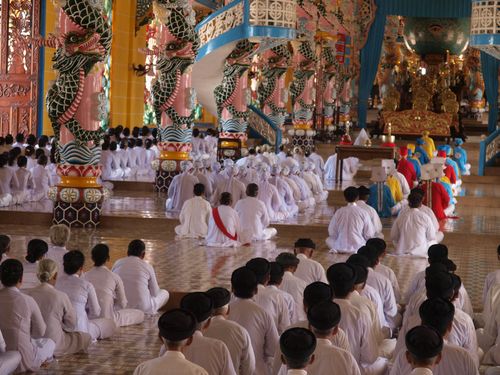
Tay Ninh • Cao Dai ceremony
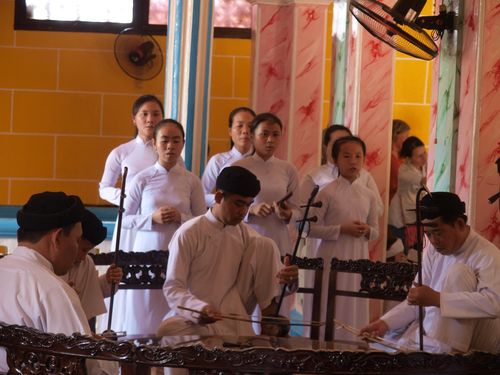
Tay Ninh • Cao Dai ceremony
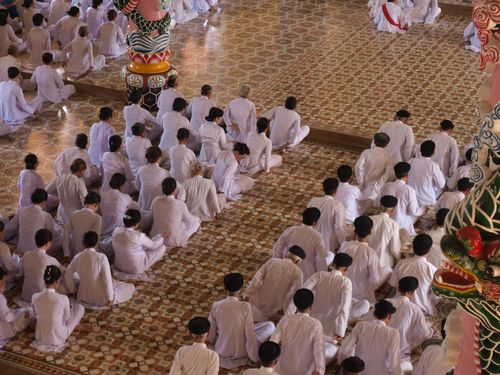
Tay Ninh • Cao Dai ceremony
Tradition profile
Cao Dai ceremony
Tradition category: Syncretic Celebrations
Tradition family: Religious traditions
Tradition genre: Religious Festivals and Celebrations
Cultural heritages: Christian, Buddhist
Geographic location: Tay Ninh • Vietnam
• Links to •
• List of videos about Tay Ninh on this site •
Cao Dai temple in Tay Ninh • Vietnam
Cao Dai Ceremonies in Tay Ninh and the Historical Development of Caodaism
Origins and Formation of the Religion
The ceremonies practiced in Tay Ninh are directly connected to the emergence of Caodaism, a Vietnamese religion officially founded in 1926 in southern Vietnam during the French colonial period. The movement developed among educated Vietnamese administrators and intellectuals seeking a spiritual system capable of integrating several religious traditions already present in Vietnamese society.
Caodaism combined elements derived from Buddhism, Taoism, Confucianism, Christianity, and certain forms of Western spiritualism introduced during the colonial era. Its founders presented the religion as a universal faith intended to reconcile different spiritual teachings within a single religious framework. Tay Ninh rapidly became the administrative and ceremonial center of the movement and remains its principal religious headquarters today.
The establishment of formal ceremonies played an essential role in organizing the new religion. Rituals provided a visible structure for worship, reinforced collective identity, and distinguished the movement from other religious communities active in southern Vietnam during the early twentieth century.
Historical Expansion and Institutional Organization
During the 1930s and 1940s, Caodaism expanded considerably across southern Vietnam. The ceremonies held in Tay Ninh became central reference models for local temples established in other provinces. A hierarchical religious administration supervised ritual practices, doctrinal teaching, and the organization of major religious festivals.
The development of ceremonial life was closely linked to the growth of the Holy See of Tay Ninh. Daily services, annual celebrations, and collective rituals attracted increasing numbers of followers. The movement established an elaborate clerical hierarchy inspired partly by imperial Vietnamese administrative traditions and partly by organizational models associated with other world religions.
Large ceremonies reinforced social cohesion among believers and contributed to the visibility of the religion in colonial society. Religious gatherings also functioned as community events connecting rural populations, urban followers, and religious dignitaries through a shared ceremonial system.
The movement’s expansion coincided with a period of political instability in Indochina. During the mid-twentieth century, Caodaism developed not only as a religious organization but also as a structured social institution with educational, charitable, and administrative activities linked to its ceremonial centers.
Political Transformations and Continuity of Ritual Practice
The ceremonies of Tay Ninh were affected by the political upheavals that marked Vietnam during the twentieth century. Periods of war and governmental change altered the organization of religious institutions and limited certain activities associated with independent religious movements.
After the reunification of Vietnam in 1975, Caodaist institutions experienced increased state supervision. Some religious activities were restricted or reorganized under new administrative frameworks. Despite these changes, ceremonial practices continued within the Tay Ninh Holy See, although often under tighter regulation.
From the 1990s onward, broader changes in Vietnam’s religious policy allowed a more visible revival of Caodaist activities. Ceremonies regained public prominence, and the Holy See of Tay Ninh resumed its role as the principal ceremonial center of the religion. Religious festivals once again attracted large gatherings of followers from different parts of Vietnam as well as overseas Caodaist communities.
The continuity of ritual practice during periods of political transformation contributed significantly to the preservation of Caodaist identity. Ceremonies remained one of the most stable elements linking successive generations of believers.
Religious Significance and Community Role
Cao Dai ceremonies serve both spiritual and social functions. They express the syncretic foundations of the religion by incorporating symbols, prayers, and ceremonial references associated with multiple religious traditions. Rituals reinforce the idea of universal spiritual unity, which occupies a central position in Caodaist doctrine.
The ceremonies also structure community life. Collective worship, religious festivals, and regular gatherings maintain relationships among followers and support the transmission of liturgical knowledge. Ceremonial participation remains closely associated with moral discipline, collective identity, and respect for religious hierarchy.
The Holy See of Tay Ninh occupies a symbolic position within this system. For many believers, it represents the institutional and spiritual center of Caodaism. Major ceremonies performed there possess a significance extending beyond the local community and are regarded as important events for the religion as a whole.
Contemporary Importance and Preservation Challenges
Today, Cao Dai ceremonies continue to be practiced daily in Tay Ninh according to established ritual schedules. The religion maintains an active presence in southern Vietnam, while Caodaist communities abroad also preserve connections with the ceremonial traditions of the Holy See.
Contemporary challenges concern the transmission of ritual knowledge, the training of younger generations, and the preservation of ceremonial practices within a rapidly changing social environment. Religious authorities seek to maintain liturgical continuity while adapting organizational structures to modern conditions.
The ceremonies of Tay Ninh remain one of the most visible expressions of Vietnam’s syncretic religious traditions and continue to play a major role in preserving the cultural and spiritual identity of the Caodaist community.
Ritual Organization and Ceremonial Practices of Cao Dai Worship in Tay Ninh
General Structure of the Ceremonies
Cao Dai ceremonies in Tay Ninh follow a highly codified liturgical organization based on fixed schedules, hierarchical positioning, and synchronized ritual movements. Daily ceremonies are usually held several times a day inside the Holy See, the principal religious center of the religion. Worshippers enter the ceremonial hall through designated circulation paths and take their places according to gender, rank, and ritual function.
The beginning of the ceremony is marked by the gradual arrival of officiants, musicians, and religious dignitaries. Participants move slowly and quietly toward their assigned positions while maintaining strict visual order. Once the assembly is complete, the ritual proceeds through sequences of prayers, chants, kneeling movements, and coordinated bows directed toward the main altar.
The progression of the ceremony follows a clearly defined rhythm. Moments of collective chanting alternate with periods of silence, instrumental accompaniment, and ritual recitations. Movements are executed simultaneously by the participants, producing a highly organized visual composition throughout the interior of the sanctuary.
Major religious festivals involve larger ceremonial gatherings and additional processional sequences. During important celebrations, large numbers of followers from different regions of Vietnam gather at Tay Ninh, increasing the scale of the rituals while preserving the same formal liturgical structure.
Ceremonial Space and Interior Organization
The architecture of the Tay Ninh Holy See directly shapes the organization of the ceremonies. The central nave serves as the principal ceremonial axis and guides movement toward the altar dominated by the Divine Eye symbol, one of the most recognizable elements of Cao Dai religious imagery.
The interior space is divided according to hierarchical and ritual functions. High-ranking dignitaries occupy the front sections nearest the altar, while ordinary worshippers stand or kneel farther back within organized rows. Men and women generally occupy separate sides of the ceremonial hall, reflecting the liturgical organization of the religion.
The broad interior spaces allow large assemblies to participate in ceremonies while maintaining visual symmetry and controlled circulation. The long perspective created by the columns and central aisle reinforces the collective aspect of the ritual. During ceremonies, the arrangement of participants transforms the architectural space into a highly structured ceremonial environment.
Open galleries and secondary spaces surrounding the main hall are used for circulation, preparation, and observation during larger events. During major festivals, exterior courtyards and surrounding areas may also be incorporated into processional activities connected to the main ceremonies.
Ritual Clothing and Symbolic Objects
One of the most immediately recognizable features of Cao Dai ceremonies is the use of standardized ritual clothing. Ordinary followers usually wear long white robes symbolizing purity and spiritual equality within the religious community. These garments create visual uniformity during collective worship.
Religious dignitaries wear more elaborate ceremonial costumes distinguished by color, decorative details, and headdresses indicating rank and symbolic affiliation. Yellow robes are associated with Buddhist traditions, blue with Taoist influences, and red with Confucian symbolism. These color distinctions reflect the syncretic structure of the religion and its integration of several spiritual traditions within a unified ceremonial framework.
The altar area contains numerous ritual objects used during ceremonies. Candles, incense burners, floral offerings, ceremonial vessels, and symbolic decorations are carefully arranged according to liturgical conventions. Incense plays a central role in the atmosphere of the rituals, producing visible smoke that accompanies prayers and processional movements.
Certain officiants handle ritual instruments used to signal transitions within the ceremony. Bells, wooden percussion instruments, and ceremonial drums punctuate important moments and help regulate the rhythm of collective actions. The use of these objects follows strict ceremonial protocols and is reserved for designated participants.
Music, Chants, and Ritual Expressions
Music occupies an essential place within Cao Dai ceremonies. Liturgical chants accompany nearly all major ritual sequences and are performed either collectively or by specialized groups positioned within the ceremonial hall. The vocal style remains measured and rhythmic, emphasizing coordination rather than individual expression.
Instrumental accompaniment is provided by ensembles using traditional Vietnamese instruments, including percussion, string instruments, and certain wind instruments. Musical interventions structure the progression of the ceremony by marking transitions between prayers, bows, recitations, and periods of silence.
The chants themselves are based on liturgical texts linked to Cao Dai doctrine and spiritual teachings. Repetition and controlled tempo create a ceremonial atmosphere that reinforces concentration and collective discipline among participants. The combination of music, chanting, and synchronized gestures produces a unified ritual environment in which sound and movement remain closely interconnected.
Body movements during ceremonies are highly regulated. Worshippers kneel, bow, rise, and reposition themselves simultaneously according to precise ritual timing. Hand positions, inclinations of the head, and the rhythm of prostrations follow established ceremonial rules transmitted through religious instruction and repeated participation.
Participants and Hierarchical Functions
Cao Dai ceremonies involve multiple categories of participants with clearly differentiated roles. High-ranking dignitaries lead the ceremonies and oversee the liturgical progression. Intermediate officiants coordinate the practical organization of the rituals, supervise movement inside the sanctuary, and manage the ceremonial instruments and chants.
Musicians and chanters occupy designated positions within the hall and maintain the rhythm of the ceremony. Assistants may help organize offerings, prepare ritual materials, or guide participants during large gatherings. Younger members of the community are sometimes involved in support functions linked to processions and ceremonial preparation.
Ordinary worshippers actively participate through collective recitation, synchronized gestures, and ritual responses. The ceremonies emphasize disciplined collective participation rather than individual devotional expression. The visual organization of the assembly therefore becomes one of the defining characteristics of the ritual itself.
Distinctive Features of Cao Dai Ceremonial Practice
One of the most distinctive aspects of Cao Dai ceremonies is the integration of symbolic references associated with several religious traditions within a single ritual system. This syncretic structure appears in the costumes, colors, liturgical hierarchy, ritual gestures, and ceremonial symbolism visible throughout the Holy See.
The ceremonies are also notable for their strong visual symmetry and spatial discipline. Long aligned rows of worshippers, coordinated movements, and balanced architectural perspectives create a carefully organized ceremonial environment. The large scale of the sanctuary allows these collective arrangements to become especially visible during major gatherings.
Another characteristic feature is the relationship between architecture and ritual movement. The broad nave, elevated altar, repetitive columns, and symmetrical circulation paths all contribute directly to the ceremonial experience. The ceremonies therefore rely not only on prayers and chants but also on the controlled interaction between participants, movement, sound, and architectural space within the Holy See of Tay Ninh.
 Links to the main sections of the site