

 Français (France)
  Nederlands (nl-NL)
 00:00 • intro | 00:32 • the mausoleum and palace of Tu Duc, last emperor of Vietnam
Personal creation from visual material collected during my trip Vietnam & Cambodia (2014)
Map of places or practices in Hue on this site
• Use the markers to explore the content •
Hue, Tu Duc Mausoleum, Memory of an Imperial Vietnam
A major funerary complex of the former Vietnamese capital
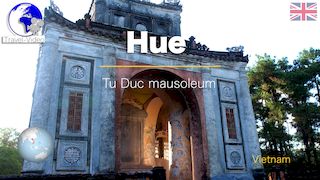
In Hue, the former imperial capital of Vietnam, the royal mausoleums of the Nguyen dynasty rank among the country’s most significant heritage sites. Among them, the Mausoleum of Tu Duc stands out for its refined atmosphere, landscaped setting, and the close relationship between architecture and the personality of the emperor it commemorates. More than a tomb, it is a carefully designed ensemble of pavilions, lakes, gardens, and ceremonial spaces conceived as both a retreat and a place of remembrance.
This video offers a clear introduction to this remarkable site through the mausoleum and palace of Tu Duc. It reveals a monument where architecture, nature, and political symbolism are combined in a harmonious composition typical of imperial Hue.
The mausoleum and palace of Tu Duc
The complex is distinguished first by its landscape design. Rather than presenting itself as a closed or severe monument, it unfolds across wooded grounds structured by ponds, courtyards, bridges, and elegant pavilions. Water plays an important role throughout the site, reflecting buildings and enhancing the calm atmosphere that was deliberately sought.
Several structures served ceremonial functions, while others were used during the emperor’s lifetime as temporary residences or places for study and leisure. This explains why the complex often feels more like a palace garden than a conventional funerary monument.
The architecture is measured and graceful. Curved roofs, timber structures, ornamental details, and inscribed panels create an environment based on balance rather than overwhelming scale. The intention was not monumental display alone, but cultivated serenity.
The burial area itself lies deeper within the complex, reached through a sequence of spaces that gradually separates the visitor from the outer world. As in other imperial mausoleums of Hue, movement through the site carries symbolic meaning, linking life, authority, and ancestral memory.
Historical and cultural context
Emperor Tu Duc reigned from 1847 to 1883, during one of the most difficult periods of the Nguyen dynasty. His reign coincided with growing internal tensions and increasing French colonial expansion in Southeast Asia. Despite these political pressures, the imperial court maintained a strong commitment to scholarship, ritual culture, poetry, and architectural patronage.
Tu Duc is often remembered as an educated ruler deeply attached to Confucian values and literary life. His mausoleum reflects this sensibility. It was conceived not only as his future resting place, but also as a retreat where he could compose poetry, reflect, and withdraw from court responsibilities.
The choice of a natural setting was consistent with broader East Asian ideas of harmony between landscape and architecture. Water, vegetation, orientation, and topography all contributed to the symbolic legitimacy of the complex. Such settings were intended to express order, continuity, and moral authority.
After the end of the monarchy, the mausoleum became an essential witness to Vietnam’s imperial civilization. Today it forms part of Hue’s internationally recognized heritage landscape.
What the videos on this site make especially clear
A video built from carefully selected and animated photographs is particularly well suited to a site like the Mausoleum of Tu Duc. Slow visual movement allows viewers to follow the perspectives, pathways, and successive courtyards with clarity.
This approach highlights the subtle relationship between architecture and landscape. Lakes, trees, pavilions, and walls appear not as separate elements, but as parts of a single composition.
Architectural details also become easier to appreciate: roof lines, gateways, inscriptions, decorative motifs, and the play of light across stone and timber surfaces. These are features often missed during a rapid visit.
The progressive sequence of images also helps explain the dual identity of the site: a residence for a living emperor and later a place dedicated to dynastic memory.
An intimate face of imperial Hue
The Mausoleum of Tu Duc offers a nuanced image of imperial Vietnam, combining political authority, literary culture, and a refined sense of landscape. This video presents an accessible introduction to one of Hue’s most elegant monuments. Visitors wishing to go further can also explore the detailed pages dedicated to this exceptional site and the wider heritage of the former imperial capital.
Links to related pages



Audio Commentary Transcript
Emperor Tu Duc, poet and artist, but also a politician fiercely opposed to any foreign influence in his country, contributed by his intransigence and his exactions against the European missionaries to precipitate the invasion of his country by the French forces, which meant the end of Imperial Vietnam in short order.
He himself drew the plans for his mausoleum, made up of a hundred buildings scattered in a 12-hectare park near the imperial city of Hue. Although he lived there the last years of his life, he was never buried there. His body rests elsewhere, in an undisclosed location.

Music:
- - YouTube video library - Missing Pieces
- - YouTube video library - Nostalgic Place
Disclaimer: Despite its appropriateness, copyright issues prevent the use of vietnamese traditional music in "Hue, the mausoleum of Tu Duc • Vietnam", hence the use of royalty-free music. Despite our careful selection, some might regret this decision, which is necessary to avoid potential lawsuits. Although difficult, this decision is the only viable solution.


