Français (France)
  Nederlands (nl-NL)
 00:00 • intro | 00:33 • funerary monuments | 01:15 • chinese nets | 02:42 • fortune teller | 03:25 • sunset
Personal creation from visual material collected during my trip Vietnam & Cambodia (2014)
Map of places or practices in Hue on this site
• Use the markers to explore the content •
Hué, Rural Landscapes and Living Traditions Beyond the Imperial City
Between historic prestige and everyday life
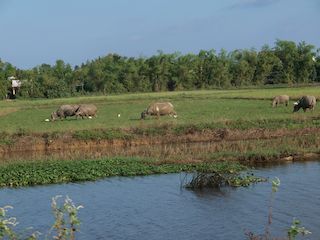
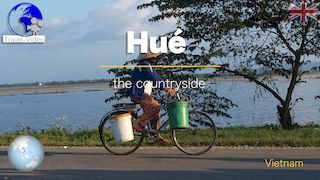
Beyond the celebrated citadel, royal tombs and ceremonial monuments of Hué lies a wider landscape that helps explain the former imperial capital in a deeper way. The surrounding countryside presents another side of central Vietnam: villages shaped by waterways, cultivated land, family burial sites, traditional fishing techniques and scenes of ordinary life that continue alongside famous heritage landmarks. In Hué, monumental history and rural continuity remain closely connected.
This video explores that quieter and often overlooked dimension of the region. It moves through open landscapes where funerary monuments appear among fields and trees, observes Chinese fishing nets rising above the water, pauses near a fortune teller, and closes with the warm light of sunset. Together, these moments reveal a territory where memory, labour, belief and nature still form a coherent whole.
Funerary heritage, water-based skills and local customs
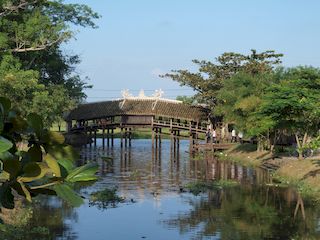
The funerary monuments seen in the countryside reflect the importance of ancestors and remembrance in Vietnamese culture. These structures may range from modest family tombs to more elaborate enclosures influenced by imperial forms. Their presence in agricultural landscapes shows that places of memory are not isolated from daily life. Fields, paths, ponds and graves often share the same environment, creating a landscape where the past remains visible.
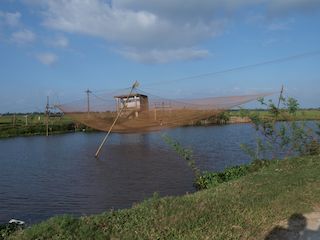
Chinese fishing nets provide another striking element. Operated through counterweights and wooden frames, these devices are used to lift nets from rivers or lagoons. Their elegant geometry makes them instantly recognisable. They also illustrate practical knowledge developed in regions where water has long been essential for transport, fishing and agriculture. More than simple tools, they contribute strongly to the visual identity of the area.
The appearance of a fortune teller introduces another aspect of local culture. Across much of Asia, practices linked to destiny, auspicious dates and symbolic guidance continue to coexist with modern urban life. Such encounters remind visitors that traditional beliefs often remain part of everyday decision-making and social life.
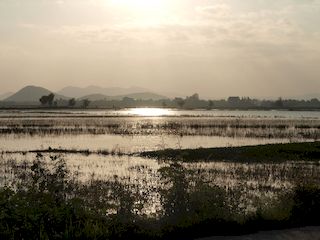
The closing sunset brings these themes together. Light over water and fields emphasises the calm rhythm of the countryside and the strong relationship between landscape and human activity.
A region shaped by imperial history
Hué became the capital of the Nguyễn dynasty in the nineteenth century and remained the political centre of Vietnam for decades. The city’s palaces, temples and royal mausoleums required resources, labour and agricultural support from the surrounding countryside. Rural communities therefore played an important role in sustaining imperial life.
Even after the monarchy ended, this relationship between historic capital and nearby villages remained visible. The countryside preserved many traditional practices while the monumental centre became one of Vietnam’s major heritage destinations. Understanding Hué fully means looking beyond its walls toward the wider territory that supported it.
Water has always been central to this region. The Perfume River, smaller channels, ponds and wetlands helped shape settlement patterns and economic life. Fishing devices such as the nets seen in the video belong to this long adaptation between people and environment.
What the videos on this site make especially clear
A video built from carefully selected and animated photographs is particularly effective for this kind of subject. Slow visual movement allows viewers to study how funerary monuments are placed within trees, fields and open space. Architectural forms become clearer when there is time to observe proportions, materials and surroundings.
Chinese fishing nets also benefit from this approach. Their structure, balance and relationship to the water can be understood more easily than during a quick visit. The viewer sees both their technical logic and their sculptural beauty.
Scenes involving people gain depth as well. The fortune teller appears not as an isolated curiosity but as part of a broader cultural environment. The final sunset then unifies monuments, work, beliefs and landscape into a single atmosphere.
Because the images progress gradually, the viewer can understand that the countryside around Hué is not separate from the imperial city, but one of the keys to interpreting it.
Another way to discover Hué
Exploring the rural surroundings of Hué offers a richer understanding of the region than monuments alone can provide. Here, ancestral memory, traditional skills, local beliefs and peaceful landscapes continue to coexist. For those wishing to go further, the related detailed pages offer additional insight into the natural and cultural setting of one of Vietnam’s great historic centres.
Links to related pages
Audio Commentary Transcript
In the countryside around Hue, one encounters many of these funerary monuments which are often more beautiful than the houses of the living. It is a testimony to the worship that the Vietnamese dedicate to their dead who must not miss anything in the hereafter.
It's not just fish in the rivers of Vietnam. There are also many duck farms all over the country.

Music:
- - YouTube video library - Nail biter - Riot
- - YouTube video library - No.10 A new beginning - Esther Abrami
Disclaimer: Despite its appropriateness, copyright issues prevent the use of vietnamese traditional music in "Hue, in the surrounding countryside • Vietnam", hence the use of royalty-free music. Despite our careful selection, some might regret this decision, which is necessary to avoid potential lawsuits. Although difficult, this decision is the only viable solution.