Français (France)
  Nederlands (nl-NL)
 00:00 • intro | 00:02 • the Perfume River | 00:44 • Celestial Lady Pagoda
Personal creation from visual material collected during my trip Vietnam & Cambodia (2014)
Map of places or practices in Hue on this site
• Use the markers to explore the content •
Hue, Thien Mu Pagoda on the Perfume River
A spiritual landmark of the former imperial capital
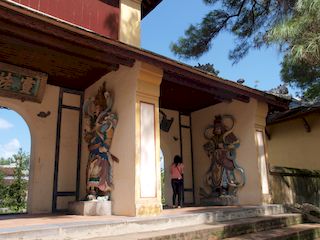
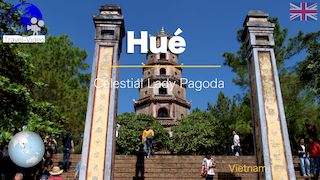
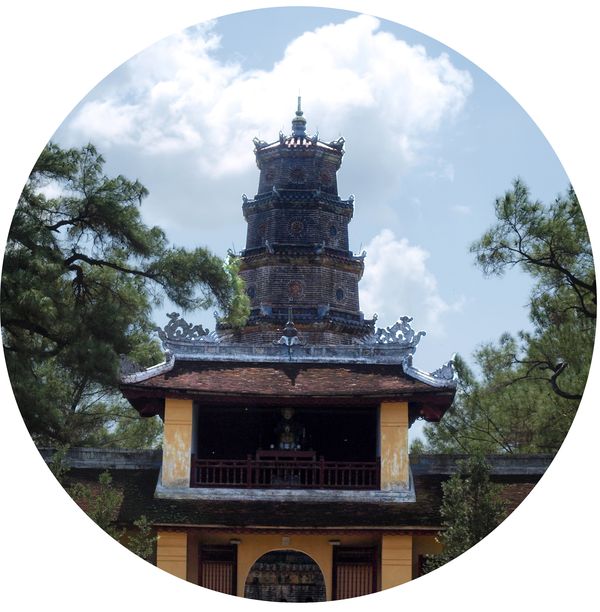
In Hue, the former dynastic capital of Vietnam, the Pagoda of the Celestial Lady, better known as Thien Mu or Tien Mu, is one of the country’s most recognizable religious monuments. Built on a hill overlooking the Perfume River, it brings together landscape, spirituality and historical memory in a remarkably harmonious setting. Its elegant multi-storey tower rising above the riverbanks has long made it one of the visual symbols of Hue.
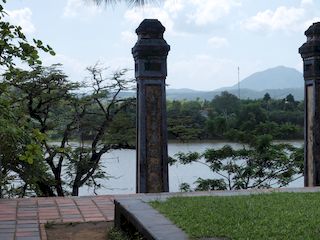
This video offers a gradual approach to the site. It first follows the Perfume River, one of the essential natural and cultural axes of the city, before reaching the pagoda itself. This progression helps explain why the monument matters so much: Thien Mu is not only a place of worship, but also a defining landmark in the historical geography of Hue.
The river and the pagoda
The Perfume River flows through Hue and shapes much of its historic landscape. Imperial palaces, royal tombs, gardens and religious monuments developed along its banks. Its calm waters and broad perspectives contribute greatly to the distinctive atmosphere of the city.
On one of these banks stands Thien Mu Pagoda. The monument is especially famous for the Phuoc Duyen Tower, a seven-storey octagonal structure added in the nineteenth century. Rising prominently above the trees, it gives the complex its instantly recognizable silhouette.
Around the tower are courtyards, shrines, gardens and ceremonial buildings. The arrangement reflects principles common to Buddhist sacred architecture: balance between built forms and nature, progressive movement through space, and an atmosphere intended to encourage calm reflection.
Historical and cultural context
The pagoda was originally founded in the early seventeenth century under the Nguyen Lords, before Hue became the imperial capital. According to local tradition, an old prophecy announced that a great ruler would build a sacred monument on this hill to protect the region. The name “Celestial Lady” refers to that legend.
When the Nguyen dynasty later established Hue as the capital, the pagoda gained prestige and received repeated restorations and enlargements. Several emperors supported the site, and the famous tower dates from this later period.
Thien Mu also played a role in modern Vietnamese history. Like other Buddhist institutions, it became associated with important religious and civic developments during the twentieth century. For that reason, the site is more than a beautiful monument: it also reflects changing chapters of national history.
Today it remains both an active religious center and one of Hue’s most visited heritage sites.
What the videos on this site make especially clear
A video created from carefully selected and animated photographs is particularly well suited to a place like Thien Mu. Slow movement across still images allows viewers to understand the relationship between river, hilltop and tower, which is fundamental to the meaning of the site.
Architectural details also become clearer: the successive levels of the tower, curved rooflines, gateways, ornamental elements and landscaped courtyards can be appreciated without haste.
This approach also helps convey the internal progression of the complex. Entrances, open spaces, gardens and sacred buildings appear as parts of a coherent spiritual journey rather than isolated scenes.
Finally, the presence of the Perfume River reminds viewers that the pagoda belongs to a wider historical landscape closely connected to the identity of Hue.
A lasting symbol of central Vietnam
Thien Mu Pagoda combines Buddhist heritage, elegant architecture and a memorable natural setting. This video offers a clear and peaceful introduction to one of Hue’s great monuments. To continue the discovery, the detailed pages devoted to the site provide further insight into one of the most enduring cultural symbols of central Vietnam.
Links to related pages



Audio Commentary Transcript
The Perfume River crosses the city of Hue. On its edges stands the oldest and best known of the city's pagodas. The Pagoda of the Heavenly Lady built at the very beginning of the 17th century on the ruins of an ancient temple dedicated to Shiva. Legend has it that an old woman in a red dress prophesied that whoever built a Buddhist temple there would found a powerful dynasty.
In 1963 an event in Saigon was going to make headlines all over the world. The immolation by fire of a monk to protest against the discrimination of the Buddhist religion in Vietnam. This monk belonged to this pagoda and this Austin is the vehicle that brought him there.
Music:
- - YouTube video library - For Originz, (© For Originz by Kevin MacLeod is licensed under a Creative Commons Attribution 4.0 license. https://creativecommons.org/licenses/by/4.0/
- Source: http://incompetech.com/music/royalty-free/index.html?isrc=USUAN1100700
- Artist: http://incompetech.com/)
Disclaimer: Despite its appropriateness, copyright issues prevent the use of vietnamese traditional music in "Hue, Celestial Lady Pagoda (Tien Mu) • Vietnam", hence the use of royalty-free music. Despite our careful selection, some might regret this decision, which is necessary to avoid potential lawsuits. Although difficult, this decision is the only viable solution.