Français (France)
  Nederlands (nl-NL)
 00:00 • intro | 00:29 • Papermaking | 03:13 • Making paper umbrellas
Personal creation from visual material collected during my trip Myanmar • Burma (2016)
Map of places or practices in Pindaya on this site
• Use the markers to explore the content •
Traditional Paper Craftsmanship in Pindaya and the Shan Highlands
Rural craftsmanship in the mountains of Myanmar
Located in the highlands of Shan State, the small town of Pindaya is best known for its Buddhist cave complex and its landscapes of hills, cultivated fields and lakes. Beyond its religious heritage, the region also preserves several traditional crafts that remain closely connected to local daily life. This video focuses on one of these activities: the handmade production of traditional paper and its use in the manufacture of decorative paper umbrellas, objects that have become strongly associated with Burmese craftsmanship.
The images reveal modest workshops where most stages of production are still carried out manually. Rather than relying on industrial methods, the artisans continue to work with techniques transmitted through practice and experience. The video offers a closer look at a form of craftsmanship that remains both an economic activity and a cultural tradition in the region surrounding Pindaya.
Handmade paper and traditional umbrella production
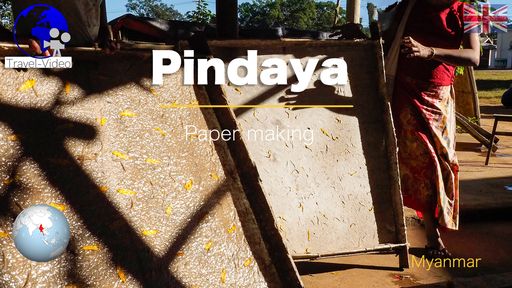
The video follows several stages of traditional paper manufacturing. In Myanmar, this type of paper is generally produced from natural plant fibers transformed into pulp before being spread by hand across wooden frames and left to dry. Basins of water, bamboo structures and drying surfaces illustrate a process that appears simple but requires precision and familiarity with the material.
Paper production has long existed in different parts of Myanmar, where handmade paper was once used for writing, religious manuscripts and administrative purposes. Today, its role is often linked to decorative crafts and tourist-oriented handicrafts, while still preserving traditional techniques. In Pindaya, small family workshops continue to maintain these methods, allowing visitors to observe practices that have changed relatively little over time.
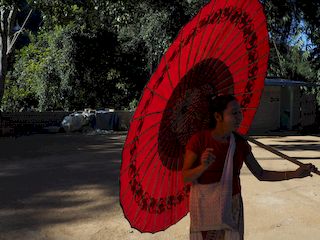
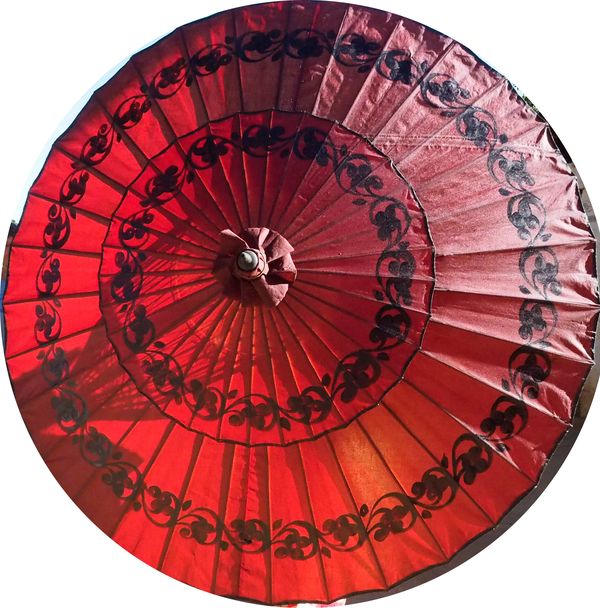
The sequences devoted to umbrella making show how paper becomes part of a wider artisanal tradition. Bamboo frames, hand-painted decorations and careful assembly techniques demonstrate the importance of manual work in the production process. These paper umbrellas are now among the most recognizable craft objects associated with Myanmar and are used both as decorative items and in certain cultural or religious contexts.
Local traditions and regional identity in Shan State
The craft activities shown in the video belong to a broader rural environment where many forms of production still operate on a small scale. Shan State has long preserved local traditions linked to available natural resources and regional trade networks. Bamboo, plant fibers and natural materials continue to play an important role in everyday objects and artisanal production throughout the region.
Pindaya itself remains strongly associated with Buddhist culture and local traditions. While many visitors are drawn primarily to the famous caves filled with Buddha images, the surrounding workshops provide another perspective on regional heritage. They reveal forms of intangible cultural heritage that are less monumental than temples or pagodas, yet equally representative of local identity and craftsmanship.
A closer observation of materials and gestures
The videos presented on this site make traditional techniques particularly easy to observe through the use of carefully selected and animated photographs. Gradual transitions between images allow viewers to follow the different stages of paper production, study textures and materials, and observe the precise gestures involved in each phase of the work. This approach helps highlight details that are often difficult to notice in rapidly edited moving footage.
Between craftsmanship, transmission and daily life
Through the manufacture of paper and decorative umbrellas, the region of Pindaya reveals a quieter but essential dimension of Myanmar’s cultural heritage. These workshops illustrate the continuity of artisanal knowledge transmitted across generations and provide insight into forms of craftsmanship that remain part of everyday life in Shan State. The detailed pages connected to this subject also offer additional information about the techniques and traditions presented in the video.
Music:
- - YouTube video library - Waking to Reality - Unicorn Heads
Disclaimer: Despite its appropriateness, copyright issues prevent the use of burmese traditional music in "Pindaya, paper making workshop • Myanmar", hence the use of royalty-free music. Despite our careful selection, some might regret this decision, which is necessary to avoid potential lawsuits. Although difficult, this decision is the only viable solution.
Links to related pages






















Audio Commentary Transcript
In Myanmar, the art of paper making, rooted in local traditions, showcases the skill and creativity of artisans across the country. In Pindaya, this craft takes a specific form at the Paper Making Workshop, where traditional techniques are employed to create paper umbrellas. This workshop exemplifies the cultural richness of the area and continues the local craft heritage by blending commerce with creativity.
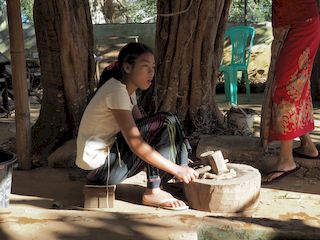
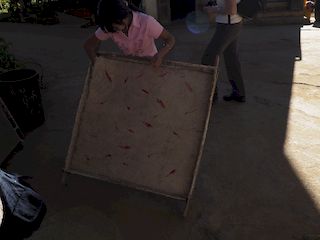
Papermaking from mulberry bark in Myanmar is a traditional art passed down through generations. The process begins with the harvesting of mulberry bark, which is then boiled to remove impurities and soften the fibers. Once cleaned, the bark is hand-beaten or pounded to turn the fibers into a homogeneous pulp. This pulp is then diluted in water to form a fine fibrous suspension. The mixture is scooped up with a screen frame that captures the fibers while allowing the water to drain. The frame is then gently shaken to distribute the fibers evenly before being left to dry in the sun. The result is a sturdy, textured sheet of paper, often used to create umbrellas, lanterns, and other handicrafts. This type of paper is valued for its durability and unique texture, reflecting the skills and creativity of Burmese artisans.
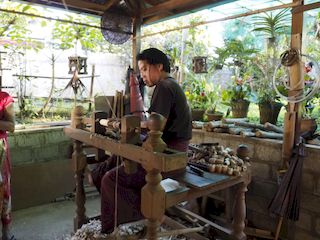
In the Pindaya workshop, the handles of the umbrellas are carefully crafted on a traditional wood lathe. This technique allows for precise shaping of the wood, creating elegant and sturdy handles, making each umbrella not only practical but also aesthetically unique.
The wooden ribs of the umbrellas from Pindaya are also shaped on site with the same attention to detail. These are meticulously carved and adjusted, then hand-assembled to structure and support the umbrella's canopy. This final assembly process ensures that each umbrella is not only functional but also visually harmonious, reflecting the traditional craftsmanship of the workshop.