Français (France)
  Nederlands (nl-NL)
 In Pindaya, in Myanmar’s Shan State, paper-making workshops preserve a form of traditional craftsmanship still practiced within rural and monastic communities. The activity is based on the manual transformation of plant fibres into sheets used for writing, religious decorations, traditional umbrellas, and various everyday objects. These workshops often combine artisanal production with the family transmission of technical knowledge. Paper production also remains closely connected to regional cultural and religious practices. Today, the workshops contribute to the preservation of traditional manufacturing techniques that face increasing pressure from industrial production methods and changing patterns in the use of paper materials.
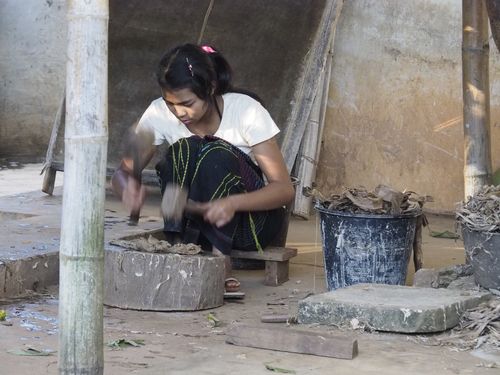
Pindaya • Paper Crafting Workshop
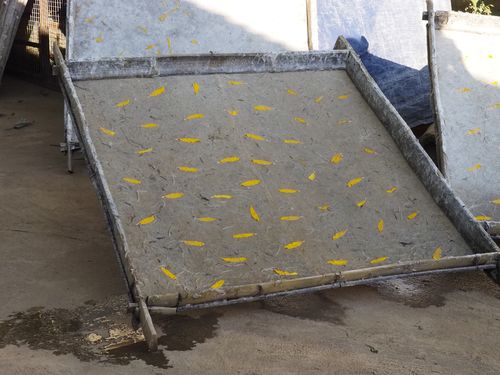
Pindaya • Paper Crafting Workshop
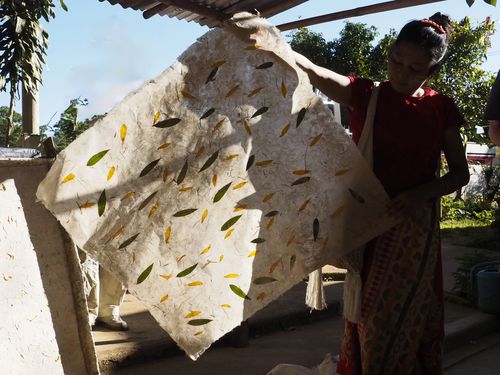
Pindaya • Paper Crafting Workshop
Tradition profile
Paper Crafting Workshop
Tradition category: Craftsmanship
Tradition family: Crafts and professions
Tradition genre: Trade and Local Creativity
Geographic location: Pindaya • Myanmar
• Links to •
• List of videos about Pindaya on this site •
Pindaya, the cave of the Buddhas • Myanmar
Pindaya, paper making workshop • Myanmar
Traditional Paper-Making in Pindaya and the Craft Heritage of the Shan Region
Origins and Early Development
Traditional paper-making in Pindaya, located in Myanmar’s Shan State, forms part of a broader network of artisanal practices historically linked to rural communities and Buddhist monastic institutions across the eastern Himalayan and mainland Southeast Asian regions. The craft developed around the manual processing of plant fibres into paper sheets used for religious, administrative, and domestic purposes.
Although the precise beginnings of paper production in Pindaya are not fully documented, the activity was likely connected to the expansion of Buddhist monastic culture in the Shan plateau. Monasteries required locally produced materials for manuscripts, ritual objects, written records, and decorative religious items. In regions where imported goods remained limited for long periods, local workshops became essential suppliers for surrounding communities.
The development of artisanal paper-making was also influenced by the environmental conditions of the Shan region. The availability of suitable plant fibres and water sources supported the emergence of small-scale production adapted to local needs rather than large commercial distribution.
Craft Organisation and Economic Role
Paper-making workshops traditionally operated within family-based or community-based structures. Production was usually integrated into a broader rural economy combining agriculture, handicrafts, and seasonal trade. Different stages of the work were distributed among family members according to age, physical strength, or technical experience.
The paper produced in these workshops served multiple functions beyond writing materials. It was used in the manufacture of decorative objects, religious ornaments, ceremonial items, and traditional umbrellas commonly associated with parts of Shan State and neighbouring regions.
Local trade networks played an important role in sustaining the workshops. Artisans sold their production in village markets or supplied nearby monasteries and craftsmen engaged in related activities. The relationship between paper-making and Buddhist ritual practices contributed to the continuity of the craft even when industrial products became more widely available.
In some communities, the workshops also functioned as places of practical transmission where younger generations learned manual skills through observation and direct participation rather than formal instruction.
Transformations During the Modern Period
The twentieth century brought major changes to the role of traditional paper-making in Myanmar. Industrially manufactured paper gradually replaced handmade products in administration, education, and everyday commercial use. Cheaper imported goods reduced the economic importance of small rural workshops, particularly in isolated regions with limited production capacity.
Political instability, economic fluctuations, and changes in transportation networks also affected artisanal production in Shan State. Some workshops disappeared entirely, while others adapted by focusing on decorative products or objects associated with regional cultural identity.
In Pindaya, part of the survival of paper-making workshops depended on diversification. Handmade paper increasingly became linked to artisanal demonstrations, small-scale cultural production, and the manufacture of objects intended for local markets and visitors. Rather than competing directly with industrial paper, workshops maintained activity through specialised uses requiring traditional materials and techniques.
Despite these transformations, many aspects of production remained strongly manual. The continuity of the craft relied more on practical experience and family transmission than on mechanisation or large-scale commercial expansion.
Contemporary Importance and Preservation Challenges
Today, traditional paper-making in Pindaya represents both an economic activity of limited scale and an important element of regional craft heritage. Workshops continue to preserve technical knowledge associated with the preparation of fibres, the formation of handmade sheets, and the use of locally available materials.
The long-term survival of the craft faces several challenges. Industrial materials dominate most commercial uses of paper, while younger generations often seek employment outside traditional artisanal sectors. The maintenance of workshops therefore depends on the ability to sustain demand for handmade products connected to cultural, decorative, or religious uses.
At the same time, the craft remains associated with regional identity in parts of Shan State. The workshops preserve production methods that reflect older forms of rural organisation and manual labour still present in certain areas of Myanmar.
Traditional paper-making in Pindaya therefore illustrates the persistence of a local craft tradition that continues to adapt to changing economic and social conditions while retaining techniques transmitted across generations.
Techniques and Working Practices in Traditional Paper-Making Workshops of Pindaya
General Production Process
Traditional paper-making workshops in Pindaya operate through a sequence of manual operations carried out in small open or semi-open working spaces. The process begins with the preparation of plant fibres used as the primary raw material. Artisans commonly use the inner bark of local shrubs and plants selected for their flexibility and resistance once transformed into pulp.
The fibres are first cleaned and cut into smaller sections before being boiled for long periods in large metal containers. This stage softens the plant material and helps remove impurities. After boiling, the fibres are rinsed repeatedly and beaten manually until they form a soft pulp suitable for sheet production.
The pulp is then mixed with water in shallow basins. Using wooden frames fitted with fine mesh screens, artisans immerse the mould into the liquid mixture and lift it carefully while distributing the fibres evenly across the surface. The quality of the final sheet depends heavily on the regularity of this movement and on the density of the pulp suspended in the water.
Once removed from the basin, the frame allows water to drain slowly while the fibres remain attached to the screen. The newly formed sheets are then placed in direct sunlight for drying. Weather conditions play a major role during this phase, since excessive humidity or unstable temperatures can affect texture, thickness, and durability.
The complete production cycle remains largely manual from beginning to end, with only limited use of mechanical equipment.
Tools, Materials, and Working Environment
The workshops rely on relatively simple equipment adapted to small-scale artisanal production. Large boiling pots, shallow water basins, wooden frames, drying boards, and hand tools occupy most of the working space. Many workshops are organised around open courtyards that provide ventilation and sunlight necessary for drying the paper sheets.
Plant fibres remain the essential raw material. Their preparation requires substantial amounts of water, making proximity to local water sources important for workshop activity. Depending on the intended use of the paper, artisans may adjust the thickness of the pulp or select different fibre qualities.
Wooden mallets or heavy sticks are commonly used during the beating process that transforms boiled fibres into pulp. The repetitive impact gradually breaks down the fibres while maintaining enough cohesion for sheet formation.
Drying surfaces form another visible element of the workshop environment. Newly produced sheets are often arranged in rows on wooden boards, fabric supports, or bamboo structures exposed to sunlight. During active production periods, large sections of the workshop may be covered with drying paper in various stages of completion.
The atmosphere combines the smell of wet plant fibres, boiling water, wood smoke, and damp pulp. The sound environment is dominated by repetitive manual actions such as beating fibres, moving water containers, and handling drying frames.
Technical Skills and Manual Gestures
The manufacture of handmade paper requires careful control of several technical gestures learned through practical experience. One of the most important skills involves managing the consistency of the pulp mixture. If the mixture is too diluted, the sheets become fragile; if too dense, the surface becomes irregular and difficult to dry evenly.
The handling of the mould frame represents another essential technique. Artisans perform slight balancing movements while lifting the frame from the basin to distribute fibres uniformly before drainage begins. Small variations in hand movement directly affect the final appearance of the paper.
Drying also requires constant observation. Artisans monitor sunlight, humidity, and airflow to avoid warping or cracking during evaporation. In some workshops, sheets are turned or repositioned several times during the drying process.
Visible irregularities in colour and texture are characteristic features of handmade paper from Pindaya workshops. Unlike industrially manufactured paper, each sheet retains traces of manual production, including variations in fibre density and surface texture.
The transfer of these techniques generally occurs through observation and repeated participation. Younger workers often begin with simpler tasks such as washing fibres or preparing basins before gradually learning the more delicate stages of sheet formation.
Workshop Organisation and Division of Labour
Traditional workshops in Pindaya usually function on a family or community basis with flexible divisions of labour. Different members participate in separate stages of production according to experience, physical demands, or technical competence.
The heaviest tasks, including fibre boiling and pulp preparation, are often handled by workers responsible for material processing. More experienced artisans usually perform the sheet-forming stage because it requires greater precision and coordination.
Production rhythms depend strongly on seasonal conditions. Dry weather allows larger quantities of paper to be produced due to faster drying times, while humid conditions slow production considerably.
Paper-making is also connected to other forms of handicraft production within the region. Handmade sheets may later be used in umbrella workshops, decorative crafts, religious objects, or packaging associated with local markets.
The workshops therefore operate not only as isolated production sites but also as part of a broader artisanal network linking several forms of manual manufacturing within Shan State.
Distinctive Features of the Craft
One of the most distinctive aspects of paper-making in Pindaya is the visible continuity between raw natural materials and finished products. Plant fibres remain identifiable throughout several stages of production, giving the final paper a texture and appearance very different from industrial paper.
The production process also depends heavily on environmental conditions rather than mechanised control. Sunlight, humidity, water quality, and seasonal temperatures all influence the final result.
Another notable characteristic is the coexistence of practical manufacturing and cultural continuity. The workshops preserve techniques that combine utility, manual labour, and regional craft traditions without extensive technological modification.
The visual organisation of the workshops, with drying sheets arranged across open spaces and workers moving continuously between water basins, boiling areas, and drying surfaces, creates a highly structured production environment shaped almost entirely by manual activity and accumulated practical knowledge.
 Links to the main sections of the site