Français (France)
  Nederlands (nl-NL)
 Cavadee is a Hindu religious practice observed in Port Louis, Mauritius, during the Thaipoosam festival. This tradition, associated with Tamil communities, is based on public expressions of devotion. Participants perform structured rituals, often connected to personal vows, and take part in organized processions linking several places of worship. Cavadee follows a defined religious calendar and involves a significant portion of the community. Its presence in the urban environment makes it a visible and structured religious event within the social life of the city.

Tradition profile
Cavadee
Tradition category: Hindu celebrations
Tradition family: Religious traditions
Tradition genre: Religious Festivals and Celebrations
Cultural heritage: Hindu
Geographic location: Port Louis • Rodrigues • Mauritius
• Links to •
• List of videos about Port Louis on this site •
Thaipoosam Cavadee (Kavadi) 2020, Port-Louis • Mauritius (EN)
Cavadee in Port Louis: origins, development and contemporary role of a Hindu tradition
Origins and early transmission
Cavadee, observed in Port Louis during the Thaipoosam festival, originates in Tamil Hindu devotional practices dedicated to the god Murugan. Its foundation lies in a religious narrative that frames acts of physical and spiritual commitment as expressions of devotion. The introduction of Cavadee to Mauritius is directly linked to the arrival of indentured laborers from the Indian subcontinent in the nineteenth century. These populations brought ritual practices that were progressively reorganized in a new social and geographical context.
In Port Louis, the establishment of temples and religious associations enabled the formalization of Cavadee within a structured framework. The tradition was not transferred as a fixed model but adapted through local initiatives, allowing it to become an integral part of religious life in the capital.
Historical development and institutional structuring
The consolidation of Cavadee in Port Louis occurred through the increasing organization of Tamil religious institutions. Temples played a central role by providing fixed locations for preparation, ritual coordination, and collective participation. Over time, the festival became regulated by community structures that ensured continuity and coherence.
The development of Cavadee also reflects adjustments to the urban environment. Processional routes, gathering points, and ritual sequences were progressively defined in relation to the spatial constraints of the city. These adaptations allowed the tradition to function within a densely populated setting without altering its core principles. The institutionalization of the celebration reinforced its stability and visibility within the broader religious landscape of Mauritius.
Religious significance and social function
Cavadee is structured around a system of vows and acts of devotion that link individual commitment to collective expression. Participants engage in a process that combines preparation, ritual discipline, and public manifestation. This dual dimension reinforces both personal religious identity and community cohesion.
Within the Tamil community of Port Louis, Cavadee functions as a central moment in the religious calendar. It provides a framework for the transmission of beliefs and practices, while also reinforcing social ties. The visibility of the procession in public space extends its significance beyond strictly religious boundaries, positioning it as a recognized component of the city’s cultural life.
Transformations and continuity over time
The evolution of Cavadee in Port Louis has been characterized by continuity rather than rupture. Changes have primarily concerned organizational aspects, including the management of participants, the regulation of processions, and the coordination with urban infrastructure. These adjustments reflect broader social transformations, such as demographic growth and changes in urban planning.
Despite these modifications, the fundamental structure of the tradition has remained stable. The persistence of core ritual elements indicates a strong attachment to established practices, even as the context in which they occur has evolved. This balance between adaptation and continuity has allowed Cavadee to maintain its relevance across generations.
Contemporary importance and societal role
Today, Cavadee represents one of the most prominent religious events for the Tamil community in Port Louis. It mobilizes a large number of participants and occupies a significant place in the annual religious calendar. Its presence in the urban environment contributes to the recognition of cultural and religious diversity within the capital.
Beyond its religious dimension, the celebration plays a role in structuring community interactions. It provides an opportunity for collective organization and reinforces networks of participation that extend beyond the duration of the festival. Its integration into the social fabric of the city reflects its sustained importance.
Transmission and contemporary challenges
The transmission of Cavadee relies on a combination of family traditions, temple-based instruction, and community involvement. Knowledge of rituals, meanings, and organizational practices is passed on through repeated participation and collective engagement.
Contemporary challenges include maintaining continuity in a changing social environment and ensuring the participation of younger generations. Urban constraints, evolving lifestyles, and institutional coordination all influence the way the tradition is practiced. The continued presence of Cavadee in Port Louis depends on the ability of the community to balance preservation with adaptation within a modern urban context.
Cavadee in Port Louis: ritual sequence and observable practices
General sequence of the celebration
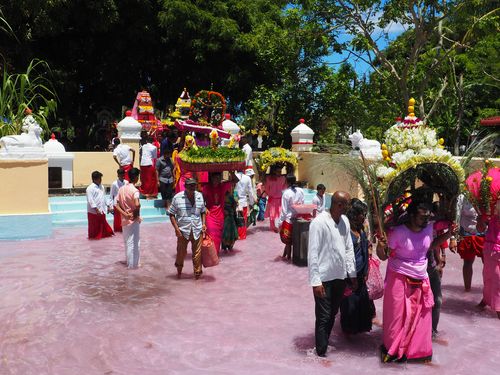
Cavadee in Port Louis follows a structured sequence that combines preparation, temple-based rites, and a public procession through the city. Participants begin with a period of ritual preparation that includes fasting and physical discipline. On the day of the event, they gather in temples where priests perform preliminary rites such as blessings and the consecration of ritual objects.
The procession forms the central phase. Participants leave the temple in an organized movement and proceed along a predefined route. The progression is continuous, with occasional pauses for ritual actions. The sequence concludes at a destination temple, where final offerings are made and the ritual cycle is completed. The entire process is organized as a progression from preparation to fulfillment.
Ritual objects and symbolic elements
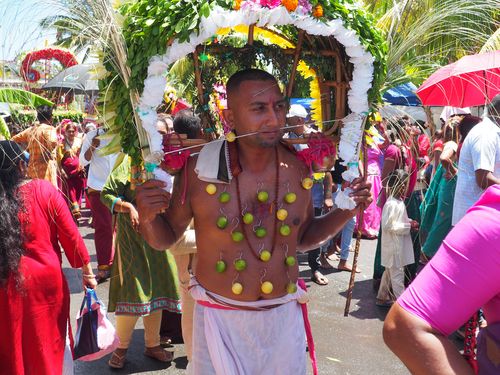
The most visible element of Cavadee is the kavadi itself, a structure carried by participants. It consists of a lightweight frame, often made of wood or metal, decorated with flowers, fabric, and symbolic elements associated with the deity Murugan. These structures vary in size and complexity, from simple forms to elaborate constructions with multiple arches.
Participants also carry offerings, most commonly containers filled with milk intended for ritual deposition at the temple. In some cases, body adornments such as small spears or hooks are used, applied according to specific rules. These objects are not decorative additions but integral components of the ritual system, each carrying a defined symbolic meaning.
Gestures and embodied practices
The actions performed during Cavadee are codified and visibly structured. Participants walk barefoot along the route, maintaining a steady rhythm that reflects both physical endurance and ritual discipline. Movements are generally controlled and repetitive, reinforcing the continuity of the procession.
Certain participants engage in acts of bodily devotion, including forms of piercing that are carried out under supervision. These practices follow established procedures and are integrated into the overall ritual framework. Additional gestures include the handling of offerings, brief pauses for prayer, and coordinated movements guided by accompanying participants. Each action corresponds to a specific stage within the ritual sequence.
Sound environment and musical components
The procession is accompanied by a defined sound environment composed of percussion and vocal expressions. Drums provide a continuous rhythmic structure that regulates the pace of movement. The tempo remains consistent over long distances, allowing participants to maintain coordination.
Chants and vocal recitations are performed collectively, often based on repeated phrases. These elements are synchronized with the rhythm of the procession and contribute to the cohesion of the group. The sound environment is directly linked to the ritual process, marking transitions and reinforcing the collective dimension of the event.
Spaces and spatial organization
Cavadee in Port Louis involves a combination of fixed and mobile spaces. Temples serve as starting and ending points, as well as locations for preparation and completion of the rites. These spaces are arranged to accommodate the gathering of participants and the performance of ritual actions.
Urban streets are temporarily transformed into processional routes. The itinerary is defined in advance, allowing for controlled movement through the city. The spatial organization ensures continuity between different stages of the ritual, linking temple spaces with the procession. The use of public space is structured and regulated, enabling the event to unfold within an active urban environment.
Participants and distribution of roles
The central participants are the kavadi bearers, who undertake the main ritual commitments. Their actions are supported by accompanying individuals who assist with movement, provide logistical support, and ensure the continuity of the procession. These support roles include helping to stabilize the structures and facilitating transitions during pauses.
Priests operate within the temple spaces, where they perform ritual actions and oversee the correct execution of ceremonies. Additional participants are involved in organizing the route, managing the flow of movement, and maintaining coordination. Observers are present along the route, contributing to the overall scale of the event without directly engaging in the ritual acts.
Distinctive observable features
Cavadee in Port Louis is characterized by the integration of a highly structured ritual within a dense urban setting. The combination of continuous movement, codified gestures, and visible ritual objects creates a coherent system that can be observed throughout the procession.
The coexistence of individual acts of devotion and collective organization is a defining feature. Each participant’s engagement is framed within a broader structure that ensures continuity and coordination. The transformation of urban space into a processional environment, combined with the presence of standardized ritual elements, gives the event a clearly defined and recognizable form.
 Links to the main sections of the site