

 Français (France)
  Nederlands (nl-NL)
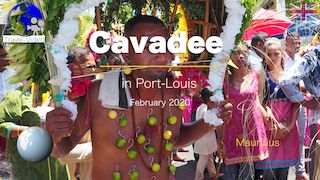
 00:00 • intro | 00:20 • Thaipoosam cavadee • the legend | 02:18 • Cavadee in Port-Louis | 02:27 • at Vishnu Kchetre Mandir temple | 03:20 • the departure of the procession | 08:41 • Arrival at Arulmigu Sockalingum Meenatchee Ammen Tirukkovil (Kaylasson) temple.
Personal creation from visual material collected during my trip Mauritius • Cavadee / Reunion (2020)
Map of places or practices in Port Louis on this site
• Use the markers to explore the content •
Thaipoosam Cavadee in Port Louis: ritual practice and urban procession
A major religious celebration within the Mauritian capital
In Port Louis, the capital of Mauritius, the Thaipoosam Cavadee festival stands as a significant expression of Hindu religious practice, particularly within the Tamil community. The event temporarily reshapes the urban environment, as streets, temples, and public spaces become part of a structured ritual sequence. Rather than remaining confined to a single location, the celebration unfolds across the city, linking fixed places of worship with movement through the urban fabric.
The video presents this interaction between ritual and space by showing both the preparation within temples and the progression of the procession through the streets. It highlights how the city accommodates and reflects a religious practice that is both collective and highly codified.
Mythological background and ritual expression
Thaipoosam Cavadee is rooted in a devotional tradition dedicated to the god Murugan. The associated legend provides the framework for the ritual actions performed during the festival. Participants engage in acts of devotion that often involve physical commitment, including the carrying of elaborately constructed structures known as cavadee.
In Port Louis, this practice takes on a visible and organized form. The gathering at the Vishnu Kchetre Mandir Temple marks one of the preparatory stages of the procession. This site serves as a point where participants assemble, perform initial rites, and prepare for the journey ahead.
Processional route and key religious sites
The movement of the procession constitutes a central component of the Cavadee. Participants follow a defined route through the city, transforming urban streets into a ceremonial pathway. This progression links multiple locations and gives structure to the sequence of ritual actions.
A key stage in this movement is the arrival at the Kaylasson Temple, formally known as Arulmigu Sockalingum Meenatchee Ammen Tirukkovil. This temple functions as a major destination where the ritual continues in a more स्थिर setting. The relationship between departure points, routes, and arrival sites creates a spatial framework that organizes the entire event.
Cultural context and organization of the celebration
The Cavadee in Mauritius reflects the adaptation of Tamil religious traditions within a specific urban and social context. In Port Louis, the organization of the festival requires coordination between participants, religious authorities, and the urban environment. The preparation of ritual objects, the timing of the procession, and the management of movement all contribute to the structured nature of the event.
The cavadee themselves play a central role in the visual dimension of the celebration. These structures, carried by participants, combine symbolic meaning with a strong physical presence. Their design and use are directly linked to the devotional act, reinforcing the connection between individual commitment and collective expression.
A visual approach that clarifies ritual dynamics
The videos on this site provide a detailed reading of this complex event. By relying on carefully selected and animated photographs, they allow for close observation of gestures, objects, and spatial relationships. This approach slows down the perception of the procession, making it easier to identify its different phases and components.
The sequence of images follows the progression of the event, from preparation in the temple to movement through the city and arrival at the final destination. This structured visual narrative highlights the continuity of the ritual and the transformation of urban space into a ceremonial setting.
A ritual embedded in contemporary urban life
Thaipoosam Cavadee in Port Louis illustrates how a religious tradition can be fully integrated into a modern urban environment. It brings together fixed architectural spaces, processional routes, and collective participation within a coherent framework.
Further exploration through the detailed pages dedicated to the temples and the Cavadee tradition provides additional insight into the meanings and practices associated with this event.
Links to related pages
Audio Commentary Transcript
Shiva the Destroyer is part of the Trinity of Supreme Hindu Gods with Brahma the Creator and Vishnu the Protector. With his wife Parvati, he lives in Mount Kailash, and they had among other children, Ganesh, the elephant-headed god and Karttikeya, the leader of the divine armies, also named Subramania, known as Muruga or Murugan in the South. of India and in the countries of the Indian diaspora, such as Mauritius and Reunion.
The sage Agatthyar asked his disciple Indunban to carry the two mountains surrounding Mount Kaylash to the south of the country.
On the way to Idumban the god Muruga turned into a child and decided to complicate his task by increasing his burden.
Indumban not knowing that this child was in fact the god Muruga got angry and hit the child.
Muruga got angry and killed Indumban.
Learning of this incident, the sage Agattiyâr implored Muruga to forgive him.
The Cavadee procession is preceded by 10 days of fasting for the participants.
Many devotees wear small copper pots on their heads. These jars contain milk which will be offered to the god Muruga on arrival at the temple, the goal of the procession.
One of Muruga's attributes is his scepter which bears the name "vel". Some of the faithful prick their skin with silver needles. These needles recall the shape of the vel de Muruga.
The vel is also placed in the mouth (sometimes crossing the cheeks and the tongue) to materialize the participant's wish for silence.
Sometimes the vel is also replaced by hooks to which lemons are attached.
Distribution of panakon (refreshing drink made from lime and tamarind)

Music:
- - YouTube video library - Action Time
- - YouTube video library - At Odds
- - - Cavadee Song
- - YouTube video library - Desert Caravan
- - YouTube video library - Epic Battle Speech
- - YouTube video library - People Watching
Disclaimer: Despite its appropriateness, copyright issues prevent the use of mauritian traditional music in "Thaipoosam Cavadee (Kavadi) 2020, Port-Louis • Mauritius (EN)", hence the use of royalty-free music. Despite our careful selection, some might regret this decision, which is necessary to avoid potential lawsuits. Although difficult, this decision is the only viable solution.


