

 Français (France)
  Nederlands (nl-NL)
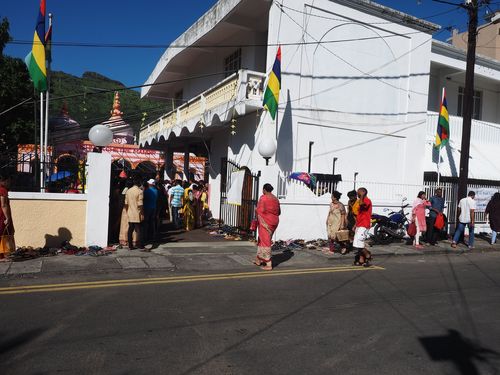
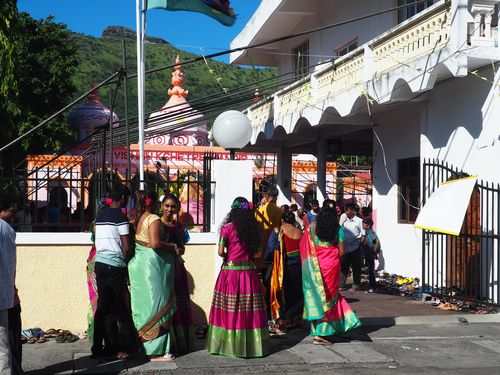
 The Vishnu Kchetre Mandir Temple is a Hindu place of worship located in Port Louis, on the island of Mauritius. It serves as a reference point for the local Hindu community and contributes to the religious diversity of the capital. Dedicated to the god Vishnu, it forms part of a broader set of spiritual practices rooted in Indian traditions present on the island. The temple regularly hosts ceremonies, collective prayers, and religious celebrations. Through its role, it contributes to the social and cultural life of the city while supporting the transmission of religious practices within the community.

Monument profile
Vishnu Kchetre Mandir Temple
Monument category: Hindu Temple
Monument family: Temple
Monument genre: Religious
Cultural heritage: Hindu
Geographic location: Port Louis • Rodrigues • Mauritius
Construction period: 19th century AD
• Links to •
• List of videos about Port Louis on this site •
Thaipoosam Cavadee (Kavadi) 2020, Port-Louis • Mauritius (EN)
Vishnu Kchetre Mandir Temple in Port Louis: Historical Development and Community Role
Foundation and Community Context
The Vishnu Kchetre Mandir Temple was established in Port Louis as part of the organization of Hindu worship within the urban environment of the Mauritian capital. Its creation is directly linked to the presence of a Hindu community seeking a structured place for religious practice. Dedicated to Vishnu, the temple was conceived as a stable setting for collective rituals, regular prayers, and religious observances. Specific details concerning the exact date of construction and the individuals or groups responsible remain limited in available documentation. However, its establishment reflects a localized initiative aimed at consolidating religious activities within a defined space.
Institutional Role and Religious Practice
From its early use, the temple functioned as a central location for organizing religious life at the community level. Activities carried out within the temple include recurring ceremonies and collective gatherings structured around devotional practices. The site supports the continuity of ritual practices by providing a fixed location for their performance. Its role extends beyond individual worship to include coordinated religious events, reinforcing its position within the community. The temple also serves as a framework for maintaining ritual regularity and transmitting practices within a stable institutional setting.
Adaptations and Continuity of Use
Over time, the Vishnu Kchetre Mandir Temple has undergone adjustments related to the evolving needs of its users. These changes primarily concern internal organization and the capacity to accommodate larger numbers of participants during major religious events. There is no documented evidence of major interruptions in its religious function or of any significant change in its primary use. The continuity of its role as a place of worship has remained intact, with modifications focused on maintaining functionality rather than altering its purpose. This stability indicates a sustained alignment between the structure and the needs of its community.
Current Role and Cultural Presence
The temple continues to operate as an active religious site within Port Louis. It remains regularly used for ceremonies, prayers, and community gatherings, maintaining its relevance in contemporary religious life. Its presence contributes to the visibility of Hindu practices within the urban fabric and reflects the ongoing role of religious institutions in structuring social interactions. The temple is maintained through continuous use, with no indication of formal preservation programs beyond routine upkeep associated with its function. Its current status illustrates a continuity of purpose grounded in active participation rather than historical transformation.
Global Historical Context
The development of Hindu temples in Port Louis corresponds to a broader pattern of Indian diaspora communities establishing religious institutions in the nineteenth century. During this period, similar places of worship emerged in regions such as the Caribbean, East Africa, and Southeast Asia. These developments occurred alongside the expansion of colonial trade networks and labor migrations. The creation of such temples reflects the transfer and adaptation of religious practices beyond the Indian subcontinent.
Spatial organization and architectural characteristics of the Vishnu Kchetre Mandir Temple in Port Louis
Site placement and overall layout
The Vishnu Kchetre Mandir Temple is positioned within a dense urban setting in Port Louis, where limited plot size directly influences its architectural configuration. The building occupies a compact footprint, resulting in a vertically emphasized composition rather than a horizontally extended plan. Access is provided through a clearly defined entrance aligned with the main axis of the structure, establishing a direct visual and spatial progression toward the inner sanctum.
The plan is organized along a linear sequence of spaces, allowing a gradual transition from the exterior threshold to the sacred interior. Circulation follows a straightforward path, minimizing lateral dispersion and reinforcing the central axis. The spatial arrangement reflects a hierarchy in which the innermost area holds the highest symbolic and functional importance.
Construction techniques and structural system
The structural system relies primarily on reinforced concrete combined with masonry infill, a solution adapted to urban construction practices in Port Louis. This choice allows for durability under local climatic conditions while enabling the creation of vertical elements and articulated façades. Load-bearing walls provide stability, while horizontal slabs define interior levels and ceiling planes.
The construction method emphasizes efficiency and structural continuity. Surfaces are finished with plaster or render, ensuring protection against humidity and facilitating maintenance. The use of modern construction techniques supports the integration of decorative components without compromising structural integrity. No complex structural innovations are documented, but the system is consistent with functional requirements and spatial constraints.
Materials and surface treatment
Materials employed in the temple include concrete, plastered masonry, and painted finishes, all contributing to the building’s visual identity. Exterior walls are coated with colored render, enhancing visibility within the surrounding urban fabric. The selection of materials reflects a balance between durability and aesthetic expression, with finishes designed to withstand environmental exposure.
Interior surfaces are treated with greater variation, particularly in areas close to the sanctum. Painted decorations, relief elements, and sculptural details are concentrated in these zones, creating a visual emphasis that corresponds to the spatial hierarchy. The contrast between relatively plain structural surfaces and more elaborate decorative areas reinforces the distinction between functional and sacred spaces.
Internal spatial organization and ritual areas
The interior is structured around the main sanctum, where the representation of Vishnu is installed. This space is set apart either by elevation or by architectural framing, marking it as the focal point of the building. In front of the sanctum lies an open prayer hall designed to accommodate collective worship. Its dimensions are adapted to the scale of the building, ensuring sufficient capacity while maintaining spatial coherence.
Secondary spaces are arranged in direct relation to the central axis. Areas designated for offerings, preparation, and ritual support functions are positioned along the periphery of the main hall. Their integration within the overall layout allows for continuous circulation without disrupting the primary spatial sequence. The organization reflects a clear functional distribution, with each zone defined by its proximity to the sanctum.
Architectural features and modifications
The façade incorporates a vertical superstructure above the entrance, forming a symbolic marker that distinguishes the building within the street. This element introduces a vertical emphasis that contrasts with the otherwise compact volume of the temple. Openings are limited in size and number, reinforcing the enclosed character of the interior spaces.
Decorative features include painted motifs and sculptural representations associated with Vishnu, primarily located on the façade and near the sanctum. These elements are applied rather than structurally integrated, allowing for adaptation or renewal over time.
Modifications to the building have focused on improving internal arrangements and accommodating increased attendance. These changes include adjustments to interior partitions and enhancements to finishes, without altering the fundamental structure. The absence of major structural interventions indicates a stable architectural configuration aligned with its original functional requirements.