

 Français (France)
  Nederlands (nl-NL)
 00:00 • intro | 00:31 • The banks of the Ganges | 03:23 • Buddha Smriti Park | 04:11 • Golghar, historic granary | 05:02 • Gurdwara Patna Sahib or Har Mandir
Personal creation from visual material collected during my trip Buddhist India • Sikkim • Bihar • West Bengal (2017)
Map of places or practices in Patna on this site
• Use the markers to explore the content •
Patna: a riverside city and a major center of Sikh tradition
A capital shaped by the Ganges and historical continuity
Located along the banks of the Ganges, Patna occupies a significant position in the historical and geographical landscape of northern India. As the capital of the state of Bihar, it developed in close relationship with the river, which continues to structure both its physical layout and its social life. The city combines administrative functions with a long-standing cultural and religious presence, reflecting successive layers of history.
Patna is also an important center for Sikhism, as it is associated with the birth of Guru Gobind Singh, the tenth Sikh Guru. The presence of the Gurdwara Patna Sahib gives the city a particular religious significance, attracting pilgrims from across India and beyond. The video brings together these different aspects by linking riverfront activity, urban spaces, and key monuments into a coherent exploration of the city.
The Ganges, urban life, and major landmarks
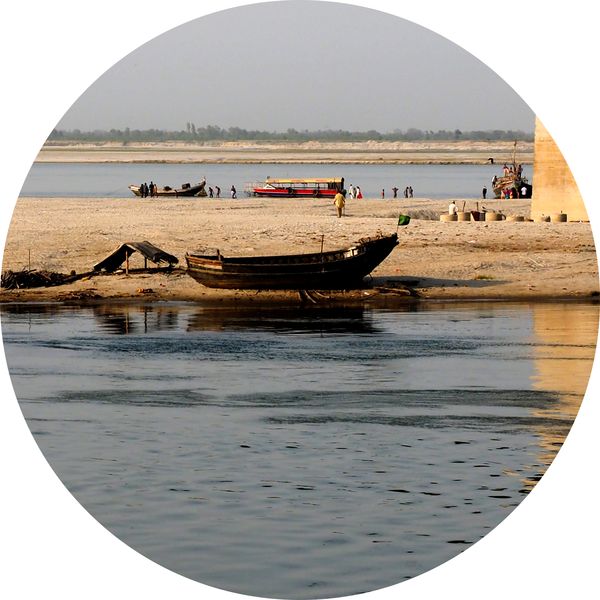
The sequences along the Ganges reveal a space that is both natural and deeply integrated into everyday life. The river functions as a place of gathering, ritual activity, and social interaction. The presence of crowds along its banks highlights its central role in the organization of the city and in the rhythm of daily practices.
Buddha Smriti Park introduces a different dimension. This contemporary site, dedicated to the memory of the Buddha, reflects the broader religious diversity of the region. It provides a structured and symbolic space within the urban environment, illustrating how modern commemorative landscapes can coexist with older traditions.
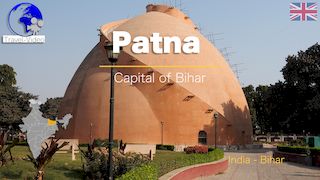
Golghar, a large granary dating from the colonial period, represents another aspect of Patna’s history. Its distinctive form and utilitarian origin recall the economic concerns of a period marked by the need to manage food supplies. Today, it stands as a recognizable landmark within the city, linking past functions with present-day urban identity.
The Gurdwara Patna Sahib, also known as Har Mandir, forms the spiritual core of the video. This major Sikh shrine is closely associated with Guru Gobind Singh and holds a central place in Sikh religious life. Its architecture and organization reflect the principles of Sikh worship, while its presence within the city underscores Patna’s importance as a pilgrimage destination.
A city at the crossroads of multiple traditions
Patna’s history extends back to ancient times, when it was known as Pataliputra and served as a capital for major Indian empires. Although much of the visible urban fabric dates from later periods, this long historical continuity remains an essential part of the city’s identity.
The coexistence of different religious traditions is another defining feature. Sikhism plays a prominent role through the Gurdwara Patna Sahib, but Buddhism and Hinduism are also present, as illustrated by Buddha Smriti Park and the practices observed along the Ganges. This diversity reflects the broader cultural complexity of the region.
Architecturally, Patna presents a varied landscape, ranging from modern constructions to colonial-era buildings and religious monuments. This diversity results from the city’s evolving role as both a political and economic center, shaped by successive historical transformations.
A clearer understanding through visual sequencing
The videos on this site rely largely on carefully selected and animated photographs, offering a gradual and structured approach to complex environments. In the case of Patna, this method makes it possible to connect diverse elements such as riverbanks, public spaces, and religious monuments.
The progression of images highlights the relationships between these different locations. The Ganges, the urban fabric, and the major landmarks appear as interconnected components rather than isolated features. Alternating between detailed views and broader perspectives helps clarify both scale and spatial organization.
This approach also enhances the understanding of how the river shapes the city and how different sites are integrated into its overall structure. The result is a coherent reading of Patna as a layered and dynamic environment.
A city where daily life and spirituality intersect
Patna is defined by the interaction between active urban life and enduring religious practices. The presence of the Ganges, the activity of public spaces, and the significance of major religious sites all contribute to this balance.
Exploring these elements offers insight into the functioning of a city where historical continuity and contemporary life coexist. For a deeper understanding of the places presented, the detailed pages dedicated to each site provide additional context on their history, architecture, and cultural significance.






Audio Commentary Transcript
On the banks of the Ganges, in the North of India, in the state of Bihar, extends one of the oldest continuously inhabited cities of the world since it was founded in 490 before our era by the king of Magadha.
Less ancient and less known than Varanasi (Benares) Patna is the 18th most important city in India by its population. It has nearly 2 million inhabitants.
Patna is also one of the holy places of Sikkhism because it saw the birth of the 10th and last Guru Gobind Singh on December 22, 1666.
Patna is the capital of the state of Bihar, one of the poorest in the Indian confederation.
The Golghar in Patna is an granary 29 meters high built at the end of the 18th century to store grain to alleviate the perpetual famines that the region was experiencing.
It was to be the first in a long series but unfortunately in the end it was the only one to see the light of day.
It was the subject of a restoration plan at the beginning of the 21st century
The Patna gurdwara is one of the 5 Takht (seat of Sikh authority) and therefore one of the 5 most important temples of Sikhism.
The founding guru (Guru Nanak) is said to have spent 3 months in the city of Patna and the last guru (Guru Gobind Singh) was born there in 1666.
Music:
- - YouTube video library - A Fallen Cowboy
- - YouTube video library - Butterflies in Love
- - YouTube video library - Island Coconuts
- - Bhai Sarabjeet Singh (Inde) - Hazoori Ragi - Sa Rasna Dhan Dhan Hai
Disclaimer: Despite its appropriateness, copyright issues prevent the use of indian traditional music in "Patna, sacred city of Sikhism • Bihar, India ", hence the use of royalty-free music. Despite our careful selection, some might regret this decision, which is necessary to avoid potential lawsuits. Although difficult, this decision is the only viable solution.


