

 Français (France)
  Nederlands (nl-NL)
 Of Islamic tradition, (with additional Hindu and Buddhist influence), the Bengal Sultanate ruled for approximately 224 years, ± between 1352 and 1576 over all or part of East India and North India, during the Medieval Period.
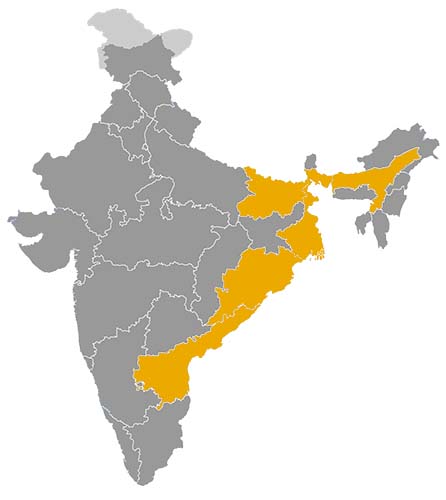
This map illustrates the maximum territory that the Bengal Sultanate Dynasty had reached at its height, covering the current regions of Bihar and Odisha in India. Its main purpose is to provide a visual aid to understand the geographical extent of this dynasty. However, it's important to note that the contemporary borders of these regions may not necessarily coincide with the historical territories.
The Bengal Sultanate and its role in the history of India
A major regional power in eastern India
The Bengal Sultanate was one of the most important regional states of medieval India. It emerged in the fourteenth century in the eastern part of the subcontinent, in a region corresponding broadly to present day Bangladesh and West Bengal, with influence at times extending toward Bihar, Assam, Tripura, Arakan and Orissa. Its geographical position, at the meeting point of the Ganges delta, riverine trade routes and the Bay of Bengal, gave it a distinctive political and economic character.
The sultanate was not ruled by a single continuous dynasty. Several ruling houses and groups succeeded one another, including the Ilyas Shahi, the house of Raja Ganesha, the restored Ilyas Shahi, the Habshi rulers, the Hussain Shahi, the Muhammad Shahi and the Karrani. Despite these dynastic changes, Bengal retained a strong regional identity and often acted as an autonomous power distinct from Delhi and later from the Mughal Empire.
The assertion of independence from Delhi
The rise of the Bengal Sultanate was closely linked to the weakening of the Delhi Sultanate’s control over its distant provinces. Bengal had long been difficult for northern rulers to govern directly because of its distance, river systems, climate and strong local centres. Shamsuddin Ilyas Shah played a decisive role by unifying the main political centres of Bengal, including Lakhnauti, Satgaon and Sonargaon.
This unification created a durable independent sultanate. The rulers of Bengal expressed their sovereignty through coinage, royal titulature, monumental construction and diplomatic activity. Their independence was not merely symbolic. The sultanate maintained armies, collected revenue, governed a wide deltaic region and resisted repeated attempts by external powers to dominate it.
Bengal therefore became a major example of regional state formation in medieval India. Its history shows how provinces once linked to Delhi could become independent political centres with their own administrative traditions and cultural priorities.
Political relations with neighbouring powers
The Bengal Sultanate occupied a strategic position between northern India, the eastern Himalayan frontier, Orissa and the Bay of Bengal. This location shaped its relations with neighbouring states. To the west, it had to watch the ambitions of Delhi, Bihar based powers, the Sur rulers and later the Mughals. To the south west, it competed with Orissa, especially for influence over frontier regions and routes toward the coastal plains.
The sultanate also maintained contact with Assam, Tripura and Arakan. These relations could involve warfare, diplomacy, tribute, trade and cultural exchange. The eastern and south eastern frontiers were not fixed borders in the modern sense. They were zones of interaction where local chiefs, hill polities, riverine routes and military campaigns influenced the balance of power.
Under the Hussain Shahi rulers, Bengal reached one of its most prominent political and cultural phases. Later, under the Karrani dynasty, it remained a significant Afghan ruled state before being defeated by the Mughals. The fall of Daud Khan Karrani in 1576 marked the end of Bengal’s independence as a sultanate and opened the way for its gradual incorporation into the Mughal imperial system.
An economy shaped by rivers, agriculture and trade
The economic importance of the Bengal Sultanate was considerable. The delta of the Ganges and Brahmaputra was one of the most fertile regions of the subcontinent. Rice cultivation, riverine transport, textile production and local markets formed the foundation of its wealth. The dense river network allowed goods, people and administrative orders to move across a landscape that was difficult to control by land alone.
Bengal was also connected to maritime trade through the Bay of Bengal. Its ports linked the region with the Indian Ocean world, including South East Asia, the Islamic world and other parts of the subcontinent. Textiles, agricultural products, metals, horses, luxury goods and other commodities circulated through these networks.
This prosperity supported urban centres, military power, court culture and religious patronage. It also made Bengal attractive to external powers. The later Mughal interest in Bengal was strongly connected to the region’s agricultural and commercial wealth.
A distinctive cultural and architectural synthesis
The Bengal Sultanate produced a distinctive regional culture. Its architecture is especially important. Because high quality building stone was less available in much of Bengal, brick became the dominant material. Mosques, tombs and gateways developed forms adapted to the local environment, including curved cornices, richly decorated façades and compact plans suited to the humid deltaic climate.
This architecture combined Islamic forms with regional building traditions. It did not simply imitate Delhi or Persian models. Instead, it created a recognisably Bengali style that reflected local materials, craftsmanship and aesthetic preferences.
The sultanate also contributed to the development of Bengali literary and cultural identity. The Hussain Shahi period is often associated with patronage of literature and a relatively open cultural atmosphere. The rulers governed a society in which Muslims, Hindus, local rural communities, merchants and landholders all played important roles. Their authority therefore required adaptation to a diverse social landscape.
A lasting legacy in eastern Indian history
The Bengal Sultanate was a major force in the history of India because it combined political independence, economic prosperity and cultural originality. It transformed Bengal from a distant province into a powerful regional state. It controlled one of the richest agricultural regions of the subcontinent, participated in maritime and inland trade, and created a distinctive architectural and cultural legacy.
Although the sultanate eventually lost its independence to the Mughals, its historical importance remained. The Mughal Empire inherited a region already shaped by centuries of regional statecraft, urban development and commercial vitality. In the broader history of India, the Bengal Sultanate stands as one of the clearest examples of how a regional power could develop a strong political identity while contributing deeply to the cultural and economic life of the subcontinent.
The geographical expansion of the Bengal Sultanate in eastern India
A deltaic power centred on Bengal
The Bengal Sultanate developed in one of the most distinctive geographical environments of medieval India. Its core territory corresponded broadly to historical Bengal, including much of present day Bangladesh and parts of eastern India, especially West Bengal. The region was shaped by the Ganges, Brahmaputra and Meghna river systems, whose channels formed fertile agricultural lands, internal routes of movement and natural barriers against outside conquest.
The sultanate emerged as an independent power in the fourteenth century, when Shamsuddin Ilyas Shah unified the main political centres of Bengal. These included Lakhnauti in the northwest, Satgaon in the western delta and Sonargaon in the east. This unification was essential because Bengal had often been divided between different governors, local powers and regional centres. By bringing these areas under one authority, the sultans created a strong eastern state that could resist the ambitions of Delhi and later the Mughals.
Northwestern Bengal and the frontier with northern India
The northwestern part of Bengal was one of the most politically important zones of the sultanate. Cities such as Lakhnauti, Pandua and later Gaur served as capitals or major centres of administration. Their location allowed the rulers to control access between Bengal, Bihar and the wider Ganges plain.
This frontier had great strategic importance. It was the main route through which armies from northern India could enter Bengal. For this reason, the sultans had to maintain strong positions in western and northwestern Bengal. Control of this region helped protect the independence of the sultanate from Delhi, the Sur rulers and eventually the Mughal Empire.
At the same time, the western frontier allowed Bengal to influence neighbouring regions. The sultans sometimes extended their authority or military activity toward Bihar, although control there was often contested. The relationship with powers based in Bihar was therefore a mixture of rivalry, defensive concern and occasional expansion.
Eastern Bengal and the role of Sonargaon
Eastern Bengal formed another essential part of the sultanate’s territory. Sonargaon was a major political, commercial and administrative centre. It controlled routes toward the Brahmaputra basin, the eastern delta, Tripura, Assam and the Bay of Bengal. Its inclusion within the sultanate gave Bengal a wide territorial reach and strengthened the unity of the delta.
This eastern zone was rich but difficult to govern. Rivers, wetlands, forests and shifting settlements made direct control challenging. Authority depended on urban centres, military outposts, fiscal networks and agreements with local elites. The sultans could not always impose uniform administration across the eastern frontier, but they maintained enough influence to make Bengal a major power in the region.
The expansion toward eastern Bengal also brought the sultanate into contact with Tripura, Assam and other frontier polities. These relations involved warfare, diplomacy, tribute, trade and cultural exchange. The borderlands were fluid and often shaped by local rulers as much as by the sultans themselves.
Southern relations with Orissa
To the southwest, the Bengal Sultanate bordered Orissa, one of its most important neighbours and rivals. The dynasties of Orissa, especially the Gajapati rulers, controlled a powerful coastal kingdom with strong religious and political centres. The frontier between Bengal and Orissa was therefore a major zone of conflict and negotiation.
The sultans of Bengal sought to extend influence toward the southern delta and the northern parts of Orissa. These campaigns were motivated by strategic, economic and political interests. Control of the frontier could provide access to coastal routes, trade corridors and fertile territories. It also limited the ability of Orissa to challenge Bengal’s southern border.
Under the Hussain Shahi rulers, Bengal’s influence reached one of its strongest phases. Later, the Karrani dynasty also projected power toward Orissa. Nevertheless, domination over this region remained contested. Orissa was not simply absorbed into Bengal for a long period. Instead, it formed a frontier where two regional powers competed for prestige and control.
Arakan, the Bay of Bengal and maritime contacts
The Bengal Sultanate was not only an inland riverine state. Its position near the Bay of Bengal gave it access to maritime networks. Ports and river mouths connected Bengal with the Indian Ocean world, including South East Asia, the Islamic world and coastal regions of eastern India.
Arakan, located to the southeast along the coast, was especially important. Relations between Bengal and Arakan included trade, political influence, cultural contact and occasional conflict. The coastal and deltaic geography made these interactions natural. Bengal’s eastern and southeastern orientation placed it within a wider maritime world, not only within the political geography of the Indian subcontinent.
This maritime dimension strengthened Bengal’s economy and gave its rulers access to commercial routes beyond their land frontiers. It also made the sultanate important in exchanges across the Bay of Bengal.
Territorial limits and Mughal conquest
Despite its wealth and regional power, the Bengal Sultanate faced structural limits. Its territory was vast, riverine and difficult to administer uniformly. Frontier zones such as Assam, Tripura, Arakan, Orissa and Bihar were often areas of influence rather than permanently controlled provinces.
The final phase of the sultanate was dominated by Afghan rulers of the Karrani dynasty. They maintained Bengal’s independence for a time and extended influence toward Orissa, but they faced growing Mughal pressure from the west. The defeat of Daud Khan Karrani in 1576 marked the end of Bengal’s independent sultanate and began the gradual incorporation of the region into the Mughal Empire.
A geographical legacy of rivers, frontiers and regional power
The geographical expansion of the Bengal Sultanate was shaped by the delta. Its power rested on the control of rivers, fertile lands, cities, ports and frontier zones. From Lakhnauti, Pandua, Gaur, Satgaon and Sonargaon, the sultans governed a region that linked northern India, eastern India and the Bay of Bengal.
This geography made Bengal wealthy and difficult to conquer, but also exposed it to constant frontier pressures. Relations with Bihar, Orissa, Assam, Tripura, Arakan and the Mughals were deeply influenced by this territorial structure. The Bengal Sultanate was therefore not a compact land empire, but a flexible and powerful regional state whose influence depended on the mastery of waterways, agricultural wealth and strategic borderlands.
The ruling families and groups of the Bengal Sultanate generally succeeded one another without lasting parallel sovereign branches. The Sur connected period mainly corresponds to external domination or administration before the restoration of autonomous Bengali rule.
Ilyas Shahi family
- Shamsuddin Ilyas Shah (1342–1358) • He unified Lakhnauti, Satgaon and Sonargaon, founding an independent Bengali sultanate.
- Sikandar Shah (1358–1390) • He consolidated Bengal’s independence from Delhi and built the great Adina Mosque.
- Ghiyasuddin Azam Shah (1390–1411) • He maintained the prestige of the sultanate and developed external diplomatic relations.
- Saifuddin Hamza Shah (1411–1413) • His brief reign opened a period of dynastic fragility.
- Nasiruddin Muhammad Shah (1413) • Known mainly from coins, he appears to have ruled very briefly.
- Shihabuddin Bayazid Shah (1413–1414) • He ruled briefly before the disturbances linked to the rise of Raja Ganesha.
- Alauddin Firuz Shah I (1414) • He ruled for a very short time before Raja Ganesha seized power.
- Raja Ganesha (1414–1415, 1416–1418, de facto rule) • A powerful Hindu lord, he took control of Bengal and temporarily interrupted sultanate continuity.
- Jalaluddin Muhammad Shah (1415–1416, 1418–1433) • The converted son of Raja Ganesha, he ruled as sultan and restored Islamic legitimacy.
- Shamsuddin Ahmad Shah (1433–1435) • His unstable reign preceded the restoration of the Ilyas Shahi.
Restored Ilyas Shahi family
- Nasiruddin Mahmud Shah I (1435–1459) • He restored the dynasty and strengthened central authority.
- Ruknuddin Barbak Shah (1459–1474) • His reign was marked by military activity and the important role of African officers.
- Shamsuddin Yusuf Shah (1474–1481) • He ruled during a period of prosperity and religious building.
- Sikandar Shah II (1481) • He ruled very briefly before being removed.
- Jalaluddin Fateh Shah (1481–1487) • The last effective ruler of this line, he was overthrown during the rise of the Habshi.
Habshi period
- Shahzada Barbak (1487) • He ruled briefly after the collapse of Ilyas Shahi authority.
- Saifuddin Firuz Shah (1487–1489) • He attempted to consolidate power amid rival military factions.
- Nasiruddin Mahmud Shah II (1489–1490) • His very short reign illustrates the instability of this phase.
- Shamsuddin Muzaffar Shah (1490–1494) • The last Habshi ruler, he was overthrown by Alauddin Husain Shah.
Hussain Shahi family
- Alauddin Husain Shah (1494–1519) • He founded a new dynasty and brought the sultanate to a period of political and cultural strength.
- Nasiruddin Nasrat Shah (1519–1533) • He maintained Bengal’s power and patronised an active court.
- Alauddin Firuz Shah II (1533) • He ruled very briefly before being replaced.
- Ghiyasuddin Mahmud Shah (1533–1538) • The last sultan of this line, he was defeated by Sher Shah Suri.
Sur connected administration
- Khidr Khan (1539–1541, Sur governor) • He governed Bengal under Sur authority and briefly tried to assert autonomy.
- Qazi Fazilat (1541–1545, Sur governor) • He administered Bengal without restoring full Bengali sovereignty.
- Muhammad Khan Sur (1545–1554, governor then autonomous claimant) • He strengthened his regional power and prepared a new independence.
Muhammad Shahi family
- Shamsuddin Muhammad Shah (1554–1555) • Muhammad Khan Sur adopted this royal name when he proclaimed Bengal’s independence.
- Ghiyasuddin Bahadur Shah II (1555–1561) • He continued the restoration of Bengali authority.
- Ghiyasuddin Jalal Shah (1561–1563) • His brief reign maintained dynastic continuity in an unstable context.
- Ghiyasuddin Bahadur Shah III (1563–1564) • The last ruler of this line, he preceded the Karrani seizure of power.
Karrani family
- Taj Khan Karrani (1564–1566) • He founded the last major Afghan dynasty of the Bengal Sultanate.
- Sulaiman Khan Karrani (1566–1572) • He strengthened the state, shifted the centre of power to Tanda and extended influence toward Orissa.
- Bayazid Khan Karrani (1572) • He ruled briefly after the death of Sulaiman Khan Karrani.
- Daud Khan Karrani (1572–1576) • The last independent sultan of Bengal, he was defeated by the Mughals.