Français (France)
  Nederlands (nl-NL)
 Of Islamic tradition, (with additional Hindu influence), the Bahmani dynasty ruled for approximately 180 years, ± between 1347 and 1527 over all or part of South India and West India, during the Medieval Period.
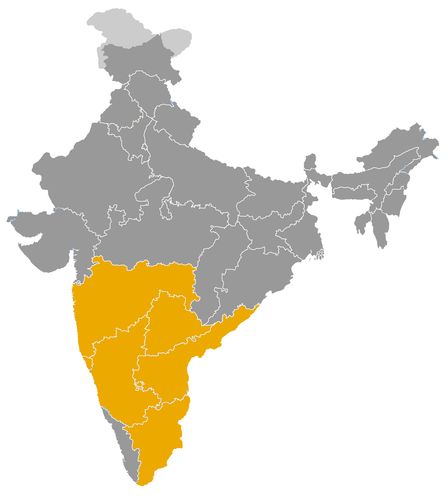
This map illustrates the maximum territory that the Bahmani Dynasty had reached at its height, covering the current regions of Goa, Karnataka, Maharashtra, Tamil Nadu and Telangana in India. Its main purpose is to provide a visual aid to understand the geographical extent of this dynasty. However, it's important to note that the contemporary borders of these regions may not necessarily coincide with the historical territories.
The Bahmani Dynasty: Its Place and Role in the History of India
The Bahmani Dynasty, which ruled much of the Deccan between 1347 and 1527, occupies a central place in the history of medieval India. Founded by Ala-ud-Din Bahman Shah after his successful revolt against the Delhi Sultanate, it became the first major independent Islamic kingdom in the Deccan. Over nearly two centuries, the Bahmani rulers transformed the political landscape of southern India while fostering remarkable cultural achievements and encouraging economic prosperity. Their legacy extended well beyond the dynasty itself, influencing the successor Deccan Sultanates and shaping the historical identity of the region.
The Rise of an Independent Deccan Power
The establishment of the Bahmani Sultanate marked a turning point in Indian history. Before its foundation, much of the Deccan remained under the influence of the Delhi Sultanate. The creation of an independent kingdom allowed the region to develop its own political institutions and strategic priorities.
Initially governed from Gulbarga, and later from Bidar after 1425, the Bahmani state gradually expanded across large parts of present-day Karnataka, Maharashtra, Telangana, and Andhra Pradesh. Its rulers built a centralized administration capable of governing a vast and culturally diverse territory. Provincial governors administered regional affairs while remaining accountable to the sultan, creating an effective balance between central authority and local governance.
The Bahmani rulers also invested heavily in military organization. A professional army, fortified cities, and strategically located strongholds enabled the dynasty to defend its frontiers while competing with powerful neighboring kingdoms, particularly the Vijayanagara Empire.
Political Influence in Medieval India
Politically, the Bahmani Dynasty played a decisive role in establishing the Deccan as an independent center of power. For almost two centuries, it prevented the political dominance of northern Indian kingdoms from extending across the entire subcontinent.
One of the defining characteristics of Bahmani diplomacy was its ability to balance military conflict with pragmatic alliances. The prolonged rivalry with the Vijayanagara Empire dominated much of southern Indian politics, particularly over the fertile Raichur Doab. Although warfare was frequent, periods of diplomacy and negotiated peace also occurred, demonstrating the political sophistication of both states.
The Bahmani administration introduced lasting institutional reforms. The kingdom was divided into provinces governed by appointed officials, while revenue collection and judicial administration became increasingly organized. These administrative structures later influenced the five Deccan Sultanates that emerged following the fragmentation of the Bahmani state during the late fifteenth and early sixteenth centuries.
The dynasty also maintained diplomatic and commercial relations with Persia, Central Asia, and neighboring Indian kingdoms, strengthening its international standing while encouraging the circulation of scholars, merchants, and craftsmen.
Cultural Achievements and Intellectual Exchange
The cultural legacy of the Bahmani Dynasty remains one of its greatest contributions to Indian history. The Bahmani court became an important center of learning where Persian, Turkish, Arab, and Indian traditions interacted and evolved into a distinctive Deccan culture.
Persian served as the principal language of administration and literature, yet local languages also flourished. The emergence of Dakhani Urdu reflected the interaction between Persian vocabulary and indigenous linguistic traditions, laying the foundations for a unique literary culture that would continue to develop under later Deccan rulers.
The Bahmani sultans actively patronized poets, scholars, theologians, and artists. Their courts attracted intellectuals from Persia and Central Asia while also encouraging local talent. This exchange of ideas stimulated advances in literature, philosophy, calligraphy, and the decorative arts.
Architecture flourished under Bahmani patronage. Monuments such as the Jama Masjid of Gulbarga, the Bahmani royal tombs, the Bidar Fort, and numerous palaces and madrasas illustrate a sophisticated architectural style combining Persian design principles with Indian craftsmanship. The extensive use of domes, arches, intricate stone carving, and glazed tile decoration became characteristic features of Deccan architecture.
The dynasty also supported the spread of Sufism throughout the region. Influential saints such as Hazrat Khwaja Bande Nawaz Gaisu Daraz promoted spiritual dialogue and contributed to a climate of religious coexistence that characterized much of the Deccan during this period.
Economic Development and Commercial Prosperity
Economic growth formed another pillar of Bahmani power. The kingdom occupied a strategic position between northern and southern India, allowing it to control important overland trade routes while benefiting from access to ports along the western coast.
Agriculture remained the foundation of the economy. The rulers invested in irrigation systems, reservoirs, and water management projects that significantly increased agricultural productivity, particularly in the fertile Krishna and Godavari river basins. Crops such as cotton, rice, cereals, and spices generated substantial revenues for the state.
Trade expanded rapidly under Bahmani rule. Commercial exchanges linked the Deccan with Persia, Arabia, East Africa, and Southeast Asia. Horses, textiles, precious stones, metals, spices, and luxury goods circulated through thriving markets that stimulated urban development across the kingdom.
Mining also contributed to economic prosperity. The diamond-producing regions associated with Golconda became valuable sources of wealth, supporting royal finances and enhancing the dynasty's prestige.
The growth of commerce encouraged the development of cities, artisan guilds, and manufacturing industries, particularly in textiles, metalworking, ceramics, and luxury craftsmanship.
Enduring Legacy
Although the Bahmani Sultanate eventually fragmented into the Deccan Sultanates of Bijapur, Golconda, Ahmadnagar, Bidar, and Berar, its influence remained profound. These successor states inherited its administrative institutions, military traditions, artistic achievements, and cultural outlook.
Today, the Bahmani Dynasty is recognized as one of the principal architects of the medieval Deccan. Its political innovations, economic development, architectural monuments, and cultural synthesis shaped the history of southern India for centuries. By establishing a stable and prosperous kingdom that successfully blended diverse traditions, the Bahmani rulers created a legacy that continues to occupy an important place in the historical and cultural heritage of India.
The Geographical Expansion of the Bahmani Dynasty in India: Territorial Growth and Relations with Neighboring Kingdoms
The Bahmani Dynasty, founded in 1347 by Ala-ud-Din Bahman Shah, emerged as the first major independent Islamic kingdom in the Deccan after breaking away from the Delhi Sultanate. During nearly two centuries of rule, the Bahmani Sultanate expanded across vast territories in southern India, establishing itself as one of the dominant political powers of the medieval period. Its geographical expansion not only shaped the political map of the Deccan but also influenced diplomatic, military, and commercial relations with neighboring dynasties. The strategic control of fertile agricultural regions, fortified cities, and major trade routes enabled the Bahmani rulers to maintain their influence while competing with rival kingdoms.
The Foundation of the Bahmani Territory
The Bahmani Sultanate was established with Gulbarga, now known as Kalaburagi in Karnataka, as its first capital. This location offered both defensive advantages and access to important communication routes across the Deccan Plateau. The newly established kingdom initially occupied territories formerly administered by the Delhi Sultanate, allowing the Bahmani rulers to inherit an administrative framework while developing an independent political identity.
As the dynasty consolidated its authority, its territory expanded across much of present-day Karnataka, Maharashtra, Telangana, and parts of Andhra Pradesh. The Deccan Plateau provided natural defensive barriers while also containing fertile agricultural lands capable of supporting a growing population and a large standing army.
In 1425, Sultan Ahmad Shah I transferred the capital from Gulbarga to Bidar. This move reflected the increasing territorial reach of the kingdom and positioned the administrative center closer to the eastern regions of the empire. Bidar soon developed into a flourishing political, cultural, and architectural center that symbolized the maturity of Bahmani rule.
Territories Controlled During Their Reign
At the height of its power, the Bahmani Sultanate controlled an extensive territory extending from the western coast toward the eastern Deccan. Major cities under Bahmani authority included Gulbarga, Bidar, Bijapur, Daulatabad, Berar, and large portions of what would later become Golconda.
The fertile Krishna and Godavari river basins represented some of the kingdom's most valuable possessions. These agricultural regions supplied cereals, cotton, and other crops that formed the economic backbone of the state. Irrigation projects further increased agricultural productivity and strengthened the kingdom's financial resources.
The Bahmani rulers also sought to dominate strategic commercial corridors linking northern and southern India. Their influence extended toward important ports on the western coast, including Dabhol and, at various periods, Goa. These maritime connections facilitated commercial exchanges with Persia, Arabia, East Africa, and Southeast Asia, integrating the Deccan into wider international trade networks.
The region surrounding Golconda became another valuable asset because of its mineral wealth, particularly its famous diamond mines. Control of these resources enhanced the financial capacity of the Bahmani state and contributed to its political prestige.
Relations with the Vijayanagara Empire
The geographical expansion of the Bahmani Dynasty inevitably brought it into conflict with the Vijayanagara Empire, its principal rival in southern India. The two powers competed for control of strategic frontier regions, most notably the Raichur Doab, the fertile territory situated between the Krishna and Tungabhadra rivers.
This region changed hands several times during prolonged military campaigns. Although warfare dominated much of their relationship, periods of negotiation and temporary peace also occurred when political circumstances required compromise. The rivalry stimulated military innovation on both sides and contributed to the construction of impressive fortifications throughout the Deccan.
Despite repeated conflicts, cultural exchanges continued across political boundaries. Architectural techniques, artistic traditions, and commercial practices circulated between the two kingdoms, illustrating the complex relationship between military rivalry and cultural interaction.
Relations with Other Neighboring Powers
The Bahmani rulers also maintained diplomatic and military relations with several other regional powers. Although the dynasty had originated through rebellion against the Delhi Sultanate, contacts with northern Islamic kingdoms remained important throughout its history. Alliances occasionally emerged when mutual interests outweighed political competition.
To the northwest, the Bahmani rulers interacted with the Sultanates of Gujarat and Malwa. These relationships combined commercial cooperation with strategic diplomacy. Trade with Gujarat proved particularly valuable, facilitating the exchange of luxury goods, horses, textiles, and skilled artisans.
Persia occupied a special place in Bahmani foreign relations. Numerous scholars, administrators, architects, and military officers arrived from the Persian world, enriching the intellectual and cultural life of the kingdom. These connections strengthened diplomatic prestige while introducing administrative methods, artistic styles, and architectural traditions that became characteristic of Bahmani civilization.
The Political Impact of Territorial Expansion
The geographical growth of the Bahmani Sultanate transformed the Deccan into a major political center independent from northern India. Its territorial cohesion allowed the rulers to establish a centralized administration capable of governing diverse populations across a vast region.
The provincial administrative system created by the Bahmanis became an important model for later Deccan states. Even after the decline of the dynasty during the late fifteenth century, its successor states inherited many of its governmental institutions, military structures, and fiscal practices.
Territorial expansion also promoted urbanization. Cities such as Bidar and Gulbarga became centers of administration, education, religion, and commerce, attracting merchants and scholars from across Asia.
Legacy of Bahmani Territorial Expansion
The fragmentation of the Bahmani Sultanate in the early sixteenth century gave rise to the five Deccan Sultanates of Bijapur, Golconda, Ahmadnagar, Bidar, and Berar. Although politically independent, these successor states inherited much of the territorial organization, administrative experience, and cultural identity established by the Bahmani rulers.
Today, the geographical legacy of the Bahmani Dynasty remains visible through its forts, mosques, palaces, and historic cities scattered across the Deccan. The kingdom's strategic expansion not only reshaped medieval India's political geography but also encouraged centuries of cultural interaction, commercial prosperity, and architectural achievement. Through its territorial vision and diplomatic adaptability, the Bahmani Dynasty laid the foundations for one of the most influential periods in the history of southern India.
The rulers of the Bahmani dynasty consistently bore the title of Sultan throughout the existence of the Bahmani Sultanate. The chronology is generally well established, although a few succession events remain subject to minor scholarly debate.
- Ala-ud-Din Bahman Shah (1347–1358) • Founded the Bahmani Sultanate after breaking away from the Delhi Sultanate.
- Muhammad Shah I (1358–1375) • Consolidated the new state and campaigned repeatedly against Vijayanagara.
- Mujahid Shah (1375–1378) • Continued the wars with Vijayanagara before being assassinated.
- Da'ud Shah (1378) • Reigned briefly before being overthrown.
- Muhammad Shah II (1378–1397) • Presided over a period of stability, prosperity and cultural development.
- Ghiyath-ud-Din Tahmatan Shah (1397) • Deposed shortly after his accession.
- Shams-ud-Din Da'ud Shah II (1397) • Ruled for only a few months before being replaced.
- Taj-ud-Din Firuz Shah (1397–1422) • One of the greatest Bahmani rulers and a patron of learning and the arts.
- Ahmad Shah I Wali (1422–1436) • Moved the capital to Bidar and strengthened the prestige of the sultanate.
- Ala-ud-Din Ahmad Shah II (1436–1458) • Maintained the sultanate despite increasing internal rivalries.
- Humayun Shah (1458–1461) • His reign was marked by harsh repression and internal unrest.
- Nizam-ud-Din Ahmad III (1461–1463) • Minor sultan who ruled under a regency.
- Muhammad Shah III Lashkari (1463–1482) • Reigned during the prominence of the famous vizier Mahmud Gawan.
- Mahmud Shah Bahmani II (1482–1518) • Witnessed the gradual decline of central authority and the rise of provincial governors.
- Ahmad Shah II (1518–1521) • Exercised largely nominal authority.
- Ala-ud-Din Shah III (1521–1522) • Held only limited effective power.
- Wali-ullah Shah (1522–1526) • Ruled during the fragmentation of the sultanate.
- Kalim-ullah Shah (1526–1527) • Last Bahmani Sultan before the state disappeared in favour of the Deccan Sultanates.
 Links to the main sections of the site