Français (France)
  Nederlands (nl-NL)
 Of Hindu tradition, the Wodeyar dynasty ruled for approximately 551 years, ± between 1399 and 1950 over all or part of South India, during the Medieval Period and the Colonial Period.
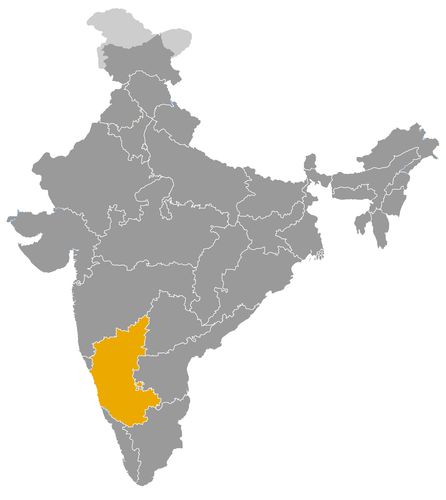
This map illustrates the maximum territory that the Wodeyar Dynasty had reached at its height, covering the current regions of Karnataka in India. Its main purpose is to provide a visual aid to understand the geographical extent of this dynasty. However, it's important to note that the contemporary borders of these regions may not necessarily coincide with the historical territories.
The Wodeyar Dynasty and Its Role in the History of India
A Regional Dynasty at the Centre of Mysore’s Historical Identity
The Wodeyar dynasty, also written Wadiyar, played a major role in the history of southern India through its long association with the kingdom of Mysore. Emerging in the late fourteenth century in the region of present-day southern Karnataka, the Wodeyars gradually transformed a local principality into one of the most important regional states of the Deccan. Their history extends from the period of Vijayanagara influence to the age of princely states under British paramountcy.
The importance of the Wodeyars lies not in the creation of a pan-Indian empire, but in their durability, adaptability and contribution to the political and cultural formation of Mysore. Their dynasty survived major historical shifts: the decline of Vijayanagara, the rise of military rule under Haidar Ali and Tipu Sultan, British intervention, princely restoration and finally the integration of Mysore into the Indian Union.
Local Chiefs within the Vijayanagara Political Order
The early Wodeyar rulers were local chiefs or rajas whose authority developed within the wider political world of the Vijayanagara Empire. During this first phase, Mysore was not yet a fully independent kingdom. The Wodeyars operated within a hierarchy in which Vijayanagara remained the dominant imperial power in much of South India.
This connection was important for the early legitimacy of the dynasty. By ruling under the influence of Vijayanagara, the Wodeyars gained political recognition while consolidating their authority in the Mysore region. The weakening of Vijayanagara after the sixteenth century created new opportunities. Local ruling houses across South India began to assert greater autonomy, and the Wodeyars were among those who benefited from this changing balance of power.
Raja Wodeyar I marked an important stage in this process. By strengthening Mysore and making Srirangapatna a key political centre, he helped transform the dynasty from a local lineage into a more autonomous regional monarchy.
The Formation of an Autonomous Mysore Kingdom
During the seventeenth century, the Wodeyars developed Mysore into a significant kingdom in southern India. Their authority expanded across parts of southern Karnataka, and the state gradually acquired stronger military, fiscal and administrative institutions. Rulers such as Kanthirava Narasaraja Wodeyar I, Dodda Devaraja Wodeyar and Chikka Devaraja Wodeyar contributed to this consolidation.
Chikka Devaraja Wodeyar was especially important for the development of royal administration and state finance. Under his rule, Mysore became more organized and better able to compete with neighbouring powers. The kingdom’s strategic position between the Deccan plateau, Tamil regions and the Western Ghats gave it both opportunities and vulnerabilities.
Mysore had to deal with several neighbouring powers, including Nayak states, Maratha forces, the Nizam of Hyderabad and regional chiefs. The Wodeyar state therefore developed in a political environment marked by shifting alliances, military rivalry and territorial competition.
Dynastic Marginalization under Haidar Ali and Tipu Sultan
The eighteenth century brought a major change in the balance of power within Mysore. The Wodeyars remained dynastic rulers, but effective authority passed increasingly to ministers and military commanders. Haidar Ali, a powerful military leader, eventually became the real master of Mysore while the Wodeyar king retained only nominal status.
Under Haidar Ali and his son Tipu Sultan, Mysore became one of the strongest military powers in southern India. This phase is sometimes described as the Sultanate of Mysore, especially under Tipu Sultan, who exercised direct sovereignty and adopted a distinct royal and Islamic political identity. However, this period should not be confused with Wodeyar rule in the strict sense. The Wodeyars were politically marginalized, though their dynastic legitimacy remained useful enough to be revived after Tipu Sultan’s defeat.
The wars between Mysore and the British East India Company made the kingdom a central actor in the struggle for power in southern India. Mysore’s resistance to British expansion under Haidar Ali and Tipu Sultan greatly shaped the later colonial order in the region.
Restoration and Princely Rule under British Paramountcy
After the death of Tipu Sultan in 1799, the British restored the Wodeyars to the throne of Mysore. Krishnaraja Wodeyar III became maharaja, but the restored kingdom was no longer fully sovereign. Mysore became a princely state under British paramountcy, with its external relations controlled by the British.
This restoration allowed the dynasty to survive, but it also transformed its political role. The Wodeyars became rulers of an internally administered princely state rather than independent monarchs. Between 1831 and 1881, the British directly administered Mysore while maintaining the maharaja. After the Rendition of 1881, princely administration was restored, giving the dynasty a renewed role in internal governance.
Under Chamarajendra Wodeyar X and especially Krishnaraja Wodeyar IV, Mysore became known as one of the most progressive princely states in British India. Administrative reform, education, irrigation, industry and public works became central to its modern identity.
Economic Modernization and State Development
The economic role of the Wodeyar dynasty was particularly important in the modern princely period. Mysore’s economy was based on agriculture, forest resources, sandalwood, silk, coffee, mining and later industrial development. The state invested in irrigation projects, roads, railways, electricity and public institutions.
The development of the Krishna Raja Sagara dam became one of the symbols of Mysore’s modernization. Hydroelectric power, urban planning and industrial initiatives helped distinguish Mysore from many other princely states. These developments did not remove social inequalities, but they contributed to a stronger regional economy and a reputation for efficient governance.
Cultural Patronage and the Mysore Court
The Wodeyars were major patrons of culture in southern India. Their court supported Kannada and Sanskrit literature, Carnatic music, painting, dance and courtly ritual. Mysore became a major cultural centre, especially through its palace traditions, the Dasara festival and royal patronage of artists and scholars.
The dynasty contributed to the formation of a distinctive Mysore identity, combining Kannada culture, Hindu kingship, court ceremony and modern education. The Mysore Palace and associated artistic traditions remain among the most visible symbols of this legacy.
A Lasting Legacy in Karnataka and India
The Wodeyar dynasty’s historical importance rests on continuity and adaptation. From local chiefs under Vijayanagara, they became autonomous kings, then nominal rulers during the rise of Haidar Ali and Tipu Sultan, and finally maharajas of a modern princely state.
Their legacy is especially visible in the political and cultural development of Karnataka. By shaping Mysore as a centre of administration, art, education and economic modernization, the Wodeyars played a durable role in regional Indian history. Their importance lies in the long-term formation of a strong southern Indian state whose institutions, culture and memory continued beyond the end of princely rule.
The Geographic Expansion of the Wodeyar Dynasty in India
A Local Power Rooted in the Mysore Region
The Wodeyar dynasty, also written Wadiyar, originated in the region of Mysore in present-day southern Karnataka. Its earliest territorial base was limited, centred on Mysore town and nearby settlements on the southern Deccan plateau. During this first phase, the Wodeyars were not independent monarchs in the full sense, but local chiefs or rajas operating within the wider political order of the Vijayanagara Empire.
This initial location was strategically important. Mysore lay between the highlands of Karnataka, the Tamil-speaking plains to the southeast, the Western Ghats to the west and the routes leading toward the Malabar Coast. This position allowed the Wodeyars to control inland communications and gradually build a regional power base. Their early expansion was slow and depended on the weakening of larger imperial authority, especially after the decline of Vijayanagara influence in southern India.
Territorial Autonomy after the Decline of Vijayanagara
The weakening of Vijayanagara after the sixteenth century created opportunities for several regional powers. The Wodeyars were among the local dynasties that used this political fragmentation to assert greater autonomy. A major step was the acquisition of Srirangapatna under Raja Wodeyar I. Located on an island in the Kaveri River, Srirangapatna offered strong defensive advantages and became a major political and military centre.
Control of Srirangapatna changed the geography of Wodeyar power. The dynasty was no longer restricted to the immediate Mysore area. It could now dominate a wider section of the Kaveri basin, one of the most important agricultural and strategic zones in southern Karnataka. The riverine landscape helped support cultivation, military movement and communication with neighbouring regions.
This expansion also changed Mysore’s relations with surrounding powers. The Wodeyars had to deal with former Vijayanagara successor states, Nayak rulers, local chiefs and competing regional lineages. Their authority grew through warfare, diplomacy, fortification and the incorporation of subordinate elites.
Expansion across Southern Karnataka
During the seventeenth century, the Wodeyar kingdom expanded across parts of southern Karnataka. Rulers such as Kanthirava Narasaraja Wodeyar I, Dodda Devaraja Wodeyar and Chikka Devaraja Wodeyar strengthened the military and administrative structure of Mysore. Their territories included fertile plains, fortified towns, forested zones and routes leading toward the Western Ghats.
Chikka Devaraja Wodeyar was particularly significant for territorial consolidation. Under his rule, Mysore became a stronger regional state with improved revenue organization and more effective control over conquered areas. The kingdom’s expansion was not merely a matter of occupying land. It involved integrating local chiefs, collecting revenue, controlling forts and securing trade routes.
The Wodeyar state stood at the meeting point of several political worlds. To the east and southeast were the Tamil regions and the remnants of Nayak power. To the north were Maratha interests and other Deccan forces. To the west lay access toward the Malabar Coast, whose commercial value was considerable because of spice trade and maritime connections.
Frontier Relations with the Tamil, Deccan and Malabar Regions
The expansion of Mysore brought the Wodeyars into frequent contact with neighbouring dynasties and regional powers. The Tamil country was important because of its economic resources, temple centres and political traditions inherited from the Nayaks. Mysore’s southeastern frontier was therefore a zone of both exchange and rivalry.
To the north, Mysore faced pressure from Maratha forces and other Deccan powers. The Marathas often claimed tribute or influence over territories in the southern Deccan, which created recurring tension. The Nizam of Hyderabad also became an important player in the broader political balance of the eighteenth century.
The western frontier was equally significant. The Western Ghats separated Mysore from the Malabar Coast, but the passes through the mountains connected the kingdom with Kerala. Control over these passages had military and economic importance. They offered access to pepper-producing regions, coastal trade and contacts with European companies active on the western coast.
The Wider Mysore State under Haidar Ali and Tipu Sultan
Although Haidar Ali and Tipu Sultan were not Wodeyar rulers, their period is essential for understanding the territorial history of Mysore. In the eighteenth century, the Wodeyars became nominal kings while effective power passed to Haidar Ali and later to Tipu Sultan. During this phase, Mysore expanded far beyond the older Wodeyar heartland.
The Mysore state under Haidar Ali and Tipu Sultan controlled or contested large parts of Karnataka, areas of Tamil Nadu, parts of Kerala and important routes toward the Malabar Coast. This expansion made Mysore one of the strongest military powers in southern India. It also brought the state into direct conflict with the Marathas, the Nizam of Hyderabad and the British East India Company.
The struggle for control of the Malabar Coast was especially important. Access to the coast meant access to maritime trade, European diplomacy and strategic resources. The territorial ambitions of Mysore were therefore not only regional but also commercial and military.
Territorial Reduction after the Fall of Tipu Sultan
The defeat and death of Tipu Sultan at Srirangapatna in 1799 radically changed the geography of Mysore. The British restored the Wodeyars to the throne, but the kingdom was greatly reduced. Territories that had been controlled or claimed under Haidar Ali and Tipu Sultan were redistributed among the British, the Nizam of Hyderabad and allied powers.
The restored Wodeyar state became a princely state under British paramountcy. Its territory was again centred mainly on southern and central Karnataka. The kingdom no longer had freedom to conduct independent military expansion or external diplomacy. Its borders became more stable, but its sovereignty was limited.
A Stable Princely State in Southern India
During the nineteenth and early twentieth centuries, Mysore remained one of the most important princely states of British India. Its territory included much of the southern Karnataka region, with Mysore and later Bangalore as major administrative and urban centres. Although the Wodeyars were restricted by British authority, they retained significant internal administrative control, especially after the Rendition of 1881.
This stable territorial framework encouraged economic and administrative development. Irrigation, roads, railways, education, industry and urban planning all benefited from the relative security of the princely state. The geographic identity of Mysore became closely linked with the later formation of modern Karnataka.
A Territorial Legacy Shaping Karnataka
The geographic history of the Wodeyar dynasty shows a long transformation from a small local principality into a major regional kingdom and finally into a modern princely state. Its heartland remained Mysore and southern Karnataka, but its influence at different times reached toward the Kaveri basin, the Tamil regions, the Western Ghats and the Malabar Coast.
This expansion shaped Mysore’s relations with neighbouring powers. It brought rivalry with Nayak states, Marathas, the Nizam, Mysore’s military rulers, European companies and the British colonial state. Through these territorial changes, the Wodeyars helped define the political geography of southern Karnataka and left a durable legacy in the history of South India.
The Wodeyars, or Wadiyars, ruled Mysore first as local chiefs connected to Vijayanagara and later as autonomous kings. In the 18th century, Haidar Ali and then Tipu Sultan held effective power, while the Wodeyars were reduced to a nominal role. After Tipu Sultan’s defeat in 1799, the British restored the Wodeyars in a princely state under their paramountcy.
Chiefs and rajas of Mysore under Vijayanagara influence
- Yaduraya Wodeyar (c. 1399 to 1423 CE) • Traditional founder of the dynasty, he established Wodeyar rule at Mysore as a local chief under Vijayanagara authority.
- Chamaraja Wodeyar I (c. 1423 to 1459 CE) • He consolidated the family principality in the Mysore region.
- Timmaraja Wodeyar I (c. 1459 to 1478 CE) • He maintained local Wodeyar authority within the framework of Vijayanagara suzerainty.
- Chamaraja Wodeyar II (c. 1478 to 1513 CE) • His reign belongs to the phase of regional continuity before Mysore’s more autonomous rise.
- Chamaraja Wodeyar III (c. 1513 to 1553 CE) • He ruled during a period of relative stability under Vijayanagara influence.
- Timmaraja Wodeyar II (c. 1553 to 1572 CE) • He ruled as Vijayanagara authority began to weaken in southern India.
- Chamaraja Wodeyar IV (c. 1572 to 1576 CE) • His brief reign preceded the stronger political rise of Raja Wodeyar I.
- Bettada Chamaraja Wodeyar V (c. 1576 to 1578 CE) • He was a transitional ruler in the Mysore succession.
Wodeyar kings of autonomous Mysore
- Raja Wodeyar I (1578 to 1617 CE) • He strongly asserted Mysore’s autonomy and shifted the centre of power toward Srirangapatna.
- Chamaraja Wodeyar VI (1617 to 1637 CE) • He maintained the kingdom’s expansion and consolidation after Raja Wodeyar I.
- Raja Wodeyar II (1637 to 1638 CE) • His reign was very short and brought no major political change.
- Kanthirava Narasaraja Wodeyar I (1638 to 1659 CE) • He strengthened Mysore’s army, coinage and royal authority.
- Dodda Devaraja Wodeyar (1659 to 1673 CE) • He expanded the kingdom’s influence and consolidated its military institutions.
- Chikka Devaraja Wodeyar (1673 to 1704 CE) • Powerful king of Mysore, he developed administration, finance and territorial expansion.
- Kanthirava Narasaraja Wodeyar II (1704 to 1714 CE) • His reign was marked by the growing influence of ministers and military commanders.
- Krishnaraja Wodeyar I (1714 to 1732 CE) • He ruled during a period when effective authority increasingly shifted toward court officials.
- Chamaraja Wodeyar VII (1732 to 1734 CE) • His short reign confirmed the weakness of direct royal authority.
Nominal Wodeyar kings during the rise of Haidar Ali and Tipu Sultan
- Krishnaraja Wodeyar II (1734 to 1766 CE) • He ruled nominally while ministers and later Haidar Ali acquired effective power in Mysore.
- Nanjaraja Wodeyar (1766 to 1772 CE, nominal rule) • He retained the royal title under the political domination of Haidar Ali.
- Chamaraja Wodeyar VIII (1772 to 1776 CE, nominal rule) • He was a titular ruler during the military ascendancy of Haidar Ali.
- Chamaraja Wodeyar IX (1776 to 1796 CE, nominal rule) • He retained limited dynastic status under Haidar Ali and then Tipu Sultan.
Wodeyar restoration and princely state under British paramountcy
- Krishnaraja Wodeyar III (1799 to 1868 CE) • Restored after the fall of Tipu Sultan, he ruled as maharaja under strong British supervision, with direct British administration from 1831.
- Chamarajendra Wodeyar X (1868 to 1894 CE) • Maharaja of Mysore, he exercised effective rule after the restoration of princely administration in 1881.
- Krishnaraja Wodeyar IV (1894 to 1940 CE) • Reforming maharaja, he made Mysore one of the most administratively advanced princely states of British India.
- Jayachamarajendra Wodeyar (1940 to 1950 CE) • Last sovereign maharaja of Mysore, he acceded to the Indian Union in 1947 and remained head of the state until the constitutional reorganization of 1950.
 Links to the main sections of the site