Français (France)
  Nederlands (nl-NL)
 Of Islamic tradition, (with additional Hindu influence), the Malwa Sultanate ruled for approximately 161 years, ± between 1401 and 1562 over all or part of Central India, North India and West India, during the Medieval Period.
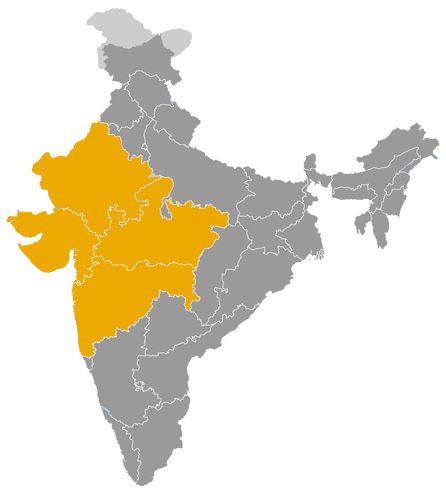
This map illustrates the maximum territory that the Malwa Sultanate Dynasty had reached at its height, covering the current regions of Gujarat, Madhya Pradesh, Maharashtra and Rajasthan in India. Its main purpose is to provide a visual aid to understand the geographical extent of this dynasty. However, it's important to note that the contemporary borders of these regions may not necessarily coincide with the historical territories.
The Malwa Sultanate and its role in the history of India
A regional state at the centre of medieval India
The Malwa Sultanate occupied an important place in the political, cultural and economic history of medieval India. It developed in the early fifteenth century on the Malwa plateau, a strategically located region in central India. This territory lay between northern India, Gujarat, Rajasthan and the routes leading toward the Deccan. Because of this position, Malwa became a zone of contact between several political worlds and a frequent arena of rivalry among regional powers.
The sultanate emerged after the weakening of the Delhi Sultanate. Dilawar Khan Ghuri, originally a governor of Malwa, asserted effective independence, and his successor Hoshang Shah consolidated the new state. Later, the Khalji dynasty of Malwa transformed the sultanate into a more powerful regional kingdom. Although it never became an empire on the scale of the Mughals, it played a significant role in shaping the balance of power in western and central India.
Mandu as a political capital and symbol of sovereignty
The identity of the Malwa Sultanate was closely linked to Mandu. Located on a naturally fortified plateau, Mandu offered strong defensive advantages and a commanding position over the surrounding region. The sultans developed it into a royal capital, administrative centre and architectural showcase.
Mandu was not merely a military stronghold. It was also a place where political authority was displayed through buildings, ceremonial spaces and court culture. Palaces, mosques, tombs, reservoirs and pavilions gave visible form to the power of the dynasty. By making Mandu their capital, the rulers of Malwa created a distinctive centre of sovereignty that could rival other regional capitals of medieval India.
This urban development strengthened the legitimacy of the sultans. It showed that Malwa was no longer only a former province of Delhi, but an independent state with its own institutions, elite culture and territorial ambitions.
A political actor between Gujarat, Mewar and Delhi
The political role of the Malwa Sultanate was shaped by its position among powerful neighbours. To the west lay the Gujarat Sultanate, a wealthy maritime and commercial state. To the northwest and north were the Rajput kingdoms, especially Mewar. To the north, Delhi remained an important political reference, even when its direct authority over central India had declined.
Under Mahmud Shah I Khalji, who ruled from 1436 to 1469, Malwa reached a high point of military and diplomatic influence. His reign was marked by campaigns against Mewar and Gujarat, as well as efforts to assert Malwa as a leading power in the region. These conflicts were not only territorial. They concerned prestige, control of forts, access to routes and influence over frontier zones.
The sultanate’s central location was both an advantage and a weakness. It allowed Malwa to intervene in several directions, but it also exposed the kingdom to pressure from several fronts. The state needed constant military readiness and flexible diplomacy to survive among ambitious neighbours.
An inland economy based on agriculture and trade routes
The economy of the Malwa Sultanate was based primarily on its inland position. Unlike Gujarat, whose prosperity depended heavily on maritime trade, Malwa drew strength from agriculture, fortified towns, regional markets and land routes. The plateau was fertile and well placed for commerce moving between northern India, Gujarat, central India and the Deccan.
The sultans benefited from agricultural revenue, market taxes, transit duties and control over towns such as Mandu, Dhar and Ujjain. Ujjain in particular had long religious and commercial significance, while Dhar retained political importance from earlier periods. These centres helped the sultanate maintain an administrative and fiscal structure capable of supporting the army and court.
Malwa’s economy was therefore less international than that of Gujarat, but it was still important. Its wealth came from controlling the routes and resources of a central plateau. This made the sultanate a valuable prize for neighbouring powers and later for the Mughal Empire.
A distinctive cultural and architectural contribution
The cultural impact of the Malwa Sultanate is most visible in its architecture, especially at Mandu. The buildings of this period combine Islamic architectural forms with regional materials, local building practices and a strong awareness of landscape. Large halls, arches, domes, terraces, water structures and elevated pavilions were adapted to the dramatic setting of the plateau.
The tomb of Hoshang Shah, the Jami Masjid and the palatial complexes of Mandu illustrate the artistic ambition of the sultans. These monuments were not only religious or residential structures. They expressed royal legitimacy, courtly refinement and the ability of the state to mobilise skilled labour and technical knowledge.
The court culture of Malwa also became associated with music, poetry and aristocratic life. The later figure of Baz Bahadur, the last independent ruler of Malwa, became linked in memory with the singer Rupmati and with the romantic image of Mandu. Although later tradition may have embellished this story, it reflects the lasting cultural prestige of the sultanate’s capital.
Political decline and incorporation into larger empires
From the early sixteenth century, the Malwa Sultanate weakened under the pressure of internal factionalism and external intervention. Noble factions gained influence, and neighbouring powers exploited the instability. The Gujarat Sultanate temporarily conquered Malwa under Bahadur Shah, showing how vulnerable the kingdom had become when central authority declined.
After periods of restoration and partial autonomy, Baz Bahadur emerged as the last significant independent ruler of Malwa. His defeat by Mughal forces in 1562 ended the effective independence of the sultanate. Malwa was gradually absorbed into the Mughal imperial system, where its strategic location remained highly valuable.
A lasting regional legacy in central India
The Malwa Sultanate was important because it turned a central plateau into a major political and cultural centre. It influenced the relations between Gujarat, Mewar, Delhi and the Deccan, controlled important inland routes and developed Mandu into one of the most remarkable architectural landscapes of medieval India.
Its legacy lies in the combination of strategic geography, regional statecraft, court culture and monumental architecture. In the broader history of India, the Malwa Sultanate represents the vitality of regional powers during the medieval period. It shows how a state of moderate territorial size could exercise influence far beyond its borders by controlling a central crossroads of politics, trade and culture.
The geographical expansion of the Malwa Sultanate in central India
A strategic territory on the Malwa plateau
The Malwa Sultanate developed in one of the most strategically important regions of medieval India. Its core territory lay on the Malwa plateau, mainly in the western part of present day Madhya Pradesh, with influence at times extending toward adjoining areas of Rajasthan and central India. This plateau stood between the Indo Gangetic world to the north, Gujarat to the west, the Rajput states to the northwest and the routes leading toward the Deccan in the south.
The sultanate emerged in the early fifteenth century, when Dilawar Khan Ghuri, formerly governor of Malwa under the Delhi Sultanate, asserted autonomy amid the weakening of Delhi’s authority. The political centre of the new state was eventually established at Mandu, a naturally fortified site that became the capital and principal symbol of Malwa’s territorial identity. From this central base, the rulers of Malwa controlled a network of towns, forts, agricultural lands and transit routes.
Mandu, Dhar and Ujjain as centres of territorial control
The geographical strength of the Malwa Sultanate rested on a group of important urban and fortified centres. Mandu was the most prominent among them. Its position on a plateau made it highly defensible and suitable for a royal capital. It protected the ruling court while also serving as a military and administrative command point.
Dhar and Ujjain also formed part of the sultanate’s territorial framework. Dhar had older political significance and remained relevant as a regional centre. Ujjain, an ancient city with religious, commercial and cultural importance, strengthened the prestige and economic value of the sultanate. Control over these cities allowed the rulers of Malwa to collect revenue, supervise trade routes and maintain authority over surrounding rural districts.
The sultanate’s expansion was therefore not simply a matter of conquering large open territories. It depended on holding strategic nodes. Forts, cities and road junctions gave the rulers influence over wider areas, even when the frontier zones remained contested or only partly controlled.
The western frontier and rivalry with Gujarat
To the west, the Malwa Sultanate bordered the Gujarat Sultanate, one of the wealthiest and most powerful states of western India. This frontier was especially important because it connected the inland plateau of Malwa with the commercial plains and ports of Gujarat. Routes between Mandu, Champaner and the Gujarat interior were economically valuable and politically sensitive.
The rivalry between Malwa and Gujarat shaped much of the sultanate’s western policy. Malwa sought to maintain access to western trade routes and to prevent Gujarat from extending its power too far eastward. Gujarat, in turn, aimed to secure its eastern frontier and control strongholds that could threaten its inland routes. The conquest of Champaner by Mahmud Begada of Gujarat placed additional pressure on Malwa and strengthened Gujarat’s strategic position near the eastern approaches to its territory.
At times this rivalry turned into open conflict. At other times, diplomacy and shifting alliances moderated the competition. The western frontier remained one of the most important zones where Malwa’s geographical ambitions met the limits imposed by a powerful neighbour.
The northern and northwestern margins facing Rajput powers
The northern and northwestern borders of Malwa brought the sultanate into contact with Rajput states, especially Mewar. These regions were marked by forts, hill territories, semi autonomous chiefs and routes connecting Rajasthan with central India. Control in such areas was rarely simple or permanent.
The rulers of Malwa, particularly Mahmud Shah I Khalji, engaged in repeated conflicts with Mewar. These struggles were not only about territorial possession. They also concerned political prestige, influence over frontier chiefs and control of routes between the plateau and Rajasthan. Mewar represented a durable barrier to Malwa’s expansion northward. Its military strength and dynastic prestige made it one of the main powers with which Malwa had to negotiate or fight.
The Rajput frontier also forced Malwa to adopt a flexible strategy. Direct conquest was difficult, and influence often depended on alliances, raids, temporary occupations and intervention in the disputes of neighbouring rulers. This made Malwa an active participant in the wider political balance of western and central India.
Routes toward the Deccan and central India
To the south and southeast, Malwa controlled routes leading toward the Deccan and other parts of central India. These routes were important for military movement, inland trade and communication between northern and southern regions. The sultanate’s position gave it the ability to influence traffic between the north, the Deccan and western India.
However, Malwa did not become a vast southern empire. Its influence toward the Deccan was limited by distance, local resistance and the presence of other regional powers. The sultanate’s strength lay less in deep territorial expansion and more in controlling access points, roads and fortified positions. This made it valuable as a crossroads state, but also exposed it to pressure from several directions.
Territorial instability during the sixteenth century
The territorial cohesion of the Malwa Sultanate weakened during the sixteenth century. Internal factional struggles reduced the authority of the sultans, while neighbouring states exploited the instability. The Gujarat Sultanate under Bahadur Shah conquered Malwa in the 1530s, showing that the sultanate’s strategic position could become a vulnerability when central control declined.
After the period of Gujarati domination, local rulers and military figures attempted to restore or maintain authority in parts of Malwa. Qadir Shah and later Shujaat Khan governed in circumstances shaped by wider regional pressures, including the influence of the Sur rulers. Baz Bahadur, the last notable independent ruler, controlled Malwa from the mid sixteenth century until Mughal expansion ended its autonomy.
Mughal conquest and the lasting importance of Malwa’s geography
In 1562, Mughal forces defeated Baz Bahadur, and Malwa was gradually absorbed into the Mughal Empire. This conquest did not diminish the geographical importance of the region. On the contrary, the Mughals valued Malwa because it helped connect northern India with Gujarat, Rajasthan and the Deccan.
The geographical expansion of the Malwa Sultanate was therefore the expansion of a central plateau power rather than that of a maritime or imperial state. Its rulers controlled Mandu, Dhar, Ujjain and surrounding districts, projected influence toward Gujarat, Rajasthan and the Deccan, and shaped relations with neighbouring dynasties through their command of inland routes and fortified centres. Its location made Malwa powerful, but also exposed it to rivalries that eventually contributed to its political decline.
The Malwa Sultanate was ruled first by the Ghurid line founded by Dilawar Khan and then by the Khalji dynasty of Malwa. The rulers mainly bore the title of sultan, although Dilawar Khan initially governed as a governor who became independent. The regnal dates remain partly indicative, especially for periods of conquest, interruption or restoration.
- Dilawar Khan Ghuri (1401–1406) • A former governor of Malwa, he used the weakening of the Delhi Sultanate to establish independent authority at Mandu.
- Hoshang Shah (1406–1435) • The first ruler formally crowned as sultan of Malwa, he consolidated Mandu as the capital and strengthened the regional state.
- Muhammad Shah Ghuri (1435–1436) • Son of Hoshang Shah, he ruled briefly before being overthrown during a dynastic crisis.
- Mahmud Shah I Khalji (1436–1469) • Founder of the Khalji dynasty of Malwa, he brought the sultanate to major military power and notably fought Mewar and Gujarat.
- Ghiyas ud-Din Shah (1469–1500) • His long reign was associated with the courtly life of Mandu and a period of relative cultural prosperity.
- Nasir ud-Din Shah (1500–1510) • He took power after a succession conflict and continued Khalji rule amid internal tensions.
- Mahmud Shah II Khalji (1510–1531) • His reign was marked by factional struggles, the influence of Medini Rai and interventions by Mewar and Gujarat.
- Bahadur Shah of Gujarat (1531–1537, external domination) • Sultan of Gujarat, he conquered Malwa and temporarily incorporated it into his own kingdom.
- Qadir Shah (1537–1542) • A former local officer, he restored independent authority over part of Malwa after the death of Bahadur Shah.
- Shujaat Khan (1542–1555, governor then autonomous ruler) • He administered Malwa under Sur influence and consolidated regional authority that prepared the rise of his son.
- Baz Bahadur (1555–1562) • The last independent ruler of Malwa, he was defeated by the Mughals and remained known for the court culture associated with Mandu.
 Links to the main sections of the site