

 Français (France)
  Nederlands (nl-NL)
 The Mysuru Palace, located in the city of Mysore in the Indian state of Karnataka, is one of the most prominent historic monuments in southern India. For centuries it served as the official residence of the Wodeyar dynasty, whose rulers played a major role in the political and cultural history of the region. Today the palace functions as an important heritage site and remains one of the most visited landmarks in India. Beyond its former role as a royal residence, it represents a powerful symbol of Mysore’s historical identity and of Karnataka’s cultural heritage, while continuing to play a significant role in major public celebrations and cultural events.
Mysore • Mysuru Palace

Mysore • Mysuru Palace
Mysore • Mysuru Palace
Monument profile
Mysuru Palace
Monument category: Palace
Monument family: Palace and Annexes
Monument genre: Residential
Geographic location: Mysore • Karnataka • India
Construction period: 14th century AD
• Links to •
• Dynasties that contributed to the construction of the monument •

• List of videos about Mysore on this site •
Mysore, Mysuru Palace, Karnataka • India
Mysore, Devaraja market, Karnataka • India
• Sources •
Digital Sources
- Wikipedia: Mysore Palace - A comprehensive page providing an overview of the history, architecture, and cultural events associated with Mysore Palace.
- Encyclopaedia Britannica: Mysore Palace - A reliable source that offers historical information and architectural details about Mysore Palace.
Books and Publications
- Condra, Jill. "The Greenwood Encyclopedia of Clothing through World History, Volume 3, 1800 to the Present." Greenwood Publishing Group, 2008.
- Mitchell, George. "The Hindu Temple: An Introduction to Its Meaning and Forms." University of Chicago Press, 1988.
History of Mysuru Palace in Mysore
Mysuru Palace, located in the city of Mysore in the Indian state of Karnataka, is one of the most significant royal residences in southern India. For several centuries it served as the principal seat of the Wodeyar dynasty, the rulers of the Kingdom of Mysore. The history of the palace reflects broader political developments in the region, including the rise of regional Hindu kingdoms, the intervention of powerful military leaders such as Hyder Ali and Tipu Sultan, the expansion of British colonial influence, and the transformation of princely states during the formation of modern India. Over time the palace evolved through multiple reconstructions, culminating in the monumental structure completed in the early twentieth century.
Political and social context of the palace’s construction
The origins of the Mysuru Palace are closely connected to the rise of the Wodeyar dynasty in the fourteenth century. The Wodeyars established their authority over the Mysore region during a period when southern India was dominated by the powerful Vijayanagara Empire. Initially serving as local governors under imperial authority, the Wodeyars gradually consolidated their influence as the power of Vijayanagara declined in the sixteenth century.
The establishment of a royal palace in Mysore served both political and symbolic purposes. In premodern Indian monarchies, royal residences functioned as administrative centers where court officials, military leaders, and diplomats gathered. They also served as ceremonial spaces where royal authority was publicly displayed through rituals, festivals, and formal audiences.
As the Wodeyars strengthened their control over the region, the palace became an important symbol of dynastic legitimacy. The rulers of Mysore sought to demonstrate their sovereignty through architecture, courtly culture, and patronage of religion and the arts. The palace thus embodied both the administrative structure of the kingdom and the ceremonial authority of the ruling family.
By the seventeenth century, the Wodeyars had transformed Mysore into a stable regional kingdom. The palace complex expanded as successive rulers added structures and ceremonial halls that reflected the growing prestige of the dynasty.
Major historical events affecting the palace
The political history of Mysore changed dramatically in the eighteenth century. During this period, the kingdom came under the influence of two powerful military leaders: Hyder Ali and his son Tipu Sultan. Although the Wodeyars remained nominal rulers, Hyder Ali effectively controlled the administration of the state after rising through the ranks of the Mysorean army.
Under Hyder Ali and Tipu Sultan, Mysore became a major military power in southern India. The kingdom engaged in a series of conflicts known as the Anglo-Mysore Wars against the British East India Company and its allies. These wars reshaped the political landscape of the region.
Tipu Sultan ruled Mysore from 1782 until his death in 1799. During his reign the kingdom developed a centralized administration and pursued alliances with foreign powers, including France, in an attempt to counter British expansion. The defeat of Tipu Sultan in the Fourth Anglo-Mysore War and the fall of Srirangapatna in 1799 marked a turning point in Mysorean history.
After the British victory, the Wodeyar dynasty was restored to the throne under the supervision of the British colonial administration. Mysore became a princely state within the British Indian Empire. Although the maharajas retained internal authority, the British exercised significant influence over the kingdom’s political affairs.
The palace continued to function as the symbolic and administrative center of the state during this period.
Reconstruction after the fire of 1897
One of the most significant events in the history of Mysuru Palace occurred in 1897, when a major fire destroyed the earlier palace structure. The previous building had been constructed largely of wood and was therefore vulnerable to fire. The disaster occurred during a wedding celebration in the royal family.
In response to the destruction, Maharani Kempananjammanni Devi, acting as regent for the young Maharaja Krishnaraja Wodeyar IV, ordered the construction of a new palace that would be more durable and architecturally impressive. The new palace was designed by the British architect Henry Irwin.
Construction began at the end of the nineteenth century and continued for more than a decade. The new building, completed in 1912, reflected both modern engineering methods and the aesthetic ambitions of the Mysorean court. The reconstruction was intended not only to replace the lost palace but also to create a monument that would symbolize the prosperity and stability of the princely state.
Global context during the palace’s reconstruction
The reconstruction of Mysuru Palace occurred during a period of profound change across the world. At the turn of the twentieth century, many monarchies and ruling elites sought to express their authority through monumental architecture.
In Europe, imperial capitals were characterized by grand palaces and ceremonial buildings that symbolized national power. Similar architectural ambitions appeared in Asia and the Middle East, where rulers commissioned palaces and administrative complexes that combined traditional design with modern construction technologies.
In British India, princely states often sought to demonstrate their prestige through architectural patronage. Palaces built during this period frequently incorporated elements of European design alongside local architectural traditions. Mysuru Palace reflects this broader pattern of cultural exchange and political symbolism.
Transformations of the palace over time
Following its completion in the early twentieth century, Mysuru Palace continued to serve as the primary residence and ceremonial center of the Wodeyar dynasty. The palace hosted royal events, diplomatic receptions, and religious ceremonies associated with the court.
The political landscape changed significantly after India gained independence in 1947. The princely states were gradually integrated into the Indian Union. Mysore became part of the modern Indian state structure, and the political authority of the maharajas diminished.
Despite these changes, the royal family retained certain ceremonial privileges and continued to maintain a connection with the palace. Portions of the complex were gradually opened to the public, transforming the palace into a major cultural and historical attraction.
Urban expansion in Mysore during the twentieth century also altered the surroundings of the palace. Once the focal point of a royal capital, the complex now stands within a modern city that has grown around it.
Contemporary role and cultural significance
Today Mysuru Palace is one of the most visited monuments in India and an important symbol of Karnataka’s cultural heritage. The palace functions as both a museum and a ceremonial space, preserving the legacy of the Wodeyar dynasty.
One of the most important events associated with the palace is the annual Dasara festival. This celebration, rooted in centuries-old royal traditions, commemorates the victory of good over evil and honors the goddess Chamundeshwari, the patron deity of Mysore. During the festival the palace becomes the central location for processions, rituals, and public celebrations.
The palace also serves as a powerful symbol of Mysore’s historical identity. Its image appears frequently in representations of the city and the state of Karnataka, reinforcing its status as a landmark of regional heritage.
Preservation and modern challenges
The preservation of Mysuru Palace requires continuous efforts to maintain both its structural integrity and its decorative elements. The building is exposed to environmental conditions typical of southern India, including heavy rainfall and seasonal humidity.
The high number of visitors presents additional challenges for conservation. Managing tourism while protecting fragile architectural features requires careful planning and ongoing restoration work.
Government authorities and heritage organizations regularly undertake conservation projects aimed at maintaining the palace’s historical authenticity. These efforts include structural reinforcement, restoration of decorative elements, and improvements to visitor infrastructure.
Although Mysuru Palace is not individually listed as a UNESCO World Heritage Site, it is widely recognized as one of the most important royal monuments in India. Its historical development reflects the complex political history of the Mysore kingdom, the interaction between regional rulers and colonial powers, and the transformation of royal institutions in the modern era.
Architecture of Mysuru Palace in Mysore
Mysuru Palace stands as one of the most remarkable examples of royal architecture in southern India. Completed in 1912 after the destruction of an earlier palace by fire, the current structure was designed by the British architect Henry Irwin for the Wodeyar dynasty of Mysore. The building represents a synthesis of traditional Indian architectural forms and modern construction methods introduced during the late colonial period. Often classified within the Indo-Saracenic style, the palace combines elements derived from Hindu, Islamic, Rajput, and European architectural traditions. Its monumental scale, elaborate decorative program, and carefully planned spatial organization reflect both the ceremonial requirements of a princely court and the technological innovations of the early twentieth century.
Technological and architectural innovations
The construction of Mysuru Palace reflects an important stage in the modernization of palace architecture in princely India. After the earlier wooden palace was destroyed by fire in 1897, the new building was conceived with a strong emphasis on durability and fire resistance. Engineers and architects adopted modern structural techniques that incorporated both traditional masonry and newly available industrial materials.
One of the most significant innovations was the integration of steel frameworks within the masonry structure. These structural elements allowed the architects to create large ceremonial halls with wide spans that would have been difficult to achieve using traditional construction alone. The use of steel beams supported expansive interiors such as reception halls and galleries without requiring dense rows of columns.
The palace design also incorporates careful solutions for ventilation and climate control. Mysore’s tropical climate requires architectural strategies that allow continuous air circulation. High ceilings, broad corridors, open arcades, and interior courtyards help regulate temperature and maintain airflow throughout the building. These features reflect longstanding principles of South Asian architecture adapted to a monumental palace scale.
Urban planning considerations also influenced the layout of the palace. The complex occupies a central position in the city of Mysore and was designed to function as a ceremonial and administrative hub. Broad approaches and gateways emphasize the symbolic axis leading to the palace, reinforcing its role as the focal point of royal authority within the urban landscape.
The palace’s towers and domes were engineered using a combination of masonry shells and internal support systems. This approach enabled the construction of visually impressive superstructures while maintaining structural stability.
Materials and construction methods
A wide range of materials was used in the construction of Mysuru Palace, reflecting both local building traditions and modern engineering practices of the late nineteenth and early twentieth centuries. The principal structural materials include granite, brick, stucco, steel, and wood.
Granite forms the base of the palace and contributes to the building’s monumental appearance. This durable stone was chosen for its strength and for its ability to withstand weathering in the regional climate. The use of granite also provides a visual contrast with the lighter surfaces of the upper levels.
Brick masonry constitutes a major component of the palace’s walls and structural framework. These brick surfaces are covered with layers of plaster and stucco, allowing the creation of intricate decorative patterns and architectural detailing. Stucco provided artisans with the flexibility to sculpt ornamental forms such as arches, cornices, and relief decorations.
Steel was introduced as an essential structural material, particularly in large halls and roof supports. Its use reflects the influence of modern engineering methods that were increasingly adopted in colonial India during this period.
Wood remains present in many decorative and functional elements, including doors, ceilings, and carved panels. Skilled local craftsmen created elaborate wooden decorations that demonstrate the region’s long tradition of fine woodwork.
The domes and towers of the palace incorporate masonry cores with structural reinforcements that ensure stability while supporting the ornamental exterior forms. These construction techniques allowed the architects to combine structural reliability with complex architectural shapes.
Architectural and artistic influences
The design of Mysuru Palace reflects the Indo-Saracenic architectural style, which emerged during the British colonial period as a synthesis of Indian and European architectural traditions. This style was often used in public buildings and royal residences across British India.
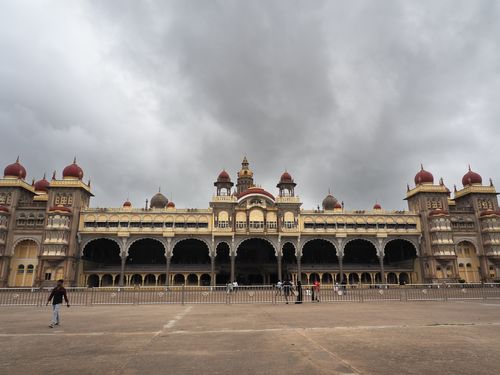
Several elements of the palace recall Islamic architectural traditions, including the bulbous domes, pointed arches, and symmetrical façade arrangements. These forms draw inspiration from Mughal and Deccan architectural precedents.
Hindu architectural traditions are also clearly visible in the decorative motifs and sculptural details of the palace. Many ornamental patterns incorporate symbolic imagery associated with Hindu mythology and royal iconography. Lotus motifs, decorative friezes, and mythological figures appear throughout the building.
Rajput and North Indian palace architecture influenced the use of pavilions, balconies, and ornamental parapets. These features contribute to the palace’s vertical silhouette and enhance its ceremonial appearance.
European architectural influences appear primarily in the structural organization and spatial symmetry of the complex. The palace plan reflects a degree of axial planning and geometric order characteristic of European palace architecture of the nineteenth century.
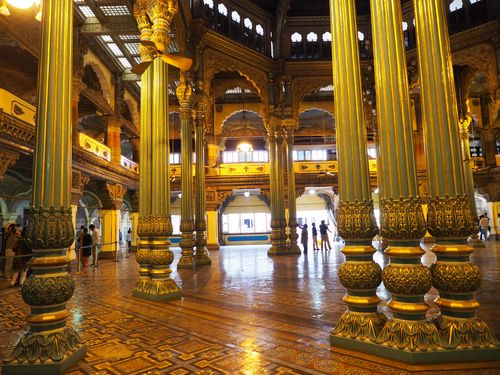
Interior decoration further illustrates this cultural synthesis. Stained glass, ornamental metalwork, painted ceilings, and richly decorated columns create elaborate visual effects that combine Indian craftsmanship with stylistic influences from Europe.
Spatial organization and structural layout
The palace complex follows a carefully organized plan that balances ceremonial grandeur with functional requirements. The structure occupies a large quadrangular site surrounded by gardens and open courtyards.
The central portion of the palace is dominated by a large dome that forms the visual focal point of the building. Surrounding this dome are several smaller domes and towers that create a layered skyline. This composition emphasizes verticality and contributes to the palace’s distinctive profile.
The main entrance leads into a sequence of halls and courtyards designed to guide visitors toward the most important ceremonial spaces. These spatial transitions reinforce the hierarchical organization of the palace, reflecting the formal protocols of the royal court.
Among the most important spaces are the Durbar Hall and other ceremonial chambers used for official gatherings. These halls feature high ceilings, decorative columns, and elaborate ornamentation that convey the authority and prestige of the ruling dynasty.
Colonnades, galleries, and balconies structure circulation throughout the building while providing vantage points for observing ceremonies and events. Staircases and corridors connect the various levels of the palace, ensuring efficient movement between residential, administrative, and ceremonial areas.
The palace also incorporates several courtyards that provide natural light and ventilation. These open spaces contribute to the climatic comfort of the building and create a rhythmic sequence within the architectural composition.
Dimensions and notable characteristics
Mysuru Palace occupies a large area in the center of the city and forms part of an extensive palace complex that includes courtyards, gates, and gardens. The central dome rises prominently above the main structure, creating one of the most recognizable features of the skyline.
Several towers and domes are distributed across the roofline, reinforcing the palace’s monumental presence. The façade combines multiple architectural layers that produce a richly articulated exterior.
Inside the palace, the ceremonial halls represent some of the most impressive architectural spaces in the complex. The Durbar Hall, in particular, features tall columns, decorative ceilings, and large windows that illuminate the interior.
One of the palace’s most distinctive features is its illumination during the annual Dasara festival. Thousands of electric lights outline the entire structure, creating a dramatic visual spectacle that highlights the architectural contours of the building.
This illumination tradition, introduced during the twentieth century, has become closely associated with the palace’s cultural identity.
International significance and conservation challenges
The architecture of Mysuru Palace contributes significantly to its international recognition as one of India’s most remarkable royal monuments. The building exemplifies the Indo-Saracenic style and illustrates the interaction between traditional Indian architectural forms and modern engineering techniques.
Today the palace functions both as a historical monument and as a major cultural attraction. Large numbers of visitors come to Mysore each year to experience its architectural grandeur and historical significance.
Preserving the palace presents ongoing conservation challenges. The structure must withstand environmental conditions such as humidity, seasonal rainfall, and temperature variations typical of southern India.
In addition, the large volume of visitors requires careful management to prevent damage to decorative elements and structural features. Conservation authorities regularly conduct restoration projects aimed at preserving the palace’s architectural integrity.
Although Mysuru Palace is not individually listed as a UNESCO World Heritage Site, it is widely regarded as one of the most important architectural landmarks in India. Its design represents a unique fusion of regional tradition, colonial-era innovation, and royal ceremonial architecture, making it a key monument in the architectural history of the subcontinent.