

 Français (France)
  Nederlands (nl-NL)
 00:00 • Introduction | 00:41 • Kashivishveshvar temple | 03:25 • Nandi in front of the Virupaksha temple | 04:05 • Virupaksha Temple
Personal creation from visual material collected during my trip Unknown India • Ladakh, Karnataka, Telangana (2022)
Map of places or practices in Pattadakal on this site
• Use the markers to explore the content •
Pattadakal and the Monumental Legacy of the Chalukyas
A Ceremonial Capital of Early Medieval India
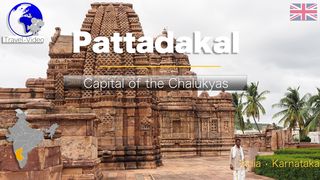
Located in northern Karnataka near the Malaprabha River, Pattadakal is one of the most important temple complexes of early medieval India. Associated with the Chalukyas of Badami, the site developed between the seventh and eighth centuries as a major religious and ceremonial center. Today, Pattadakal is recognized as a UNESCO World Heritage Site and remains one of the clearest architectural testimonies to the artistic ambitions of the Chalukya dynasty.
The video explores several aspects of this remarkable ensemble, where temples stand within an open landscape shaped by both religious activity and political symbolism. Pattadakal occupies a special place in the history of Indian architecture because it reflects a period of experimentation and exchange between northern and southern Indian temple traditions. Towers, sanctuaries and sculpted decorations reveal how different artistic influences were brought together within a single monumental complex.
The images also highlight the balance between architectural scale and sculptural refinement. Pillared halls, carved walls and carefully proportioned structures demonstrate the high level of craftsmanship achieved under Chalukya patronage.
The Kashivishveshvara Temple and the Virupaksha Complex
The Kashivishveshvara Temple represents one of the important monuments of the site and illustrates the later evolution of Chalukya temple architecture. Its tower, decorative bands and sculpted details reveal strong influences from northern Indian architectural traditions while remaining deeply rooted in the artistic culture of the Deccan. The temple demonstrates how Chalukya builders adapted and transformed external influences into original local forms.
The video then focuses on the monumental Nandi positioned before the Virupaksha Temple. As the sacred bull associated with Shiva, Nandi occupies an essential symbolic role in Shaivite temple architecture. The pavilion housing the sculpture reinforces the ritual axis leading toward the main sanctuary and forms an important part of the overall religious composition.
The Virupaksha Temple itself stands among the masterpieces of early medieval South Indian architecture. Built during the eighth century, probably under the patronage of Queen Lokamahadevi to commemorate a military victory of the Chalukyas, the temple represents one of the earliest fully developed examples of Dravidian architecture in Karnataka. Sculpted pillars, narrative panels and ceremonial spaces contain numerous depictions drawn from Hindu traditions, including scenes from the Ramayana and the Mahabharata.
Architecture Between Northern and Southern Traditions
Pattadakal is especially significant because it illustrates the coexistence of multiple architectural styles within a single religious center. The Chalukyas controlled large territories across the Deccan and maintained political and cultural connections with different regions of the Indian subcontinent. These exchanges encouraged experimentation between the Nagara style of northern India and the Dravidian traditions of the south.
The temples visible in the video reveal different approaches to tower design, sanctuary organization and sculptural decoration. Pattadakal therefore represents an important transitional phase in the development of medieval Indian temple architecture. Many artistic solutions developed here would later influence temple construction in other parts of southern India.
The site also carried strong ceremonial importance. Pattadakal is believed to have served as a coronation center for Chalukya rulers, linking the temple complex directly to royal authority and dynastic prestige. The monuments were not only places of worship but also expressions of political legitimacy and cultural patronage.
What These Videos Make Easier to Observe
The videos on travel-video.info are largely created from carefully animated photographs, allowing viewers to observe architectural and sculptural details with greater clarity. This format encourages a slower and more progressive reading of the monuments than rapidly moving footage often permits.
Transitions between wide perspectives and close details help reveal the proportions of the temples, the alignment of columns and the richness of the carved reliefs. The visual progression also makes it easier to understand the spatial relationships between the various monuments and the surrounding landscape.
This approach is particularly effective at Pattadakal, where many of the artistic subtleties depend on careful observation of sculptural surfaces, architectural volumes and decorative compositions.
A Major Testimony to Chalukya Art
Pattadakal remains one of the most important sites for understanding the evolution of Hindu temple architecture in the Deccan. Through the Kashivishveshvara and Virupaksha temples, the video offers a detailed exploration of a monumental heritage shaped by religious devotion, artistic innovation and royal ambition. The detailed pages dedicated to the associated monuments provide further insight into the history, architecture and cultural significance of the Chalukya period in Karnataka.
Links to related pages








Audio Commentary Transcript
The struggles between the dynasties of India have raged for centuries. To celebrate their victory over the Pallavas of Kanchi towards the end of the 7th century, the Chalukyas erected a series of magnificent temples, intended to inscribe in stone the supremacy of the Chalukyas.
Although never having been the capital of the empire (this role was reserved for Badami), Pattadakal was a place of great importance for the dynasty, which is why the site of Pattadakal was chosen to erect these monuments. which persist to this day.
The Kashivishveshvara temple was erected around the 8th century and is dedicated to Shiva. The temple is actually composed of 3 sanctuaries, and is characterized by a harmonious fusion of architectural styles from North and South India.
Of relatively modest size, this temple is also distinguished by the quality of the sculptures.
In front of the entrance to the Virupaksha temple stands a kind of kiosk, also called Nandi Mandapa, housing a magnificent statue of Nandi, Shiva's bull. The Nandi is an important figure in Hindu cosmogony and is often depicted in or in front of temples dedicated to Shiva. That of Pattadakal is particularly interesting because of the finesse and care given by the sculptor to this sacred work.
The Virupaksha Temple is another outstanding example of ancient Indian architecture. This temple was built in the 8th century during the Chalukya period, a dynasty famous for the refinement of its culture and more particularly of its architecture. One of the characteristics of Chalukya architecture was the harmonious integration of North and South Indian styles.
The beauty of the sculptures around and in the temple gives an idea of what must have been the refinement at the court of the Chalukyas more than 12 centuries ago.

Music:
- - YouTube video library - Calcutta Sunset - E's Jimmy Jams
- - YouTube video library - For Originz, (© For Originz by Kevin MacLeod is licensed under a Creative Commons Attribution 4.0 license. https://creativecommons.org/licenses/by/4.0/
- Source: http://incompetech.com/music/royalty-free/index.html?isrc=USUAN1100700
- Artist: http://incompetech.com/)
- - YouTube video library - Heavy Interlude, (© Heavy Interlude by Kevin MacLeod is licensed under a Creative Commons Attribution 4.0 license. https://creativecommons.org/licenses/by/4.0/
- Source: http://incompetech.com/music/royalty-free/index.html?isrc=USUAN1100515
- Artist: http://incompetech.com/)
Disclaimer: Despite its appropriateness, copyright issues prevent the use of indian traditional music in "Pattadakal • Capital of the Chalukyas • Karnataka, India", hence the use of royalty-free music. Despite our careful selection, some might regret this decision, which is necessary to avoid potential lawsuits. Although difficult, this decision is the only viable solution.


