

 Français (France)
  Nederlands (nl-NL)
 The Virupaksha Temple is located in Pattadakal in the Indian state of Karnataka. It forms part of a group of religious monuments that illustrate the historical and cultural significance of this site in the development of religious traditions in the Deccan region. Dedicated to the Hindu deity Shiva in the form of Virupaksha, the temple has served as a place of worship and gathering for devotees for centuries. It stands within a monumental landscape composed of several sanctuaries built during different periods. Today the Virupaksha Temple remains one of the most prominent monuments of Pattadakal and contributes to the international heritage value of the site.
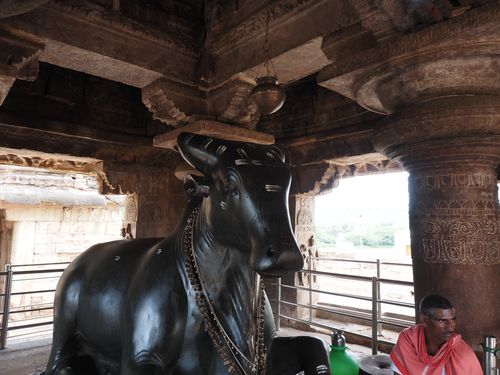
Pattadakal • Virupaksha Temple: Nandi
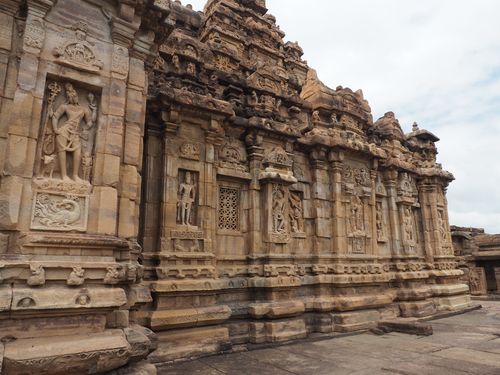
Pattadakal • Virupaksha Temple: facade of the temple
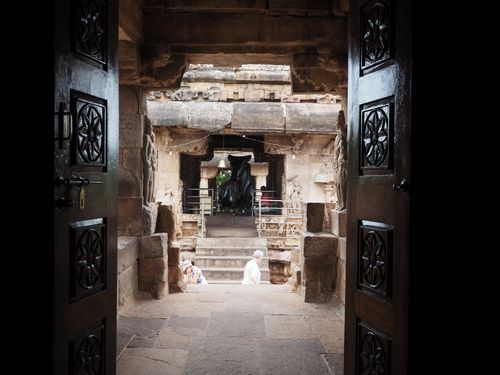
Pattadakal • Virupaksha Temple: vue on Nandi
Monument profile
Virupaksha Temple
Monument categories: Hindu Temple, Dravidian temple
Monument family: Temple
Monument genre: Religious
Cultural heritage: Hindu
Geographic location: Pattadakal • Karnataka • India
Construction period: 8th century AD
This monument in Pattadakal is inscribed on the UNESCO World Heritage List since 1987 and is part of the serial property "Group of Monuments at Pattadakal".See the UNESCO monuments featured on this site
• Links to •
• Dynasties that contributed to the construction of the monument •

• List of videos about Pattadakal on this site •
Pattadakal • Capital of the Chalukyas • Karnataka, India
• References •
Wikipedia EN: Pattadakal
Karntaka Tourism: Karnataka department of tourism: Pattadakal
UNESCO: Group of Monuments at Pattadakal
History of the Virupaksha Temple at Pattadakal
Foundation of the monument and political context
The Virupaksha Temple at Pattadakal was constructed during the first half of the eighth century in the Deccan region of southern India. The monument is associated with the reign of the Western Chalukya ruler Vikramaditya II, who governed the Chalukya kingdom of Badami during a period of territorial expansion and political consolidation. The temple was commissioned by Queen Lokamahadevi, one of the king’s principal consorts, in order to commemorate military victories achieved by Vikramaditya II over the Pallava dynasty of southern India.
The construction of the temple followed the Chalukya campaigns against the Pallava capital of Kanchipuram. These campaigns strengthened the authority of the Chalukya state and extended its influence across large parts of the Deccan plateau. The decision to erect a monumental temple at Pattadakal served both religious and political purposes. The temple functioned as a visible expression of royal power while simultaneously affirming the devotional allegiance of the ruling dynasty to the god Shiva.
The role of Queen Lokamahadevi as patron of the temple is documented through inscriptions associated with the monument. Her patronage reflects the participation of royal women in religious and architectural initiatives within the Chalukya court. The Virupaksha Temple therefore represents both a dynastic monument and a religious sanctuary connected to the Shaivite tradition.
Religious function and role within Pattadakal
At the time of its construction, the Virupaksha Temple formed part of an expanding group of temples established at Pattadakal. This site functioned as a ceremonial center within the Chalukya kingdom, where royal rituals, religious festivals, and temple patronage were concentrated. The location of Pattadakal along the Malaprabha River contributed to its role as an important religious landscape during the Chalukya period.
The Virupaksha Temple was dedicated to Shiva under the name Virupaksha, a form of the deity widely venerated in the Shaivite tradition. The sanctum of the temple housed a linga representing the presence of Shiva. Ritual worship carried out by temple priests included daily offerings, ceremonial ablutions, and the recitation of sacred texts associated with Shaivite practice.
Within the broader complex of Pattadakal, the Virupaksha Temple occupied a prominent position. Its scale and architectural elaboration suggest that it was intended to serve as one of the principal shrines within the ceremonial landscape of the site. The temple was also integrated into a network of nearby sanctuaries dedicated to different deities, forming a religious ensemble in which multiple cults were practiced.
The temple’s presence contributed to the organization of religious activities within Pattadakal. Processional rituals, public ceremonies, and acts of royal devotion could be conducted in and around the monument, reinforcing the connection between political authority and sacred space.
Historical development and later phases of use
After the decline of the Chalukya dynasty of Badami during the later eighth century, the political control of the region shifted to other dynasties in the Deccan. Despite these changes, the Virupaksha Temple continued to exist as a functioning religious monument. The structure itself remained largely intact, and its role as a Shaivite sanctuary persisted even as new centers of political power emerged elsewhere.
Over the following centuries, patterns of temple patronage evolved as different ruling powers established their authority in the region. Some temples in Pattadakal experienced reduced ritual activity when royal attention shifted to other urban or religious centers. The Virupaksha Temple, however, retained symbolic significance because of its association with the Chalukya dynasty and its monumental scale.
Environmental factors gradually affected certain parts of the structure. Sculptural surfaces and decorative elements were exposed to weathering over long periods. Nevertheless, the fundamental architectural form of the monument survived with relatively limited structural alteration. The continued presence of the temple allowed later observers to study the historical context of its construction and patronage.
Modern recognition and conservation
Interest in the monuments of Pattadakal increased significantly during the nineteenth century as scholars and surveyors began documenting historical architecture across the Indian subcontinent. The Virupaksha Temple attracted particular attention because of its inscriptions, sculptural program, and well-preserved structure. Archaeological studies conducted during this period helped clarify the historical circumstances surrounding its construction.
During the twentieth century, conservation initiatives were undertaken to stabilize the temple and protect its sculptural decoration from further deterioration. These efforts focused on maintaining the structural integrity of the building while preserving the original features that illustrate its historical significance.
The temple forms part of the archaeological site of Pattadakal, which was inscribed on the UNESCO World Heritage List in 1987 under the official designation “Group of Monuments at Pattadakal.” Within this serial property, the Virupaksha Temple is recognized as one of the most significant monuments associated with the Chalukya period.
Today the temple remains an important reference point for historians and archaeologists studying the political and religious history of the Deccan region during the early medieval period.
Global historical context
The construction of the Virupaksha Temple during the eighth century occurred during a period of major political and cultural developments in several regions of the world. In East Asia, the Tang dynasty governed a powerful empire characterized by extensive trade and cultural exchange. In the Middle East, the transition from the Umayyad to the Abbasid Caliphate reshaped political authority across the Islamic world. In Western Europe, the Carolingian dynasty was consolidating power under rulers who would later shape the early medieval political order. Across Southeast Asia, emerging kingdoms supported the construction of Hindu and Buddhist religious monuments comparable in scale and ambition to those of the Deccan.
Architecture of the Virupaksha Temple at Pattadakal
Location and general layout of the monument
The Virupaksha Temple stands within the monumental complex of Pattadakal in the Indian state of Karnataka, on the northern bank of the Malaprabha River. The building occupies a prominent position within a group of early medieval temples arranged along the river terrace. Its placement within this ceremonial landscape reflects the deliberate organization of sacred architecture in Pattadakal, where multiple shrines were constructed in close proximity during the Chalukya period.
The temple is oriented toward the east, a direction that aligns the main entrance with the rising sun. This orientation guides the axial organization of the building and establishes the principal ceremonial approach. Visitors ascend a set of steps leading to the platform on which the temple stands. The platform forms a rectangular base that raises the monument above the surrounding terrain and establishes a clearly defined architectural perimeter.
The ground plan follows a longitudinal arrangement structured along an east–west axis. The temple consists of a sequence of architectural units including the sanctum (garbhagriha), an intermediate vestibule (antarala), and a pillared hall (mandapa). These elements are aligned in a continuous spatial progression that directs movement from the entrance toward the inner sanctuary.
A circumambulatory passage surrounds the sanctum. This corridor allows devotees to perform ritual circumambulation around the central shrine. The presence of this passage influences the thickness of the sanctuary walls and contributes to the overall organization of the temple plan. The combination of axial movement and circular ritual circulation creates a complex spatial structure within the monument.
Spatial organization and interior structure
The garbhagriha forms the architectural core of the Virupaksha Temple. This chamber has a square plan and houses the sacred linga dedicated to Shiva. The interior space is enclosed by thick masonry walls that provide structural support for the superstructure above while also isolating the sanctum from the outer areas of the temple.
Directly in front of the sanctum lies the antarala, a short transitional space that connects the sanctuary with the larger hall. The antarala functions as a threshold that marks the shift between the sacred interior chamber and the more accessible architectural spaces. Its dimensions are deliberately narrow, reinforcing the hierarchical progression toward the central shrine.
The mandapa represents the most expansive interior section of the temple. This hall is supported by rows of stone pillars arranged in a regular grid. The pillars divide the hall into multiple bays and establish a structural framework capable of supporting the roof. The arrangement of these pillars also organizes movement within the interior space, allowing worshippers to circulate while maintaining a clear visual axis toward the sanctum.
The ceiling of the mandapa consists of stone slabs resting on horizontal beams placed across the pillars. The ceiling panels often display carved decorative motifs, which enhance the architectural composition of the hall while remaining structurally integrated into the construction.
Together, these interior spaces form a sequence that guides movement gradually from the exterior toward the sanctum. The architectural design emphasizes both spatial continuity and ritual hierarchy within the building.
Construction techniques and materials
The Virupaksha Temple is constructed primarily from sandstone obtained from nearby quarries in the Malaprabha valley. The stone blocks were cut and finished with precision before being assembled into the walls and structural components of the building. The careful fitting of the blocks allowed the builders to create stable masonry structures with minimal reliance on binding materials.
The temple rests on a moulded plinth composed of multiple horizontal bands. These mouldings establish a structural transition between the platform and the rising walls of the temple. The plinth also provides a stable foundation that distributes the weight of the superstructure across the base of the building.
The pillars of the mandapa were carved from monolithic blocks of stone. Each pillar consists of a square or polygonal base, a shaft that may incorporate decorative carving, and a capital that supports the horizontal beams of the roof. The systematic placement of these pillars forms a coherent load-bearing framework for the hall.
The roofing system relies on large stone slabs laid across beams that span the distances between pillars and walls. This technique allows the creation of relatively wide interior spaces without compromising structural stability. The weight of the roof is distributed through the pillars and walls down to the plinth.
The tower above the sanctum, known as the shikhara, is constructed through the progressive stacking of stone courses that gradually diminish in size toward the top. This method produces a stepped pyramidal profile that transfers structural loads downward through the walls of the sanctum.
Exterior articulation and sculptural program
The external walls of the Virupaksha Temple display a complex architectural articulation created through alternating projections and recesses. These vertical offsets divide the façades into multiple segments, each containing sculptural niches that house carved figures.
The sculptural program includes representations of Hindu deities, mythological narratives, and symbolic motifs associated with the Shaivite tradition. These sculptures are positioned within architectural frames that form part of the wall structure. Their placement corresponds to the rhythm established by the projections and recesses of the façades.
Horizontal decorative bands extend along the base and upper sections of the walls. These bands include friezes depicting animals, processional scenes, and ornamental patterns. The arrangement of these decorative elements contributes to the visual hierarchy of the building while reinforcing the architectural divisions of the walls.
Above the sanctum rises the shikhara, which constitutes the dominant vertical feature of the temple. The tower is composed of several superimposed tiers that gradually narrow as they ascend. Each tier incorporates miniature architectural motifs that replicate the form of the main shrine. This repetition creates a visual continuity between the base of the structure and the summit of the tower.
The uppermost portion of the tower is crowned by a finial element that marks the vertical culmination of the temple structure. This element reinforces the upward emphasis of the superstructure and contributes to the monument’s silhouette within the architectural ensemble of Pattadakal.
Architectural transformations and conservation
Over the centuries, the Virupaksha Temple has been exposed to environmental factors that have affected parts of its sculptural decoration and surface details. Weathering has gradually softened certain carvings and ornamental features, particularly on the exterior walls.
Despite these effects, the structural components of the temple remain largely intact. The sanctum, mandapa, and superstructure preserve their original spatial configuration, allowing scholars to analyze the architectural design with considerable accuracy.
Archaeological conservation efforts have focused on stabilizing the masonry and protecting the sculptural elements from further deterioration. These interventions involve the consolidation of stone blocks, the monitoring of structural stability, and the maintenance of the monument’s drainage and surrounding terrain.
The temple is preserved as part of the protected archaeological zone of Pattadakal. Its architectural integrity provides important evidence for the construction techniques and spatial organization employed by builders during the Chalukya period.