

 Français (France)
  Nederlands (nl-NL)
 Of Islamic tradition, the Slave dynasty (or Mamluk) ruled for approximately 84 years, ± between 1206 and 1290 over all or part of Central India, North India and the Himalayan region, during the Medieval Period.
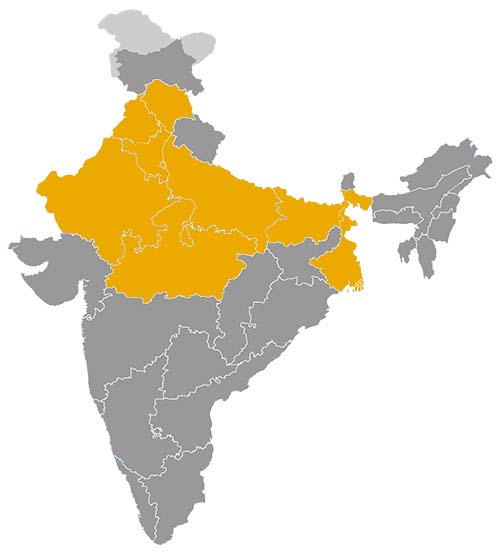
This map illustrates the maximum territory that the Slave dynasty (or Mamluk) Dynasty had reached at its height, covering the current regions of Bihar, Delhi (NTC), Haryana, Himachal Pradesh, Madhya Pradesh, Punjab, Rajasthan and Uttar Pradesh in India. Its main purpose is to provide a visual aid to understand the geographical extent of this dynasty. However, it's important to note that the contemporary borders of these regions may not necessarily coincide with the historical territories.
The Slave Dynasty and the Foundations of Sultanate Rule in Northern India
The first ruling house of the Delhi Sultanate
The Slave Dynasty, also known as the Mamluk dynasty of Delhi, holds a foundational place in the history of medieval India. It ruled from 1206 to 1290 and formed the first line of sovereign rulers of the Delhi Sultanate. Its name refers to the background of several of its early leaders, who had risen through the military slave system of the Islamic world. These mamluks were not ordinary slaves in a domestic sense, but trained military elites who could become commanders, governors and even rulers.
The dynasty emerged from the Ghurid conquests in northern India. After the death of Muhammad of Ghor, his former commander Qutb al-Din Aibak established independent authority over the Ghurid territories in India. Delhi gradually became the centre of this new state. The dynasty’s importance lies not only in its military origins, but in its ability to transform conquest into a durable political institution.
The creation of a stable sultanate in northern India
The main political role of the Slave Dynasty was the consolidation of Muslim rule in northern India. Qutb al-Din Aibak began this process, but it was Shams al-Din Iltutmish who gave the sultanate a more stable structure. He strengthened Delhi as capital, organized administrative authority, defeated rivals and obtained symbolic recognition from the Abbasid caliphate. This recognition helped place the Delhi Sultanate within the wider political world of Islam.
The dynasty had to govern territories that were still unstable after conquest. Provincial governors, military commanders and local chiefs often retained considerable influence. The early sultans therefore had to combine military force, diplomacy, revenue collection and political appointments in order to maintain authority.
Under Ghiyas al-Din Balban, royal power became more formal and centralized. Balban emphasized the dignity of kingship, the discipline of the nobility and the authority of the monarch over aristocratic factions. His reign helped define a model of sultanate rule that later dynasties would inherit and adapt.
Court politics, succession struggles and the limits of authority
The history of the Slave Dynasty was also marked by internal instability. Succession was not always orderly, and the nobility often played a decisive role in choosing, supporting or removing rulers. After the death of Iltutmish, several short reigns reflected the difficulty of maintaining dynastic continuity.
Razia Sultana, the daughter of Iltutmish, represents one of the most remarkable figures of the dynasty. She ruled directly as sovereign from 1236 to 1240 and remains one of the few women to have exercised royal authority in Delhi. Her reign, however, faced strong resistance from sections of the Turkish nobility. Her fall shows both the possibilities and the constraints of power in the early sultanate.
The dynasty also faced external pressures, especially from the northwest. Mongol expansion in Asia made the Punjab and the frontier regions strategically vital. The need to defend these areas strengthened the military character of the state and increased the importance of loyal governors and fortified towns.
The cultural formation of early Indo-Islamic Delhi
The cultural impact of the Slave Dynasty was substantial. During this period, Delhi began to develop as a political, religious and cultural centre. Persian became the principal language of administration, diplomacy and elite literary culture. This connected northern India with the broader Persianate and Islamic worlds of Central Asia, Iran and the Middle East.
Architecture was one of the clearest expressions of this cultural change. The Qutb complex in Delhi, associated with the early period of the sultanate, illustrates the emergence of Indo-Islamic architecture. Mosques, minarets, arches, inscriptions and monumental gateways reflected Islamic artistic forms, while also using Indian materials, craftsmen and construction traditions.
This period also saw the growing presence of scholars, jurists and Sufi figures. Sufi networks played an important role in linking the new Muslim ruling centres with wider social and spiritual communities. Their influence helped give Islam in India a presence beyond the court and the army, although the process was gradual and regionally varied.
Economic foundations based on land revenue and urban growth
The economy of the Slave Dynasty depended heavily on agricultural revenue. Control of the Indo-Gangetic plain and the Doab between the Ganges and Yamuna rivers provided the state with a valuable fiscal base. These revenues financed the army, the court, the administration and monumental building projects.
Delhi’s rise as a capital stimulated urban activity. Soldiers, administrators, merchants, artisans and religious specialists gathered around the court and its institutions. The city’s location linked it to Lahore, the Punjab, Rajasthan and the Ganges basin, making it an important node in military and commercial networks.
The dynasty also had to manage the economic fragility of a recently conquered state. Rebellions, frontier threats and court conflicts could disrupt revenue collection. As a result, the ability to control land, towns and provincial officers became central to the survival of the sultanate.
A formative legacy for later Indian history
The Slave Dynasty ended in 1290, when the Khaljis replaced the Mamluk rulers of Delhi. Yet its historical importance continued long after its fall. It had established Delhi as the political centre of a new Indo-Islamic state, created the first durable institutions of the Delhi Sultanate and introduced administrative and cultural patterns that later rulers would expand.
Its rulers did not create a fully unified Indian empire, nor did they control the whole subcontinent. Their achievement was more foundational: they converted military conquest into a lasting state. Through their political consolidation, cultural patronage, economic organization and defence of northern India, the Mamluks of Delhi laid the groundwork for the later development of the Delhi Sultanate and for many features of medieval Indo-Islamic rule.
The Geographic Expansion of the Slave Dynasty and the Formation of the Early Delhi Sultanate
A northern Indian state built from the Ghurid conquests
The Slave Dynasty, also known as the Mamluk dynasty of Delhi, ruled from 1206 to 1290 and formed the first ruling house of the Delhi Sultanate. Its geographic base was inherited from the Ghurid conquests of the late twelfth century. After the death of Muhammad of Ghor, his former commander Qutb al-Din Aibak established an independent authority over the Ghurid possessions in northern India. Delhi became one of the principal centres of this new power, although Lahore also retained importance during the early phase.
The territorial structure of the dynasty should not be understood as a compact and uniformly administered empire. Its authority rested on a network of fortified towns, garrisons, provincial commanders and strategic routes. The sultans controlled key centres rather than every district with equal intensity. Their expansion was therefore both military and administrative, but often uneven.
Delhi, Lahore and the Punjab as strategic centres of power
The core of the Slave Dynasty’s rule lay in northern India. Delhi became the political capital and the main symbol of sovereignty, while Lahore and the Punjab remained crucial for military defence and communication with the northwest. These regions connected the sultanate with Afghanistan, Central Asia and the wider Islamic world. They also exposed the state to external threats.
The Punjab was not simply a frontier province. It was a zone of military pressure, commercial movement and political competition. Control of Lahore, Multan and nearby routes allowed the sultans to defend the approaches to Delhi. During the thirteenth century, the Mongol advance across Central Asia made this frontier increasingly important. The need to protect the northwest influenced the dynasty’s relations with governors and military commanders, whose loyalty was essential for the survival of the state.
The Indo-Gangetic plain as the fiscal heartland of the dynasty
The fertile lands of the upper Indo-Gangetic plain formed the economic foundation of the early Delhi Sultanate. The Doab, the region between the Ganges and Yamuna rivers, was especially valuable because of its agricultural productivity. Control over this zone provided land revenue, which financed the army, the court and the administrative apparatus.
Under Iltutmish, the authority of the dynasty expanded and consolidated across Delhi, the upper Ganges basin, parts of Haryana, the Punjab and several important towns of northern India. His reign gave the sultanate a more durable territorial shape. He subdued rivals and strengthened the connection between the capital and the provincial centres.
This expansion brought the Mamluk rulers into contact with local Hindu chiefs, landed elites and older regional powers. The sultanate had to rely on both force and accommodation. In many areas, practical control depended on the obedience of local intermediaries rather than direct administration from Delhi.
Rajasthan and the contested frontier with Rajput powers
The westward and southward reach of the Slave Dynasty brought it into frequent conflict with Rajput lineages and fortified regional states. Ajmer, Ranthambore, Gwalior and other strongholds were important because they controlled routes between Delhi, Rajasthan and central India. These territories were difficult to dominate permanently, partly because of their forts, aristocratic warrior traditions and local political resilience.
Relations between the Delhi sultans and the Rajput powers were therefore marked by warfare, temporary submission, rebellion and negotiated coexistence. The sultanate could impose military superiority in some campaigns, but Rajput resistance remained a constant factor in the political geography of northern and western India.
The struggle over these frontier zones shaped the identity of the early Delhi Sultanate as a military state. It also created a pattern that later dynasties would continue: Delhi sought to control strategic forts and routes, while regional dynasties defended local autonomy and prestige.
Bengal and the limits of distant authority
Bengal was one of the most difficult regions for the Slave Dynasty to control. It was wealthy, distant and geographically distinct from the Delhi heartland. Its river systems, local resources and distance from the capital allowed provincial governors to act with considerable independence.
At several moments, the rulers of Delhi claimed authority over Bengal or attempted to reassert control there. Iltutmish intervened in the east to bring rebellious governors back under the authority of the sultanate. Yet even when Bengal acknowledged Delhi’s supremacy, effective control remained uncertain. The province repeatedly showed tendencies toward autonomy.
This situation influenced the wider political relations of eastern India. Bengal was linked to Delhi through military campaigns, appointments and claims of sovereignty, but it was rarely governed with the same intensity as the regions closer to the capital. The Mamluk experience in Bengal revealed the structural difficulty of ruling distant provinces from Delhi.
The northwest frontier and the pressure of the Mongols
The Mongol threat transformed the geography of the Slave Dynasty during the thirteenth century. The sultans had to defend the approaches from Central Asia and the Indus region. This made frontier towns and military commanders exceptionally important.
Balban paid particular attention to frontier security, internal discipline and the defence of the sultanate’s core territories. His policies strengthened royal authority and reduced the autonomy of some nobles, but they also showed how external pressure limited expansion. The dynasty had to concentrate resources on survival and consolidation rather than continuous conquest.
A foundational territory for later sultanate expansion
The Slave Dynasty did not create the largest version of the Delhi Sultanate. Later Khalji and Tughlaq rulers expanded much farther into Gujarat, Malwa and the Deccan. The importance of the Mamluk period lies instead in the formation of the territorial base from which these later expansions became possible.
By controlling Delhi, the Doab, parts of the Punjab, important towns of the upper Ganges plain and contested frontier zones in Rajasthan and Bengal, the Slave Dynasty reshaped the political map of northern India. It forced Rajput powers, provincial governors and frontier commanders to respond to a new centre of authority. Its geographic legacy was therefore foundational: it established Delhi as the core of a durable Indo-Islamic state and prepared the ground for the wider ambitions of the later Delhi sultans.
The Slave Dynasty, also known as the Mamluk dynasty of Delhi, formed the first ruling line of the Delhi Sultanate. The dominant title was sultan. The reign dates are generally accepted, but some very short or nominal reigns, especially those of Rukn al-Din Firuz and Kayumars, remain indicative.
- Qutb al-Din Aibak (1206–1210) • A former Ghurid general, he founded the Delhi Sultanate and established the first basis of Mamluk power in northern India.
- Aram Shah (1210–1211) • His authority was fragile and quickly challenged by Iltutmish, who emerged as the effective ruler.
- Shams al-Din Iltutmish (1211–1236) • He consolidated the sultanate, organized the administration and gained symbolic recognition from the Abbasid caliphate.
- Rukn al-Din Firuz (1236) • His very brief reign followed the death of Iltutmish and was marked by instability in the succession.
- Razia Sultana (1236–1240) • The daughter of Iltutmish, she exercised sovereign power directly and remains one of the few women to have ruled Delhi.
- Muizz al-Din Bahram (1240–1242) • He ruled under the strong influence of Turkish nobles, whose rivalries limited his authority.
- Ala al-Din Masud (1242–1246) • His reign was dominated by aristocratic factions and ended with his deposition.
- Nasir al-Din Mahmud (1246–1266) • His personal power remained limited, while Balban became the main political actor in the sultanate.
- Ghiyas al-Din Balban (1266–1287) • He strongly reinforced monarchical authority, noble discipline and defence against external threats.
- Muizz al-Din Qaiqabad (1287–1290) • His reign, weakened by court intrigues, preceded the fall of the Mamluk dynasty.
- Kayumars (1290, nominal reign) • A child sultan, he held only nominal power before Jalal al-Din Firuz Khalji seized authority.