Français (France)
  Nederlands (nl-NL)
 Of Islamic tradition, (with additional Hindu, Buddhist and Jain influence), the Delhi Sultanate ruled for approximately 320 years, ± between 1206 and 1526 over all or part of Central India, East India, North India, South India, the Himalayan region and West India, during the Medieval Period.
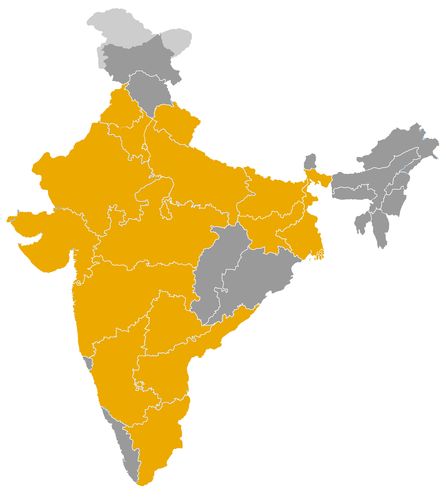
This map illustrates the maximum territory that the Delhi Sultanate Dynasty had reached at its height, covering the current regions of Bihar, Delhi (NTC), Haryana, Jharkand, Karnataka, Madhya Pradesh, Maharashtra, Punjab, Rajasthan, Tamil Nadu, Uttar Pradesh and Uttarakhand in India. Its main purpose is to provide a visual aid to understand the geographical extent of this dynasty. However, it's important to note that the contemporary borders of these regions may not necessarily coincide with the historical territories.
The Delhi Sultanate and the Transformation of Medieval India
A succession of ruling houses rather than a single dynasty
The Delhi Sultanate occupies a central place in the political and cultural history of medieval India. Although it is often described as a single power, it was not one dynasty in the strict sense. It was a succession of ruling houses that governed from Delhi between 1206 and 1526: the Mamluk or Slave dynasty, the Khalji dynasty, the Tughlaq dynasty, the Sayyid dynasty and the Lodi dynasty. Together, they created one of the most influential states of the Indian Middle Ages.
The Delhi Sultanate occupies a major place in the history of medieval India. It was not a single dynasty, but a succession of ruling houses that governed from Delhi between 1206 and 1526. These dynasties exercised authority that varied according to period and region, without ever controlling the entire Indian subcontinent in a uniform way. Their political, military, cultural and economic influence nevertheless extended far beyond the Delhi region.
- Slave dynasty, or Mamluk dynasty: as the founding dynasty of the Delhi Sultanate, it consolidated the first political, military and administrative foundations of Muslim rule in northern India.
- Khalji dynasty: it brought the sultanate into a major phase of expansion, especially toward Gujarat, Rajasthan, Malwa and the Deccan.
- Tughlaq dynasty: it attempted to govern a very extensive empire, but its ambitions exposed the administrative limits of a Delhi-centred power.
- Sayyid dynasty: it ruled a reduced territory after Timur’s invasion and maintained fragile authority in a fragmented northern India.
- Lodi dynasty: of Afghan origin, it partially restored the power of Delhi before being defeated by Babur in 1526.
The establishment of Delhi as a major imperial capital
One of the most important roles of the Delhi Sultanate was the transformation of Delhi into a durable political centre. Earlier cities in northern India had also held regional importance, but under the sultans Delhi became the seat of a large, militarised and administratively ambitious state. Its location gave access to the Punjab, the Gangetic plain, Rajasthan and the routes leading toward Central Asia.
The sultans used Delhi not only as a military base but also as a symbol of sovereignty. Fortifications, mosques, palaces, tombs and administrative quarters expressed the authority of the ruling elite. This role endured after the fall of the sultanate, as the Mughals later inherited and expanded the political prestige of Delhi.
A new model of centralized military rule
Politically, the Delhi Sultanate introduced and developed forms of centralized rule that had a lasting effect on northern India. The sultans relied on armies, governors, revenue officials and court elites to control wide territories. They also had to manage a powerful military aristocracy, often composed of Turkish, Afghan, Persianized and Indian Muslim groups.
Iltutmish consolidated the early state and gained symbolic recognition from the Abbasid caliphate. Balban strengthened royal authority and tried to discipline the nobility. Ala al-Din Khalji expanded the power of the sultanate and introduced strict controls over revenue, markets and the army. Muhammad bin Tughlaq attempted even more ambitious administrative experiments, though many of them proved difficult to sustain.
This political system was effective but fragile. Governors could become independent, distant provinces could rebel, and succession disputes frequently weakened central authority. The history of the sultanate therefore shows a constant tension between imperial ambition and regional fragmentation.
Military expansion and the reshaping of regional politics
The Delhi Sultanate was also a major military power. Its armies fought Rajput rulers, regional Hindu kingdoms, rival Muslim powers, rebellious governors and invading forces from the northwest. The Mongol threat was particularly significant. The ability of the sultanate to resist repeated Mongol pressure helped preserve northern India from direct Mongol domination.
Under Ala al-Din Khalji, the sultanate reached a remarkable level of military expansion. Campaigns were launched into Gujarat, Rajasthan, Malwa and the Deccan. The Yadavas of Devagiri, the Kakatiyas of Warangal, the Hoysalas and the Pandyas all came into contact with the military power of Delhi. In some cases, these campaigns led to direct annexation; in others, they imposed tribute or political submission.
This expansion changed the balance between northern India and the Deccan. It brought Delhi into the political affairs of regions that had previously developed largely under independent regional dynasties. It also contributed indirectly to the later rise of new powers, including the Bahmani Sultanate and the Vijayanagara Empire.
Cultural exchange and the growth of Indo-Persian civilization
The cultural impact of the Delhi Sultanate was profound. Persian became the main language of administration, diplomacy, literature and court culture. It connected northern India with wider Islamic and Persianate worlds stretching across Central Asia, Iran and the Middle East. At the same time, this culture developed in an Indian environment and gradually acquired distinct local forms.
Architecture was one of the clearest expressions of this transformation. Mosques, madrasas, tombs, gateways and minarets combined Islamic architectural concepts with Indian materials and craftsmanship. The Qutb complex in Delhi is one of the best-known examples of this early Indo-Islamic architectural language. Arches, domes, calligraphy and geometric decoration became part of the monumental vocabulary of northern India.
Sufism also played a major role in the cultural history of the period. Sufi orders, especially the Chishtis, established networks of spiritual centres that attracted people from different social and religious backgrounds. Their shrines became places of devotion, memory and cultural interaction.
Economic structures based on agriculture, taxation and urban growth
The economy of the Delhi Sultanate depended heavily on agricultural revenue. Control of the fertile Indo-Gangetic plain allowed the sultans to finance armies, maintain courts and build monumental architecture. Revenue collection was therefore one of the central functions of the state.
Ala al-Din Khalji’s reign is especially important for economic history. His administration tried to regulate prices, control grain supplies and supervise markets in order to support a large standing army. These measures show the capacity of the state to intervene directly in economic life, even if such control was difficult to maintain over the long term.
Urban growth also expanded under the sultanate. Delhi, Lahore, Multan, Badaun, Jaunpur and other centres became important for administration, trade, military organization and religious life. The circulation of merchants, scholars, soldiers and artisans linked northern India more closely to commercial networks across Central Asia, the Persian Gulf and the Indian Ocean.
A lasting foundation for later Indo-Islamic states
The Delhi Sultanate ended in 1526 when Ibrahim Lodi was defeated by Babur at the First Battle of Panipat. Yet its historical role did not end with its fall. It had established Delhi as a major imperial centre, developed Indo-Persian political culture, expanded urban and architectural traditions, and created administrative models later adapted by the Mughal Empire.
Its history was marked by conquest, resistance, cultural exchange and political instability. For this reason, the Delhi Sultanate should be understood not only as a ruling power but as a formative period in the making of medieval India.
The Geographic Expansion of the Delhi Sultanate and Its Impact on Regional Powers in India
A northern Indian power centred on Delhi
The Delhi Sultanate, established in 1206 and ended in 1526, was one of the most important political formations of medieval India. Its territorial extent changed considerably over time, depending on the strength of its rulers, the loyalty of provincial governors and the resistance of regional dynasties. Although Delhi remained its political centre, the sultanate at different moments controlled or influenced large parts of northern India, the Punjab, Rajasthan, Gujarat, Bengal, Malwa and the Deccan.
The state began as the successor to the Ghurid conquests in northern India. Its earliest rulers controlled Delhi, parts of the Punjab, Haryana, the upper Ganges basin and strategic towns such as Ajmer and Lahore. These territories gave the sultans access to fertile agricultural zones, military routes and trade corridors linking India with Central Asia and the wider Islamic world.
Consolidation in the Punjab and the Ganges plain
Under the Mamluk or Slave dynasty, the Delhi Sultanate strengthened its authority over northern India. Iltutmish played a decisive role in consolidating the state. He secured Delhi as capital, asserted control over the Punjab and the upper Ganges plain, and dealt with challenges from rival Turkish commanders and regional chiefs. His authority also extended toward Bengal, although this distant region remained difficult to govern from Delhi.
The Punjab was of special strategic importance. It was both a frontier and a gateway. Control of this region protected Delhi from incursions from the northwest and allowed the sultanate to monitor routes from Afghanistan and Central Asia. Repeated Mongol pressure in the thirteenth century made the northwest frontier a permanent military concern. This threat shaped the sultanate’s relations with frontier governors, who were expected to defend key towns while remaining loyal to the central court.
The Ganges plain, especially the region between the Ganges and Yamuna rivers, became the agrarian heartland of the sultanate. Revenue from this area financed the army and the court. Its control also brought Delhi into contact and conflict with local Hindu chiefs, landed elites and older regional powers.
Expansion into Rajasthan, Gujarat and central India
The Delhi Sultanate’s expansion westward and southward brought it into direct contact with Rajput states and other regional powers. Rajasthan was never an easy territory to control. Its forts, warrior lineages and local political traditions allowed strong resistance. Campaigns against Ranthambore, Chittor and other Rajput centres demonstrated the military ambition of the sultans, but also the limits of direct rule in fortified regions.
Under Ala al Din Khalji, the sultanate reached one of its greatest phases of expansion. Gujarat was conquered, giving Delhi access to wealthy commercial centres and maritime trade routes. This was significant because Gujarat connected inland India with the Arabian Sea, the Persian Gulf and the Indian Ocean trade network. Control or influence over Gujarat strengthened the economic base of the sultanate and increased its contact with merchant communities.
Malwa and parts of central India also came under the influence of Delhi. These regions served as corridors between northern India and the Deccan. Their occupation or submission helped the sultans project power farther south, but such control often depended on military pressure rather than stable administration.
Campaigns in the Deccan and the limits of imperial ambition
The most dramatic expansion of the Delhi Sultanate occurred under Ala al Din Khalji and later under Muhammad bin Tughlaq. Armies from Delhi campaigned deep into the Deccan and southern India. The Yadavas of Devagiri, the Kakatiyas of Warangal, the Hoysalas of Dvarasamudra and the Pandyas in the far south were all affected by the military reach of the sultanate.
In many cases, these campaigns did not create permanent direct rule. Instead, defeated rulers were required to pay tribute, accept political subordination or provide wealth and resources to Delhi. This system allowed the sultanate to claim supremacy over distant regions without always administering them directly.
Muhammad bin Tughlaq attempted to transform this influence into a more integrated imperial system. His decision to move the capital temporarily to Daulatabad reflected the ambition to control both northern India and the Deccan from a more central position. Yet the scale of the territory made governance extremely difficult. Distance, rebellion, administrative pressure and regional resistance weakened Delhi’s hold. The Deccan eventually produced independent powers, including the Bahmani Sultanate, while the Vijayanagara Empire emerged as a major southern rival.
Bengal and the problem of distant provinces
Bengal was another region that illustrates the limits of Delhi’s geographic control. Although the sultans claimed authority over Bengal at several moments, the province often acted independently. Its distance from Delhi, riverine geography and wealth made it difficult to control. Governors sent from Delhi frequently established their own authority and gradually separated from the centre.
This pattern influenced relations between Delhi and eastern India. The sultanate could intervene militarily or claim overlordship, but lasting control remained uncertain. Bengal’s tendency toward autonomy contributed to the broader fragmentation of the sultanate in the later medieval period.
Territorial contraction after Timur’s invasion
The invasion of Timur in 1398 severely weakened Delhi. The city was devastated, and the authority of the Tughlaq rulers collapsed. Under the Sayyid dynasty, the sultanate controlled only a reduced area around Delhi and parts of the surrounding region. Many former provinces became independent or semi independent powers, including Gujarat, Malwa, Bengal, Jaunpur and the Deccan sultanates.
The Lodi dynasty restored part of Delhi’s strength in the fifteenth century. The Lodis controlled much of the Ganges plain, parts of the Punjab and territories extending toward Bihar. However, their rule remained contested by Afghan nobles, Rajput chiefs and regional rulers. Their conflict with neighbouring powers created the conditions in which Babur could intervene and defeat Ibrahim Lodi at the First Battle of Panipat in 1526.
A fluctuating empire that reshaped India’s political map
The geographic history of the Delhi Sultanate was marked by expansion, overextension and contraction. Its strongest base lay in northern India, especially Delhi, the Punjab and the Ganges plain. Its influence reached Gujarat, Rajasthan, Bengal, Malwa and the Deccan, but control over these regions varied greatly.
This expansion changed relations among Indian powers. Rajput kingdoms, Deccan dynasties, Bengal rulers and emerging regional sultanates all had to respond to Delhi’s military and political ambitions. The sultanate did not create permanent unity across India, but it reshaped the balance between northern and southern powers, encouraged the rise of new regional states and prepared the political landscape in which the Mughal Empire later emerged.
The Delhi Sultanate was ruled successively by the Mamluk, Khalji, Tughlaq, Sayyid and Lodi dynasties. The reign dates are indicative for several short or contested reigns, especially during the Tughlaq crisis of the late fourteenth century. Khizr Khan ruled Delhi without fully assuming the title of an independent sultan, presenting himself as a representative of Timurid authority.
Mamluk or Slave dynasty of Delhi
- Qutb al-Din Aibak (1206–1210) • A former Ghurid general, he founded the Delhi Sultanate and the Mamluk dynasty.
- Aram Shah (1210–1211) • His brief and fragile reign was soon challenged by Iltutmish.
- Shams al-Din Iltutmish (1211–1236) • He consolidated the Delhi state and gained symbolic recognition from the Abbasid caliphate.
- Rukn al-Din Firuz (1236) • His very short reign was marked by instability after Iltutmish’s succession.
- Razia Sultana (1236–1240) • The daughter of Iltutmish, she exercised sovereign power directly in Delhi.
- Muizz al-Din Bahram (1240–1242) • He ruled under the strong influence of the Turkish nobles at court.
- Ala al-Din Masud (1242–1246) • His authority remained limited by aristocratic factions.
- Nasir al-Din Mahmud (1246–1266) • His reign was dominated by the rise of Balban, his powerful minister.
- Ghiyas al-Din Balban (1266–1287) • He strengthened monarchical authority and imposed strict discipline on the nobility.
- Muizz al-Din Qaiqabad (1287–1290) • His weakened reign preceded the fall of the Mamluk dynasty.
- Kayumars (1290) • A child sultan, he held only nominal power before the rise of the Khaljis.
Khalji dynasty
- Jalal al-Din Firuz Khalji (1290–1296) • He founded the Khalji dynasty after overthrowing the Mamluks of Delhi.
- Ala al-Din Khalji (1296–1316) • He led extensive conquests and greatly strengthened the sultanate’s fiscal and military control.
- Shihab al-Din Omar (1316) • A child sultan, he ruled briefly under the guardianship of court factions.
- Qutb al-Din Mubarak Shah (1316–1320) • He restored his personal authority before being overthrown by Khusrau Khan.
- Nasir al-Din Khusrau Shah (1320) • His very short reign ended the Khalji dynasty.
Tughlaq dynasty
- Ghiyas al-Din Tughlaq (1320–1325) • He founded the Tughlaq dynasty and restored central authority after the Khalji crisis.
- Muhammad bin Tughlaq (1325–1351) • His reign was marked by wide imperial ambitions and controversial reforms.
- Firuz Shah Tughlaq (1351–1388) • He promoted public works and governed an empire more fragile than that of his predecessors.
- Ghiyas al-Din Tughlaq II (1388–1389) • His brief reign opened a period of succession struggles.
- Abu Bakr Shah (1389–1390) • He seized the throne but was overthrown by Muhammad Shah Tughlaq.
- Nasir al-Din Muhammad Shah III (1390–1394) • He tried to restore Tughlaq authority amid growing fragmentation.
- Ala al-Din Sikandar Shah (1394) • He ruled for only a few weeks before his death.
- Nasir al-Din Mahmud Shah Tughlaq (1394–1413) • His reign was weakened by Timur’s invasion and the collapse of central authority.
- Nusrat Shah (1394–1398, concurrent reign) • He was a rival Tughlaq claimant controlling a limited share of power around Firozabad.
Sayyid dynasty
- Khizr Khan (1414–1421) • Founder of the Sayyid dynasty, he ruled Delhi as a representative of Timurid authority.
- Mubarak Shah (1421–1434) • He asserted greater autonomy for Sayyid rule and tried to contain regional revolts.
- Muhammad Shah (1434–1445) • His reign continued the territorial and political decline of the sultanate.
- Ala al-Din Alam Shah (1445–1451) • He surrendered Delhi to Bahlul Lodi and later retained only a limited dynastic position at Badaun.
Lodi dynasty
- Bahlul Lodi (1451–1489) • He founded the Lodi dynasty and restored part of Afghan authority in Delhi.
- Sikandar Lodi (1489–1517) • He strengthened administration, developed Agra and consolidated Lodi power.
- Ibrahim Lodi (1517–1526) • The last sultan of Delhi, he was defeated by Babur at the First Battle of Panipat.
 Links to the main sections of the site