Français (France)
  Nederlands (nl-NL)
 Of Hindu tradition, (with additional Jain influence), the Yadava of Devagiri dynasty ruled for approximately 130 years, ± between 1187 and 1317 over all or part of South India and West India, during the Medieval Period.
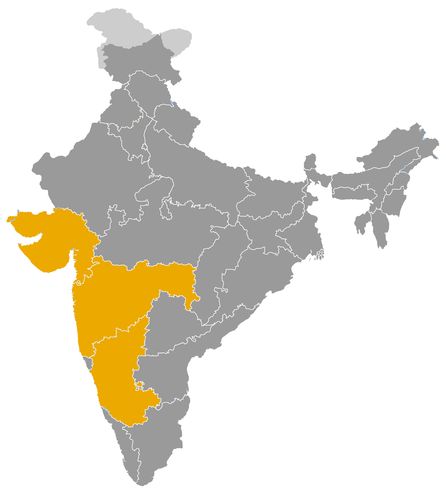
This map illustrates the maximum territory that the Yadava of Devagiri Dynasty had reached at its height, covering the current regions of Karnataka and Maharashtra in India. Its main purpose is to provide a visual aid to understand the geographical extent of this dynasty. However, it's important to note that the contemporary borders of these regions may not necessarily coincide with the historical territories.
The Yadava Dynasty of Devagiri and Its Role in Indian History
A Major Regional Power of the Medieval Deccan
The Yadava dynasty of Devagiri, also known as the Seuna Yadavas, was one of the most important regional powers of medieval India. Although the lineage had earlier roots as a subordinate family in the western Deccan, its principal historical phase began in the late twelfth century, when Bhillama V established an independent kingdom centred on Devagiri, the later Daulatabad, in present-day Maharashtra. From this strategic fortress-capital, the Yadavas ruled a large part of the western Deccan until their final defeat by the Delhi Sultanate in the early fourteenth century.
Their importance lies in their role as a bridge between earlier Deccan imperial traditions and the new political order that emerged after the expansion of northern sultanates into southern India. They inherited elements of Rashtrakuta and Chalukya political culture, but also helped shape the regional identity of Maharashtra through administration, language, religion and patronage.
The Rise from Feudatory Chiefs to Independent Kings
The early Seuna Yadavas were regional chiefs who served larger Deccan powers, especially the Rashtrakutas and later the Western Chalukyas. This subordinate status was typical of many medieval Indian lineages, which gradually built local authority before claiming sovereignty when imperial control weakened.
The decisive turning point came under Bhillama V in the late twelfth century. Taking advantage of the decline of the Western Chalukyas, he asserted independence and established Devagiri as the political centre of the kingdom. The choice of Devagiri was highly significant. Its natural defensive strength and central position on routes linking northern India, the western coast and the Deccan plateau made it an ideal capital.
Under later rulers, especially Simhana II, the dynasty reached its political height. Simhana expanded Yadava influence across the Deccan and made Devagiri one of the leading powers of the thirteenth century. The kingdom competed with the Hoysalas in the south, the Kakatiyas in the east and the Paramaras and other central Indian powers in the north.
Political Influence in the Deccan
The Yadavas played a central role in the political balance of medieval India. Their kingdom stood between several powerful neighbours, and its rulers had to maintain authority through warfare, diplomacy and the management of subordinate chiefs. Their strategic position made them both influential and vulnerable.
To the south, rivalry with the Hoysalas shaped Yadava policy in Karnataka. To the east, the Kakatiyas of Warangal limited Yadava ambitions in the Telangana region. To the north, contact with Malwa, Gujarat and eventually the Delhi Sultanate brought the kingdom into wider political networks. Devagiri’s wealth and location eventually attracted the attention of Alauddin Khalji, whose campaigns marked the beginning of northern Muslim expansion into the Deccan.
The Yadavas therefore stand at a turning point in Indian history. Their fall did not simply end a regional dynasty; it opened the way for the deeper penetration of the Delhi Sultanate into the Deccan and later for the emergence of new political formations in central and southern India.
Economic Strength Based on Agriculture and Trade Routes
The economic foundation of the Yadava kingdom rested on agriculture, land revenue, market activity and control of strategic routes. Their territory included productive regions of present-day Maharashtra, especially areas around the upper Godavari basin, Nashik, Paithan and Devagiri. These zones provided revenue from cultivation, village taxation and regional exchange.
Devagiri’s location gave the dynasty access to long-distance trade routes. Goods moved between northern India, the Deccan interior and the western coastal ports. Horses, textiles, metals, salt, agricultural produce and luxury items circulated through these networks. Control of these routes strengthened the royal treasury and gave the kingdom military and diplomatic importance.
The Yadavas also relied on grants to religious institutions, Brahmins and local elites. Such grants had economic as well as religious significance. They helped integrate rural territories, reward loyal groups and extend royal authority into newly controlled areas.
Cultural Contribution to Maharashtra
The cultural role of the Yadavas was especially important in the history of Maharashtra. Their period is associated with the growing importance of Marathi as a language of administration, devotion and literary expression. Sanskrit remained prestigious in learned and courtly contexts, but Marathi gained greater visibility during the Yadava age.
This linguistic development had long-term consequences. The Yadava period helped create conditions in which Marathi religious and literary traditions could flourish. The broader devotional environment of the time favoured the development of bhakti movements, including traditions connected with saints and vernacular religious expression.
The dynasty also patronized temples and religious institutions. Their rule supported Hindu religious life, especially Shaiva, Vaishnava and other Brahmanical traditions, while the wider society of the Deccan remained culturally diverse. Temple construction and religious donations reinforced both piety and political legitimacy.
Devagiri as a Symbol of Strategic Power
Devagiri was more than a capital; it was a symbol of Yadava power. Its fortified hill dominated the surrounding landscape and made the city one of the most defensible centres in India. The strength of Devagiri reflected the military culture of the Deccan, where control of forts, routes and plateaus was essential to political survival.
After the fall of the Yadavas, Devagiri retained its strategic importance. The Delhi Sultanate and later powers continued to value the site, and it was renamed Daulatabad under Muhammad bin Tughluq. This later history confirms the importance of the location first made prominent under the Yadavas.
A Lasting Regional Legacy
The Yadava dynasty of Devagiri occupies a significant place in Indian history because it shaped the western Deccan during a crucial transitional period. Politically, it created a powerful regional kingdom after the decline of older Deccan empires. Economically, it controlled productive lands and important routes. Culturally, it contributed to the rise of Marathi identity and supported religious and literary developments in Maharashtra.
Its fall to the Delhi Sultanate marked a major shift in the political history of the Deccan. Yet its legacy endured through the continued importance of Devagiri, the growth of regional culture and the historical memory of Maharashtra as a major centre of medieval Indian civilization.
The Geographic Expansion of the Yadava Dynasty of Devagiri in India
A Western Deccan Kingdom Centred on Maharashtra
The Yadava dynasty of Devagiri, also known as the Seuna Yadavas, developed in the western Deccan and became one of the major regional powers of medieval India. Although the dynasty had earlier origins as a subordinate lineage, its main historical phase as an independent kingdom began in the late twelfth century, especially under Bhillama V. Its capital, Devagiri, the later Daulatabad, was located in present-day Maharashtra and became one of the most strategically important fortified centres of the Deccan.
The core territory of the Yadavas lay in northern and central Maharashtra. Earlier family bases were connected with the Sinnar region near Nashik, while the later kingdom expanded around Devagiri, Paithan, the upper Godavari basin and surrounding plateau regions. This location placed the dynasty between northern India, the western coast, Karnataka, Telangana and central India. Geography therefore shaped both the strength of the kingdom and the complexity of its relations with neighbouring dynasties.
From Local Seuna Chiefs to Rulers of Devagiri
Before their independence, the Seuna Yadavas governed as regional chiefs under larger Deccan powers, first the Rashtrakutas and later the Western Chalukyas. Their early territories were limited and probably consisted of local holdings in the northern Deccan. During this period, their authority depended on service to greater monarchies and on gradual consolidation within a frontier zone between Maharashtra and Karnataka.
The decline of the Western Chalukyas created an opportunity for territorial independence. Bhillama V used this political vacuum to establish the Yadavas as sovereign rulers and made Devagiri a major royal centre. The shift from a local base to a fortified capital was decisive. Devagiri controlled routes linking the Deccan plateau with the north, the western coast and the southern interior. It allowed the Yadavas to defend their territory, collect revenue and supervise movement across a broad region.
Expansion across Maharashtra and the Godavari Basin
The strongest and most durable Yadava control was exercised over much of present-day Maharashtra. The upper Godavari basin was especially important, as it included fertile agricultural zones and old urban and religious centres such as Paithan. The regions around Nashik, Aurangabad and Devagiri formed the political heartland of the kingdom.
This control gave the Yadavas a strong agrarian base. Revenue from villages, markets and transit routes supported their army, administration and religious patronage. The kingdom also benefited from its position on commercial routes connecting inland Deccan regions with western ports. These routes carried textiles, horses, metals, agricultural products, salt and luxury goods.
The consolidation of Maharashtra under Yadava authority had long-term consequences. It helped create a political framework in which Marathi language and regional culture gained greater importance. The territory was not only a military domain, but also a space of cultural integration.
Southern Expansion and Rivalry with the Hoysalas
To the south, the Yadavas came into direct contact with the Hoysalas, who controlled large parts of southern Karnataka. The frontier between the two kingdoms was not fixed. It shifted according to campaigns, alliances, fort control and the loyalty of subordinate chiefs.
Under Simhana II, the greatest Yadava ruler, expansion toward the southern Deccan became especially significant. The Yadavas sought influence in northern Karnataka and contested territories formerly linked to the Chalukya political sphere. The struggle with the Hoysalas was not simply a border conflict. Both dynasties competed for prestige as successors to older Deccan imperial traditions.
These rivalries shaped diplomacy and warfare in the thirteenth century. Local chiefs in frontier zones often became decisive actors, because their allegiance could alter the balance between Devagiri and the Hoysala court. The southern frontier was therefore a zone of military pressure, negotiation and political fluidity.
Eastern Contacts with the Kakatiyas of Warangal
The eastern limits of Yadava expansion were shaped by the power of the Kakatiyas, whose capital was at Warangal in present-day Telangana. The Kakatiyas controlled important regions of the eastern Deccan and limited Yadava ambitions beyond the Godavari and adjoining plateau zones.
Relations between the Yadavas and Kakatiyas alternated between conflict, rivalry and strategic balance. Both kingdoms valued the routes and fortresses that connected the western and eastern Deccan. Control over these zones affected access to trade, military mobility and agrarian revenue.
The presence of the Kakatiyas forced the Yadavas to maintain an active eastern frontier policy. Devagiri could not expand freely toward Telangana, and the two powers became part of a broader political triangle that also included the Hoysalas to the south.
Northern Connections and the Approach of Delhi
To the north, the Yadavas interacted with powers in Malwa, Gujarat and central India. Their position in northern Maharashtra gave them access to routes toward the Narmada valley and the wider political world of northern India. This northern openness brought commercial advantage but also strategic danger.
The wealth and location of Devagiri eventually attracted the attention of the Delhi Sultanate. Alauddin Khalji’s campaigns against Devagiri at the end of the thirteenth century marked a turning point. Ramachandra was forced to accept tributary status, and the kingdom’s independence began to weaken.
The final rulers, Shankaradeva and Harapaladeva, attempted to preserve or restore Yadava authority, but Delhi’s military pressure proved decisive. By 1317, Devagiri was annexed, ending the independent Yadava kingdom.
A Strategic Realm between North and South India
The geographic expansion of the Yadavas made Devagiri one of the central powers of medieval India. Their kingdom linked Maharashtra, the western Deccan, Karnataka, Telangana and the routes toward northern India. This position gave the dynasty economic strength and political importance, but also exposed it to powerful neighbours.
Their expansion shaped relations with the Hoysalas, Kakatiyas, Paramaras, Gujarat powers and finally the Delhi Sultanate. The Yadavas transformed Devagiri into a major strategic capital, but the same location that made the kingdom powerful also made it a target. Their territorial history therefore illustrates the central role of the Deccan as a bridge, frontier and battlefield between regional Indian kingdoms and the expanding powers of northern India.
The Yadava dynasty of Devagiri, also known as the Seuna or Seuna Yadava dynasty, first ruled as a regional lineage subordinate to the Rashtrakutas and later to the Western Chalukyas, before becoming an independent kingdom from the time of Bhillama V. The dates of the early rulers are approximate and vary according to historical reconstructions.
Seuna Yadava chiefs before the independence of Devagiri
- Dridhaprahara (c. 860 to 880 CE) • Traditional founder of the lineage, he established local authority in the region of Sinnar and northern Maharashtra.
- Seunachandra I (c. 880 to 900 CE) • He gave his name to the Seuna tradition and consolidated the dynasty’s first territorial base.
- Dhadiyappa I (c. 900 to 925 CE) • He maintained family authority within dependent relations with the major powers of the Deccan.
- Bhillama I (c. 925 to 950 CE) • Regional chief of the early Yadavas, he continued the consolidation of local power.
- Rajugi (c. 950 to 970 CE) • His reign belongs to a still poorly documented phase of dynastic continuity.
- Vaddiga I (c. 970 to 985 CE) • He preserved the lineage’s local autonomy under the dominant authority of neighbouring powers.
- Dhadiyasa (c. 985 to 1005 CE) • He ruled during a transitional period in the western Deccan.
- Bhillama II (c. 1005 to 1025 CE) • He probably strengthened the position of the Yadavas in their original territory.
- Vesugi I (c. 1025 to 1040 CE) • His reign is associated with the continuity of the lineage as a subordinate regional power.
- Bhillama III (c. 1040 to 1055 CE) • He ruled in a context dominated by rivalries among the great dynasties of the Deccan.
- Vaddiga II (c. 1055 to 1075 CE) • He maintained the Yadava position before their more evident rise to power.
- Seunachandra II (c. 1075 to 1085 CE) • He continued the regional consolidation of the dynasty.
- Airammadeva (c. 1085 to 1105 CE) • He ruled as a regional chief under Western Chalukya suzerainty.
- Singhana I (c. 1105 to 1120 CE) • He preceded the expansion phase that led the Yadavas toward growing autonomy.
- Mallugi (c. 1120 to 1145 CE) • He strengthened the family’s military and political position in the northern Deccan.
- Amara-gangeya (c. 1145 to 1160 CE) • His reign belongs to the final period of dependency before the assertion of the kingdom.
- Govindaraja (c. 1160 to 1165 CE) • He was a transitional ruler in a still uncertain succession.
- Amara-mallugi (c. 1165 to 1173 CE) • He preceded the rise of Bhillama V, who transformed the regional power into an independent kingdom.
Independent Yadava kings of Devagiri
- Bhillama V (c. 1173 to 1192 CE) • Founding king of independent Devagiri power, he used the decline of the Western Chalukyas to assert Yadava sovereignty.
- Jaitugi (c. 1192 to 1200 CE) • He consolidated the kingdom and continued campaigns against neighbouring Deccan powers.
- Simhana II (c. 1200 to 1247 CE) • Greatest Yadava king, he greatly expanded the kingdom and made Devagiri a major power of the Deccan.
- Krishna (c. 1247 to 1261 CE) • He maintained royal authority after the expansion of Simhana II.
- Mahadeva (c. 1261 to 1271 CE) • He continued the stability of the kingdom and patronized religious and cultural activity.
- Ammana (c. 1271 CE, brief reign) • He ruled very briefly before being replaced by Ramachandra.
- Ramachandra (c. 1271 to 1311 CE) • He ruled during the kingdom’s late height, before becoming a tributary of the Delhi Sultanate after Alauddin Khalji’s campaigns.
- Shankaradeva (c. 1311 to 1313 CE) • He attempted to maintain Yadava authority amid the growing domination of the Delhi Sultanate.
- Harapaladeva (c. 1313 to 1317 CE) • Last Yadava ruler, he led resistance against Delhi before the final annexation of Devagiri.
 Links to the main sections of the site