

 Français (France)
  Nederlands (nl-NL)
 Of Hindu tradition, (with additional Buddhist influence), the Harsha dynasty ruled for approximately 41 years, ± between 606 and 647 over all or part of Central India and North India, during the Classical Period.
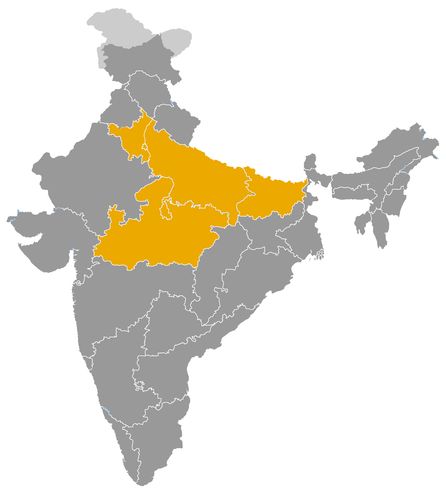
This map illustrates the maximum territory that the Harsha Dynasty had reached at its height, covering the current regions of Bihar, Delhi (NTC), Haryana, Madhya Pradesh and Uttar Pradesh in India. Its main purpose is to provide a visual aid to understand the geographical extent of this dynasty. However, it's important to note that the contemporary borders of these regions may not necessarily coincide with the historical territories.
The Harsha Period and Its Role in the History of Northern India
A reign associated with the Vardhana lineage rather than a separate dynasty
The so-called Harsha dynasty does not represent a separate dynasty in the strict historical sense. The expression refers here to the period dominated by Harshavardhana, the most prominent ruler of the Vardhana, or Pushyabhuti, lineage. This family was first established at Sthanishvara, modern Thanesar, before political authority shifted toward Kannauj under Harsha.
Harshavardhana ruled from 606 to 647 and occupies a distinctive place in Indian history. His reign came after the decline of the political order associated with the Guptas and before the more durable emergence of medieval regional kingdoms. He did not recreate an empire comparable in scale or administrative coherence to that of the Mauryas or the Guptas, but he succeeded in establishing authority or suzerainty over much of northern India. His reign therefore represents one of the last major attempts to create a broad political order in the north before a long period of regional competition.
The rise of Harsha in a fragmented political landscape
Harsha’s accession took place in a period of dynastic crisis and shifting alliances. His father, Prabhakaravardhana, had already strengthened the Vardhana position in the region of Thanesar. After his death, power briefly passed to Harsha’s elder brother, Rajyavardhana. The political situation then became unstable because of conflicts involving the Maukharis of Kannauj, the ruler of Gauda and other powers of northern India.
The death of Rajyavardhana and the crisis surrounding their sister Rajyashri brought Harsha into the centre of northern Indian politics. His rise was therefore both a dynastic succession and a military intervention in a wider regional struggle. From the beginning of his reign, Harsha had to restore his family’s authority, secure alliances and confront rivals who threatened the balance of power in the Gangetic plain.
This background shaped his political role. Harsha was not merely the heir of an established kingdom. He became a restorer of order in a region where several post-Gupta powers were competing for prestige, territory and legitimacy.
Kannauj as the centre of northern Indian authority
Under Harsha, Kannauj became the main political centre of his rule. This city occupied a strategic position in the central Gangetic plain, with access to agricultural resources, communication routes and networks linking western, central and eastern northern India. Its control allowed Harsha to project authority across a wide region.
The shift from Thanesar to Kannauj was politically significant. Thanesar represented the older dynastic base of the Vardhanas, while Kannauj became the symbol of wider kingship in northern India. After Harsha, the city remained a central prize in Indian politics and was later contested by major powers such as the Gurjara-Pratiharas, the Palas and the Rashtrakutas.
Harsha’s authority was not uniform across all territories associated with his rule. In some areas he exercised more direct control; elsewhere his influence depended on tributary relations, alliances or recognition of superior status. This flexible structure was typical of many early medieval Indian polities, where royal authority often rested on prestige, military power and negotiated relationships rather than centralised administration alone.
Cultural patronage and the prestige of Sanskrit court life
The Harsha period is closely associated with literary and intellectual activity. Sanskrit remained the principal language of high culture, courtly expression and learned production. Harsha himself is traditionally credited with plays such as Ratnavali, Priyadarsika and Nagananda, although the precise nature of these attributions must be treated with caution.
The court poet Bana played a major role in shaping Harsha’s image. His Harshacharita presents the ruler as an ideal king, protector of order and patron of culture. As a courtly work, it is not a neutral chronicle, but it is essential for understanding the values and political ideals associated with Harsha’s reign.
The visit of the Chinese Buddhist pilgrim Xuanzang also gave the period an international dimension. His observations on cities, monasteries, religious practices and political conditions made Harsha’s reign one of the better documented phases of early medieval India. Through such accounts, the Harsha period became important not only for Indian history but also for the wider history of Buddhist networks across Asia.
Religious patronage and the management of plural traditions
Harsha is often associated with Mahayana Buddhism, especially because of his support for Buddhist institutions and his connection with Xuanzang. However, his religious policy should not be reduced to Buddhism alone. He also supported Brahmanical institutions and ruled in a society where Hindu, Buddhist and Jain traditions coexisted.
The large religious assemblies held at Kannauj and Prayaga had political as well as spiritual significance. They displayed royal generosity, gathered religious elites and affirmed the ruler’s role as protector of moral and social order. Donations, ceremonies and public acts of patronage helped convert royal power into visible legitimacy.
This religious policy reflects a broader Indian model of kingship. The ruler was expected not only to conquer and govern, but also to protect religious institutions, support learned communities and redistribute wealth through ritualised generosity.
Economic foundations in the Gangetic plain
The economic strength of Harsha’s rule rested largely on the agricultural resources of northern India, especially the fertile regions of the Gangetic plain. Land revenue, local taxation, tribute and control of routes helped sustain the court, military activity and religious patronage.
Urban centres, pilgrimage sites and monasteries contributed to economic circulation. Religious donations had an important material dimension, since monasteries and Brahmanical establishments could receive land, income and privileges. Such transfers reinforced ties between political authority and religious institutions, while also shaping local patterns of landholding and administration.
The economy of the Harsha period was therefore not based on imperial expansion alone. It depended on agrarian productivity, regional exchange, institutional patronage and the ability of the ruler to maintain a network of dependent or allied territories.
A short-lived political order with lasting historical significance
Harsha’s power did not survive him in a durable form. After his death in 647, the political structure he had built rapidly weakened, largely because there was no strong successor capable of maintaining the same authority. This fragility shows that the unity of his realm depended heavily on his personal prestige and political skill.
Nevertheless, the Harsha period remains a major turning point in the history of northern India. It marks one of the last broad political formations of the post-Gupta world and anticipates the regional patterns of the medieval period. Through his military authority, cultural patronage, religious diplomacy and control of Kannauj, Harsha gave northern India a temporary but historically significant political balance.
The Geographical Reach of the Harsha Period in Northern India
A political sphere linked to Harshavardhana rather than a separate dynasty
The expression “Harsha dynasty” is not a separate dynastic label in the strict historical sense. It refers here to the period dominated by Harshavardhana, the most prominent ruler of the Vardhana, or Pushyabhuti, lineage. His reign, from 606 to 647, marked one of the last major attempts to create a broad political order across northern India before the rise of more durable regional kingdoms.
The geographical extent of Harsha’s authority must be understood with caution. His rule did not cover the entire Indian subcontinent, nor was his control equally direct in every region. In some territories he exercised firm authority, while in others his influence took the form of suzerainty, tribute, alliance or diplomatic recognition. Even so, his political sphere was substantial, centred on the Indo-Gangetic plain and organised around two important centres: Thanesar and Kannauj.
Thanesar as the original Vardhana power base
Before Harsha’s rise, the Vardhana dynasty was based at Sthanishvara, modern Thanesar, in present-day Haryana. This region occupied a strategic position in northern India, close to the Punjab, the Yamuna basin and the routes linking the Gangetic plain with north-western India. It was not merely a local capital, but a political base from which the Vardhanas could intervene in the affairs of neighbouring kingdoms.
Under Prabhakaravardhana, Harsha’s father, the Vardhana kingdom became more militarily active and politically visible. Its territory was still regional in scale, but it was well placed between the post-Gupta powers of the north, the frontier zones of the north-west and the richer lands of the central Gangetic plain. This initial base gave Harsha the military and dynastic foundation from which he could expand eastward.
Thanesar retained symbolic importance as the ancestral centre of the lineage. However, the wider geography of Harsha’s reign was shaped by the political shift toward Kannauj.
Kannauj and the control of the central Gangetic plain
The incorporation of Kannauj was the decisive stage in the expansion of Harsha’s power. Located in present-day Uttar Pradesh, Kannauj occupied a central position in the Gangetic plain. Control of this city gave access to fertile agricultural zones, riverine routes, military roads and networks of political influence connecting western, central and eastern northern India.
Harsha’s involvement in Kannauj was linked to the crisis of the Maukhari kingdom and to conflicts with other powers, especially Gauda. By making Kannauj his principal political centre, Harsha transformed his authority from a regional kingship based in Thanesar into a larger northern Indian monarchy.
The territories most closely associated with his rule included parts of present-day Haryana, Uttar Pradesh and probably significant areas of Bihar. His influence extended across much of the northern plain, although the precise degree of direct administration varied. In many areas, authority depended on dependent rulers, tribute relationships and recognition of Harsha’s superior status rather than on continuous bureaucratic control.
Eastern limits and rivalry with Gauda
The eastern expansion of Harsha’s power was shaped by conflict with the kingdom of Gauda, associated with Bengal and the ruler Shashanka. This rivalry was central to the early phase of Harsha’s reign. The political crisis involving Rajyavardhana, Rajyashri, the Maukharis and Gauda helped define the eastern frontier of Harsha’s ambitions.
Harsha succeeded in extending influence into parts of the eastern Gangetic region, but direct and lasting control over Bengal remained uncertain. The eastern territories of the subcontinent had strong local powers and complex political traditions. As a result, Harsha’s authority in this direction was less stable than in the central Gangetic plain.
This situation influenced relations with neighbouring dynasties by forcing Harsha to combine military action with diplomacy. The eastern frontier was not simply a line of conquest; it was a zone of rivalry, negotiation and fluctuating influence.
Southern boundary and the Chalukya resistance
The most clearly defined limit of Harsha’s expansion lay to the south. His attempt to extend power beyond northern India was checked by the Chalukya dynasty of Badami, ruled by Pulakeshin II. Their confrontation is one of the most important episodes in seventh-century Indian geopolitics.
The Narmada River became, in practice, a major boundary between Harsha’s northern sphere and the Chalukya-controlled Deccan. Harsha’s failure to defeat Pulakeshin II prevented the creation of a political order uniting the Gangetic north with peninsular India. It also confirmed the strength of the Deccan as an independent political zone.
This rivalry shaped Harsha’s external relations by defining the southern limit of his authority. It strengthened the prestige of the Chalukyas and showed that Harsha’s power, although extensive, was not subcontinental. His political world remained primarily northern Indian.
Western and Himalayan connections through diplomacy and suzerainty
To the west and north-west, Harsha’s influence was connected to the regions around Punjab, Rajasthan’s approaches and the old Vardhana base in Haryana. His authority in these areas seems to have relied on a mixture of direct inheritance, military pressure and alliances. These regions were important because they linked the Gangetic plain with routes toward Central Asia and north-western India.
Harsha also maintained relations with rulers in the Himalayan and trans-Himalayan sphere. These links were not necessarily territorial control in a strict sense, but they contributed to his prestige as a major northern Indian sovereign. Diplomatic recognition, religious patronage and participation in public assemblies helped display a hierarchy of power in which Harsha stood at the centre.
A broad but fragile northern Indian order
The geographical expansion of the Harsha period created a wide northern Indian political sphere, but not a deeply centralised empire. Its strongest centres were Thanesar and Kannauj, with the central Gangetic plain forming the core of authority. Around this core lay zones of alliance, tribute, rivalry and uncertain control.
This geography strongly affected relations with neighbouring dynasties. Gauda limited eastern expansion, the Chalukyas blocked southern ambitions, and smaller kingdoms were drawn into a system of suzerainty and diplomacy. Harsha’s power depended on military success, personal prestige and the ability to manage a network of subordinate or allied rulers.
After Harsha’s death in 647, this territorial order quickly weakened. Yet its historical importance remained considerable. His reign elevated Kannauj to a central position in northern Indian politics and prepared the ground for the later struggles among the Gurjara-Pratiharas, Palas and Rashtrakutas. The Harsha period therefore represents a brief but decisive moment in the political geography of early medieval India.
The Harsha period does not correspond to a separate dynasty in the strict sense. It refers here to the reign of Harshavardhana, the leading ruler of the Vardhana or Pushyabhuti dynasty, treated separately because of his political, cultural and religious importance in the history of northern India.
- Harshavardhana (606–647) • King of Thanesar and later ruler of Kannauj, he dominated much of northern India and brought the Vardhana dynasty to its greatest political and cultural prominence.