Français (France)
  Nederlands (nl-NL)
 Of Buddhist then Hindu tradition, (with additional Hindu, Buddhist and Jain influence), the Vardhana dynasty ruled for approximately 67 years, ± between 580 and 647 over all or part of Central India, East India and North India, during the Classical Period and the Medieval Period.
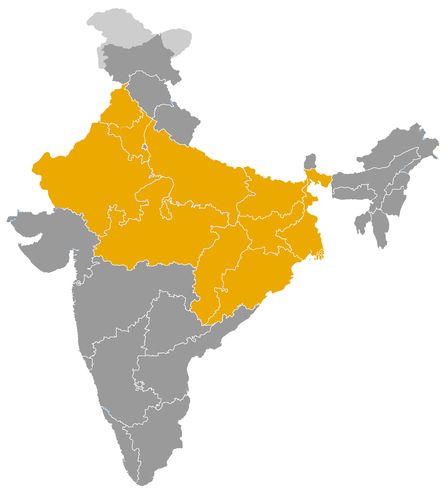
This map illustrates the maximum territory that the Vardhana Dynasty had reached at its height, covering the current regions of Bihar, Haryana, Jharkand, Madhya Pradesh, Odisha, Punjab, Rajasthan, Uttar Pradesh and West Bengal in India. Its main purpose is to provide a visual aid to understand the geographical extent of this dynasty. However, it's important to note that the contemporary borders of these regions may not necessarily coincide with the historical territories.
The Vardhana Dynasty and Its Role in the History of Northern India
A post-Gupta power in a fragmented political landscape
The Vardhana dynasty, also known as the Pushyabhuti dynasty, occupies an important place in the history of northern India during the transition between the classical and early medieval periods. Its first political centre was Sthanishvara, modern Thanesar in Haryana, before its authority became closely associated with Kannauj under Harshavardhana, better known as Harsha.
The dynasty rose after the weakening of the Gupta political order, when northern India was divided among several regional powers. In this context, the Vardhanas were not heirs to a fully unified empire, but builders of a new political structure in a fragmented landscape. Their importance lies less in the length of their rule than in their ability to restore, for a short period, a broad northern Indian authority centred on the Gangetic plain.
Thanesar as the first dynastic base of power
The early Vardhanas appear to have ruled as regional kings in and around Thanesar. The earliest figures of the dynasty, including Naravardhana, Rajyavardhana I and Adityavardhana, are poorly documented, and their political reach was probably limited. Their role was nevertheless important because they established the territorial and dynastic base from which later expansion became possible.
The dynasty became more prominent under Prabhakaravardhana, the father of Harsha. He strengthened the military standing of the Vardhanas and asserted their position among the competing powers of northern India. His reign marked the transition from a local or regional lineage to a more ambitious political house.
Thanesar’s location was strategically significant. It lay near the Punjab, the Yamuna basin and the routes connecting north-western India with the Gangetic plain. This position allowed the Vardhanas to participate in the politics of both the western and central parts of northern India.
Harshavardhana and the expansion of Vardhana authority
The decisive phase of Vardhana history came with Harshavardhana, who ruled from 606 to 647. His accession followed a period of dynastic crisis. After the death of his father, his elder brother Rajyavardhana II briefly succeeded to the throne, but conflicts involving the Maukharis of Kannauj, the kingdom of Gauda and other regional powers soon reshaped the political situation.
Harsha emerged from this crisis as the central figure of the dynasty. He extended Vardhana authority beyond Thanesar and shifted the political centre toward Kannauj, a city of exceptional importance in the central Gangetic plain. This move transformed the dynasty from a regional power into the leading force of northern India.
His authority extended over much of the north, although it was not uniform everywhere. Some territories were probably under direct control, while others were linked through tribute, alliance, suzerainty or recognition of his superior status. This flexible structure was typical of many early medieval Indian polities, where prestige, military capacity and diplomatic relations were as important as centralised administration.
A political bridge between classical empire and regional kingdoms
The Vardhana dynasty represents a transitional moment in Indian political history. It did not recreate the scale or administrative unity of the Gupta Empire, yet it temporarily restored a broad political order in northern India. Its power was strongest in the Indo-Gangetic plain, while its southern expansion was blocked by the Chalukyas of Badami under Pulakeshin II.
This confrontation with the Chalukyas was historically significant because it confirmed the political separation between northern India and the Deccan. Harsha’s failure to extend lasting authority beyond the Narmada showed the limits of Vardhana expansion and the strength of peninsular powers.
After Harsha’s death, the dynasty’s authority collapsed rapidly, largely because no strong successor maintained his network of power. This fragility shows that the Vardhana political order depended heavily on Harsha’s personal prestige and leadership. Nevertheless, the dynasty helped raise Kannauj to a central position in northern Indian politics, where it remained a major prize for later powers.
Cultural influence through Sanskrit literature and court patronage
The cultural role of the Vardhanas is closely linked to Harsha’s court. Sanskrit remained the language of prestige, literary production and royal representation. Harsha himself is traditionally associated with several Sanskrit plays, including Ratnavali, Priyadarsika and Nagananda, although such attributions must be treated with caution.
The most important literary figure of the period was Bana, author of the Harshacharita. This work presents Harsha as an ideal ruler, restorer of order and patron of culture. Although it is a courtly text rather than a neutral historical chronicle, it remains essential for understanding the political ideals, literary refinement and royal imagery of the Vardhana period.
The presence of the Chinese Buddhist pilgrim Xuanzang also gave the dynasty an international dimension. His account of northern India under Harsha provides important information about cities, monasteries, religious practices and political conditions. Through such testimony, the Vardhana period became one of the better documented phases of early medieval India.
Religious patronage in a plural society
Harsha is often associated with Mahayana Buddhism, especially because of his support for Buddhist institutions and his relationship with Xuanzang. However, Vardhana religious policy should not be reduced to Buddhism alone. The dynasty also supported Brahmanical traditions and operated in a society where Hindu, Buddhist and Jain communities coexisted.
Large religious assemblies at Kannauj and Prayaga had both spiritual and political importance. They displayed royal generosity, gathered religious elites and reinforced the ruler’s image as protector of moral and social order. Religious patronage thus served both devotional and political purposes.
Economic foundations in agriculture, tribute and religious institutions
The Vardhana economy was based primarily on the agricultural wealth of northern India, especially the fertile lands of the Gangetic plain. Land revenue, tribute, local taxation and control of routes supported the court, army and religious patronage.
Donations to monasteries and Brahmanical institutions also had economic significance. They transferred land, income and privileges to religious communities, strengthening links between political authority and local society. This system helped organise landholding, patronage and social hierarchy.
A short-lived dynasty with lasting historical importance
The Vardhana dynasty was brief, but its historical role was substantial. It restored a measure of political unity in northern India, strengthened Kannauj as a major centre of power, supported Sanskrit culture and promoted religious patronage across several traditions.
Its collapse after Harsha’s death shows the limits of a political order built around one dominant ruler. Yet its legacy remained important. The Vardhanas stand at a turning point between the classical world of the Guptas and the regional kingdoms of medieval India.
The Geographical Expansion of the Vardhana Dynasty in Northern India
A regional dynasty rooted in Thanesar
The Vardhana dynasty, also known as the Pushyabhuti dynasty, first developed as a regional power in northern India. Its earliest political centre was Sthanishvara, modern Thanesar in Haryana. This location was strategically important because it stood near the Punjab, the upper Yamuna basin and the routes linking north-western India with the central Gangetic plain.
In its early phase, the dynasty probably controlled a relatively limited territory around Thanesar. The first known rulers, such as Naravardhana, Rajyavardhana I and Adityavardhana, are poorly documented, and their authority appears to have been regional rather than imperial. Their domain likely included parts of present-day Haryana and neighbouring areas connected with the Yamuna corridor.
This initial base was nevertheless significant. It gave the Vardhanas access to military routes, agricultural resources and political networks that connected the north-western frontier zones with the richer lands of the Gangetic plain. Under Prabhakaravardhana, the father of Harshavardhana, the dynasty became more assertive and began to play a more visible role in the politics of northern India.
The shift from Thanesar to Kannauj
The decisive expansion of Vardhana power occurred under Harshavardhana, who ruled from 606 to 647. His accession followed a period of dynastic crisis involving the death of his father, the short reign and death of his brother Rajyavardhana II, and conflicts connected with the Maukharis of Kannauj and the kingdom of Gauda.
Kannauj became the key to wider Vardhana expansion. Located in the central Gangetic plain, in present-day Uttar Pradesh, it offered a far more advantageous position than Thanesar for controlling northern India. It lay close to fertile agricultural lands, riverine routes, military roads and communication networks linking western, central and eastern parts of the Gangetic basin.
The move toward Kannauj marked a major transformation. Thanesar remained the ancestral and dynastic centre, but Kannauj became the political capital of a broader northern Indian monarchy. Through this shift, the Vardhanas moved from regional kingship to a wider form of sovereignty, based on control of the Gangetic plain and recognition by neighbouring powers.
Control over the Indo-Gangetic heartland
Under Harshavardhana, the Vardhana sphere extended across a large part of northern India. The strongest core of authority probably included Haryana, much of Uttar Pradesh and important parts of the central Gangetic plain. Areas of Bihar also seem to have fallen within Harsha’s influence, although the degree of direct control varied from region to region.
The Vardhana state should not be imagined as a uniformly administered empire. In some areas, royal authority was probably direct; in others, it operated through tribute, alliance, suzerainty or recognition of Harsha’s superior status. This flexible political geography was typical of many early medieval Indian kingdoms. Authority depended not only on administration, but also on military prestige, ritual status, diplomacy and networks of subordinate rulers.
The control of the Indo-Gangetic plain gave the Vardhanas access to major economic resources. The region was agriculturally rich and contained important towns, religious centres and routes of circulation. This geographical base allowed Harsha to sustain military campaigns, courtly patronage and large religious assemblies.
Eastern expansion and rivalry with Gauda
The eastern limits of Vardhana expansion were shaped by rivalry with the kingdom of Gauda, associated with Bengal and the ruler Shashanka. This conflict was central to the early political career of Harsha. The crisis involving Rajyavardhana, Rajyashri, the Maukhari kingdom and Gauda made the eastern Gangetic region one of the main theatres of Vardhana ambition.
Harsha appears to have extended his influence into parts of the eastern Gangetic plain, especially toward Bihar. However, direct and durable control over Bengal remained limited or uncertain. Gauda retained a strong political identity, and eastern India continued to contain regional powers capable of resisting full incorporation into the Vardhana sphere.
This situation shaped relations with neighbouring dynasties. The Vardhanas could not simply absorb the eastern kingdoms; they had to combine military pressure, diplomacy and symbolic claims to overlordship. The eastern frontier was therefore a zone of competition rather than a clearly fixed administrative boundary.
The southern boundary formed by the Chalukyas
The most important limit to Vardhana expansion lay in the south. Harshavardhana’s attempt to extend his authority beyond northern India was checked by the Chalukya dynasty of Badami under Pulakeshin II. Their confrontation was one of the major political events of seventh-century India.
The Narmada River became, in practice, the dividing line between Harsha’s northern sphere and the Chalukya-dominated Deccan. Harsha’s failure to defeat Pulakeshin II prevented the creation of a political order uniting the Gangetic north with peninsular India. It also confirmed the Chalukyas as a major power capable of resisting northern expansion.
This southern limit strongly influenced relations between dynasties. It created a balance between the Vardhanas in the north and the Chalukyas in the Deccan. Rather than becoming a subcontinental empire, Vardhana power remained essentially northern Indian.
Western and northern connections
To the west and north-west, the Vardhanas remained connected to their original base around Thanesar and to regions near Punjab. These zones were important because they linked the dynasty to the routes leading toward north-western India and Central Asian contacts. Control or influence in this direction strengthened the strategic value of the dynasty’s homeland.
Harsha also maintained diplomatic relations with rulers beyond his directly controlled territory, including Himalayan and trans-Himalayan spheres. These relationships were not necessarily forms of territorial rule, but they contributed to his prestige as a major northern Indian ruler.
A broad but short-lived territorial order
The geographical expansion of the Vardhana dynasty was impressive but fragile. It rested on an original base at Thanesar, expanded through the control of Kannauj, and reached its greatest extent across much of the Indo-Gangetic plain. Its eastern ambitions were limited by Gauda, while its southern advance was blocked by the Chalukyas.
After Harshavardhana’s death in 647, this territorial order quickly weakened. Yet its effects were lasting. The Vardhanas elevated Kannauj to a central place in northern Indian politics and helped define the geopolitical landscape that later medieval dynasties would contest. Their expansion was brief, but it marked a decisive stage in the transition from post-Gupta fragmentation to the regional power struggles of early medieval India.
The Vardhana dynasty is also known as the Pushyabhuti dynasty. It was first centred on Sthanishvara, modern Thanesar, and later associated with Kannauj under Harshavardhana. The earliest rulers are poorly documented and their dates remain indicative; the titles range from regional kingship to imperial titulature under Harsha.
- Pushyabhuti (c. late 5th century or early 6th century) • Traditional founder of the lineage, he remains a poorly documented figure known mainly through dynastic tradition.
- Naravardhana (c. 500–525) • Regional ruler of the Pushyabhuti line, he belongs to the earliest phase known through dynastic genealogies.
- Rajyavardhana I (c. 525–555) • Ruler of the Vardhana line, he continued the consolidation of family power in the Thanesar region.
- Adityavardhana (c. 555–580) • Regional ruler, he strengthened the dynasty’s position before the more prominent rise of Prabhakaravardhana.
- Prabhakaravardhana (c. 580–605) • King of Thanesar, he greatly increased the military and political power of the Vardhanas against neighbouring kingdoms.
- Rajyavardhana II (605–606) • King of Thanesar, he briefly succeeded his father during a political crisis in northern India.
- Harshavardhana (606–647) • King of Thanesar and later ruler of Kannauj, he dominated much of northern India and brought the dynasty to its greatest prominence.
 Links to the main sections of the site