Français (France)
  Nederlands (nl-NL)
 Of Hindu tradition, (with additional Jain influence), the Rajputs: clans, lineages and princely houses ruled for approximately 1397 years, ± between 550 and 1947 over all or part of Central India, North India and the Himalayan region, during the Classical Period, the Medieval Period, the Colonial Period and the Modern Period.
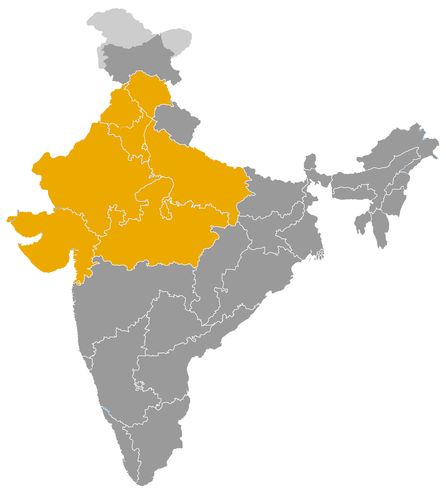
This map illustrates the maximum territory that the Rajputs: clans, lineages and princely houses Dynasty had reached at its height, covering the current regions of Delhi (NTC), Haryana, Himachal Pradesh, Madhya Pradesh, Punjab, Rajasthan and Uttar Pradesh in India. Its main purpose is to provide a visual aid to understand the geographical extent of this dynasty. However, it's important to note that the contemporary borders of these regions may not necessarily coincide with the historical territories.
The Rajputs and the Formation of Aristocratic Power in Indian History
A group of lineages rather than a single dynasty
The term Rajput does not refer to one dynasty, one kingdom or one continuous line of rulers. It designates a broad aristocratic and warrior grouping that developed over time in northern, western and central India. Rajput identity was associated with lineage, landholding, martial prestige and claims to kshatriya status. For this reason, the Rajputs should be understood as a constellation of clans and ruling houses rather than as a unified political dynasty.
Among the best known Rajput groups were the Chahamanas or Chauhans, the Guhilas and later Sisodias of Mewar, the Rathores of Marwar, the Kachwahas of Amber and Jaipur, the Hadas of Bundi and Kota, the Bhatis of Jaisalmer, the Chandelas of Bundelkhand, the Paramaras of Malwa, the Solankis or Chaulukyas of Gujarat, the Bundelas and several others. Each of these houses had its own regional history, political alliances, conflicts, capitals and genealogical traditions. The historical role of the Rajputs lies precisely in this diversity.
Regional rulers in medieval and early modern India
Politically, Rajput houses played a major role in the formation of regional powers from the early medieval period onward. They controlled forts, towns, agricultural districts, trade routes, desert zones and mountain passes. Their authority was rooted in military capacity, land control and the prestige of descent. In many regions, Rajput rulers acted as kings, rajas, ranas, maharanas, rawals, raos, thakurs or local chiefs, depending on the territory and period.
The strongest Rajput states emerged in regions such as Rajasthan, Gujarat, Malwa, Bundelkhand and parts of the western Gangetic plain. Mewar, Marwar, Amber, Jaisalmer, Bundi, Kota, Bikaner, Orchha and several other centres became associated with distinctive Rajput ruling traditions. These polities were often smaller than the great imperial states of Indian history, but they were durable, strategically placed and deeply rooted in local society.
Rajput power was not limited to independent rule. Many Rajput chiefs also served larger empires as military commanders, governors or subordinate allies. This dual role, both autonomous and service based, made them important intermediaries between imperial centres and regional societies.
Conflict and cooperation with sultanates and the Mughal Empire
The Rajputs are often remembered for their resistance to external conquest, especially in relation to the Delhi Sultanate and the Mughal Empire. Fortresses such as Chittorgarh, Ranthambore and Jaisalmer became symbols of military endurance and dynastic honour. Episodes of siege, sacrifice and defence occupy an important place in Rajput historical memory.
However, Rajput relations with Islamic powers were not defined only by conflict. They also included diplomacy, alliance, service and marriage politics. Under the Mughal emperor Akbar, several Rajput houses became important partners of the empire. The Kachwahas of Amber, in particular, rose to high rank in the Mughal administration and army. Rajput nobles served as commanders, mansabdars and provincial officers, while some ruling families strengthened their regional position through imperial favour.
This cooperation did not erase conflict. The Sisodias of Mewar, for example, maintained a powerful tradition of resistance, especially under rulers such as Rana Sanga and Maharana Pratap. The Rajput world therefore cannot be reduced to either opposition or collaboration. It was shaped by a pragmatic political culture in which honour, autonomy, advantage and survival were constantly balanced.
Cultural patronage and the shaping of regional identities
The cultural impact of the Rajputs was considerable. Their courts supported architecture, painting, poetry, music, temple construction, genealogical writing and heroic narrative traditions. Rajput patronage helped produce some of the most recognisable artistic and architectural landscapes of India.
Forts and palaces were central to Rajput political culture. Chittorgarh, Kumbhalgarh, Mehrangarh, Amber, Jaisalmer, Bundi, Gwalior and Orchha reflect a world in which military defence, dynastic representation and artistic refinement were closely linked. These complexes were not only strongholds. They were ceremonial centres, symbols of legitimacy and expressions of regional identity.
Rajput courts also fostered important schools of painting, particularly in Rajasthan. Mewar, Marwar, Bundi, Kota, Jaipur and Kishangarh developed distinctive visual traditions. These works depicted courtly life, religious themes, hunting scenes, epics and devotional subjects. They reveal the Rajput capacity to combine martial ideals with refined cultural patronage.
The Rajput cultural world was also shaped by bards, genealogists and oral traditions. These traditions preserved memories of descent, battle, loyalty, sacrifice and honour. They contributed strongly to the identity of Rajasthan and to wider Indian images of heroic kingship.
Economic foundations in land, routes and fortified centres
The economic strength of Rajput houses depended largely on land revenue, control of villages, taxes on trade and access to strategic routes. In arid regions such as Rajasthan, the management of water, wells, tanks and artificial lakes was essential. Fortified towns often developed around routes linking Gujarat, Delhi, Sindh, Malwa and northern India.
Some Rajput states benefited from caravan trade, salt routes, agricultural taxation or tribute from subordinate chiefs. Others depended on service within larger imperial systems. Under the Mughals, Rajput nobles could receive mansabs, jagirs and military assignments that expanded their resources. Under Maratha and later British pressure, many Rajput states preserved internal authority but accepted varying degrees of external suzerainty.
This economic adaptability helped explain the survival of Rajput houses into the colonial period. Many became princely states under British paramountcy and retained ceremonial status until the integration of princely states into independent India after 1947.
A lasting legacy in Indian political and cultural history
The Rajputs occupy an enduring place in Indian history as one of the most important aristocratic and regional power formations of the subcontinent. They were not a single dynasty, but a network of clans and ruling houses whose influence extended across warfare, governance, architecture, literature, religion and regional memory.
Their legacy remains visible in forts, palaces, temples, paintings, genealogies and the political history of former princely states. They shaped the history of Rajasthan in particular, but their influence extended far beyond it. In the broader history of India, the Rajputs represent a durable model of lineage based power, martial prestige and regional sovereignty, marked by both fragmentation and remarkable continuity.
The Geographical Reach of the Rajput Clans and Princely Houses in India
A network of regional powers rather than a single kingdom
The Rajputs did not form one dynasty with a single capital, territory or line of succession. They were a broad group of clans, lineages and princely houses that developed across northern, western and central India over many centuries. Their geographical expansion was therefore not the expansion of a unified empire, but the spread of many related aristocratic houses that controlled forts, towns, agrarian districts, desert routes and hill regions.
Their strongest and most enduring base was Rajasthan, but Rajput power also extended into Gujarat, Malwa, Bundelkhand, parts of the western Gangetic plain, the Himalayan foothills, Kathiawar and central India. Some houses ruled compact kingdoms, while others governed frontier forts, semi-arid tracts, tributary estates or princely states under larger imperial systems. This territorial diversity explains why Rajput history is best understood through clans and ruling houses rather than through one continuous dynastic chronology.
Rajasthan as the principal Rajput heartland
Rajasthan became the region most closely associated with Rajput power. Its geography, marked by deserts, hills, plateaus, trade routes and fortified settlements, favoured the rise of warrior lineages controlling strategic points. Mewar, Marwar, Amber, Jaipur, Bikaner, Jaisalmer, Bundi, Kota and several smaller states became major centres of Rajput political identity.
The Sisodias of Mewar controlled the region around Chittorgarh and later Udaipur. Their territory occupied a strategic position between the Aravalli hills, Gujarat and the plains of northern India. Marwar, ruled by the Rathores from Jodhpur, dominated a large part of western Rajasthan and controlled routes across the Thar Desert. The Bhatis of Jaisalmer held an important frontier zone linked to desert trade and routes toward Sindh. The Kachwahas of Amber and later Jaipur occupied eastern Rajasthan, closer to the Mughal heartland and the routes toward Delhi and Agra.
This concentration of Rajput states made Rajasthan a mosaic of related but often competing powers. Alliances, rivalries, marriages and wars between Rajput houses were frequent, and their relations with external empires were shaped by the need to defend or expand these regional territories.
Gujarat, Kathiawar and western maritime connections
Rajput influence also extended into Gujarat and Kathiawar. The Chaulukyas, also known as Solankis, were among the most important medieval ruling houses of Gujarat. Later Rajput groups such as the Jadejas became prominent in Kutch and parts of Saurashtra. These western territories differed from the inland Rajput states of Rajasthan because they were connected to maritime trade, ports and commercial networks across the Arabian Sea.
Control of Gujarat and Kathiawar brought Rajput houses into contact with merchant communities, Islamic sultanates, coastal polities and later European trading powers. The geography of these regions made political authority dependent not only on forts and land revenue, but also on trade routes, ports, salt, pastoral zones and access to sea borne commerce.
Relations with neighbouring dynasties were often shaped by competition for commercial centres and routes. The Rajput houses of western India had to interact with the Gujarat Sultanate, the Mughals, local chiefs and later the British. Their survival often depended on adaptation, alliance and recognition within broader political systems.
Malwa, Bundelkhand and central Indian Rajput power
In central India, Rajput lineages controlled important regions such as Malwa and Bundelkhand. The Paramaras of Malwa ruled from centres including Dhar and played a major role in the political and cultural history of central India. Their territory linked northern India, Gujarat and the Deccan, making Malwa a strategic region frequently contested by neighbouring powers.
The Chandelas of Bundelkhand ruled the region historically known as Jejakabhukti. Their territory included important strongholds and temple centres, most famously Khajuraho. Later, the Bundelas became a major Rajput house in the same broad region, ruling from centres such as Orchha and Datia. Bundelkhand’s rugged terrain, river valleys and forts gave local dynasties opportunities for resistance and autonomy, but also exposed them to pressure from larger states.
These central Indian territories placed Rajput houses between the powers of the Gangetic plain, the Deccan and western India. As a result, they frequently interacted with the Delhi Sultanate, the Mughals, the Marathas and neighbouring regional rulers.
Rajput frontiers in northern India and the Himalayan foothills
Rajput clans were also present in parts of northern India beyond Rajasthan. The Tomaras were associated with Delhi and surrounding regions before the rise of later powers. The Chahamanas or Chauhans controlled areas including Shakambhari, Ajmer, Delhi, Ranthambore and Jalor through various branches. Their territories placed them directly in the path of expanding Turkic and Afghan powers from the northwest.
In the Himalayan foothills and hill states, Rajput lineages also played an important role. Several ruling houses in present day Himachal Pradesh and neighbouring hill regions claimed Rajput status or maintained Rajput political traditions. These territories were smaller and more fragmented than the great plains kingdoms, but their mountain geography allowed many local dynasties to preserve autonomy for long periods.
The frontier position of these northern and hill Rajput houses shaped relations with larger powers. They could serve as allies, tributaries or buffers between empires and mountain regions.
Relations with sultanates, Mughals, Marathas and the British
Rajput geography strongly influenced political relations with neighbouring dynasties. States located near Delhi, Ajmer and the Gangetic plain were drawn early into conflict with the Delhi Sultanate. Forts such as Ranthambore and Chittorgarh became important military targets because they controlled strategic routes and symbolised regional authority.
Under the Mughals, Rajput states followed different strategies. Some, especially the Kachwahas of Amber, entered close alliance with the empire and gained high office. Others, particularly Mewar, preserved a stronger tradition of resistance, although even these relations changed over time. Rajput territories became part of the imperial system through diplomacy, marriage alliances, military service and negotiated autonomy.
In the eighteenth century, the decline of Mughal power exposed Rajput states to Maratha pressure. Tribute, warfare and shifting alliances became common. Under British paramountcy, many Rajput states survived as princely states, retaining internal authority but losing full sovereignty.
A lasting territorial legacy in Indian history
The geographical history of the Rajputs is the history of a dispersed but durable aristocratic world. From Rajasthan to Gujarat, from Malwa to Bundelkhand, and from Delhi to the Himalayan foothills, Rajput houses shaped regional politics through forts, capitals, estates and princely courts. Their territories were rarely united under one authority, but together they formed one of the most enduring political landscapes of northern and western India.
Their influence survived the sultanates, the Mughals, the Marathas and the British Raj. After 1947, the princely states were integrated into independent India, ending their political sovereignty. Yet the geography of former Rajput rule remains visible in forts, palaces, cities, regional identities and the historical memory of Rajasthan and neighbouring regions.
The Rajputs did not form a single dynasty, but a broad group of clans, lineages and ruling houses that developed gradually in northern, western and central India. The dates below indicate periods of political emergence or regional dominance, not continuous individual reigns; they are therefore indicative and may vary according to branches and historical traditions.
- Guhila or Guhilot (c. 6th–14th century) • An early lineage associated with Mewar, it formed one of the dynastic foundations of later Rajput houses in the region.
- Tomara (c. 8th–12th century) • A Rajput clan associated especially with Delhi and parts of northern India before the rise of the Chahamanas and the sultanates.
- Paramara (c. 9th–14th century) • A Rajput ruling house linked mainly to Malwa, noted for its political and cultural role around Dhar.
- Chandela (c. 9th–13th century) • A lineage of Bundelkhand, it ruled the region of Jejakabhukti and patronised the temples of Khajuraho.
- Chaulukya or Solanki (c. 10th–13th century) • A ruling house of Gujarat and western India, it played a major role in regional architecture and politics.
- Chahamana or Chauhan (c. 10th–14th century) • A major Rajput clan grouping associated with Shakambhari, Ajmer, Delhi, Ranthambore, Jalor and several regional branches.
- Bhati (c. 10th century–1949) • A Rajput clan associated with the Thar Desert and Jaisalmer, where its rawals maintained a strong frontier identity.
- Jadeja (c. 12th century–1948) • A Rajput house of Yaduvanshi tradition, established mainly in Kutch and Saurashtra in western India.
- Rathore (c. 13th century–1949) • A Rajput clan that became dominant in Marwar, Jodhpur and Bikaner, with several important princely branches.
- Sisodia of Mewar (c. 14th century–1948) • A branch descended from the Guhilas, it bore the title rana and later maharana and became famous for its symbolic resistance to sultanates and Mughals.
- Kachwaha (c. 11th century–1949, major prominence from the 16th century) • The ruling house of Amber and later Jaipur, it gained great importance through its alliances with the Mughal Empire.
- Hada (c. 14th century–1949) • A Chauhan branch established in Bundi and Kota, it played a notable role in the political history of eastern Rajasthan.
- Jhala (c. 14th century–1948) • A Rajput clan present especially in Gujarat, Saurashtra and several princely states linked to Rajasthan and Kathiawar.
- Bundela (c. 16th century–1948) • A Rajput house of Bundelkhand, it ruled Orchha, Datia and several princely states of central India.
 Links to the main sections of the site