

 Français (France)
  Nederlands (nl-NL)
 Jantar Mantar in Jaipur is a monumental astronomical observatory located in the capital of the Indian state of Rajasthan. Designed for systematic observation of celestial phenomena, the complex consists of large-scale instruments built in stone and masonry. These structures were created to measure time, determine the positions of celestial bodies, and study the movements of the sun, moon, and planets according to the principles of traditional Indian astronomy. Through its scientific conception and the scale of its installations, the site represents an important example of astronomical knowledge developed in India during the pre-modern period. Today, Jantar Mantar is recognized as a significant element of Jaipur’s scientific and cultural heritage.

Monument profile
Jantar Mantar
Monument category: Observatory
Monument family: Historic University or Observatory
Monument genre: Cultural or scientific
Geographic location: Jaipur • Rajasthan • India
Construction period: 18th century AD
This monument in Jaipur is inscribed on the UNESCO World Heritage List under the name Jantar Mantar since 2010.See the UNESCO monuments featured on this site
• Links to •
• Dynasties that contributed to the construction of the monument •


• List of videos about Jaipur on this site •
Jaipur, the pink city • Rajasthan, India
• References •
UNESCO: The Jantar Mantar, Jaipur
History of Jantar Mantar in Jaipur
Foundation of the Observatory and the Initiative of Sawai Jai Singh II
The Jantar Mantar observatory in Jaipur was constructed in the early eighteenth century under the patronage of Maharaja Sawai Jai Singh II, ruler of the Kachhwaha dynasty and founder of the planned city of Jaipur. The establishment of the observatory formed part of the ruler’s broader intellectual and administrative initiatives, which included the promotion of scientific knowledge, astronomical calculation, and the refinement of calendrical systems used in political and religious contexts.
Construction of the observatory began around 1728 and continued for several years during the early development of Jaipur as a new royal capital. Sawai Jai Singh II personally supervised many aspects of the project and relied on a network of scholars and astronomers familiar with Indian astronomical traditions as well as scientific works circulating in Persian and Arabic scholarly communities. The ruler sought to improve the accuracy of astronomical observations that were essential for the preparation of calendars, the determination of ritual timings, and the interpretation of astrological data used by the court.
A central element of Jai Singh’s approach was his decision to construct large fixed instruments in masonry rather than relying solely on smaller portable devices. Instruments made of metal or wood were considered vulnerable to misalignment and wear, which could introduce errors in astronomical measurements. By building instruments directly in stone and brick, the observatory could maintain precise orientations and stable geometrical proportions. The Jantar Mantar in Jaipur was conceived as the most extensive and technically ambitious of the observatories commissioned by the ruler.
A Network of Observatories and the Role of Jaipur
The Jaipur observatory formed part of a wider program that included similar installations in several other cities of northern India. Sawai Jai Singh II sponsored observatories in Delhi, Ujjain, Mathura, and Varanasi. Each of these locations had specific astronomical or geographical importance, but the observatory in Jaipur was designed as the largest and most complete facility within the network.
The construction of the Jaipur observatory reflected the ruler’s intention to consolidate astronomical research within his newly established capital. The site brought together a large number of instruments capable of measuring different celestial coordinates and determining time through solar observation. Scholars associated with the court used these installations to conduct systematic observations and to compare existing astronomical tables with empirical data obtained from the instruments.
One of the principal scholarly projects connected with the observatory was the compilation of revised astronomical tables known as the Zij-i Muhammad Shahi. This work was prepared under Jai Singh’s patronage with the assistance of astronomers trained in both Indian and Islamic traditions of mathematical astronomy. Observations carried out at Jantar Mantar contributed to the correction and verification of numerical data used in astronomical calculations.
The observatory therefore functioned not only as a physical installation but also as an intellectual center where astronomical knowledge was studied, measured, and recalculated. Its instruments were used by specialists capable of interpreting complex mathematical relationships between celestial movements and the systems of coordinates employed in Indian astronomy.
Decline of Scientific Activity after the Eighteenth Century
After the death of Sawai Jai Singh II in 1743, the scientific activity associated with the observatory gradually diminished. Although the monumental instruments remained intact, the systematic program of astronomical observation initiated during the ruler’s lifetime was not maintained with the same intensity by his successors.
Changes in political circumstances within the region contributed to this decline. The resources required to support a permanent group of astronomers and technicians became more difficult to sustain, and the observatory slowly lost its function as an active center of research. Without continuous use, some instruments fell into partial disrepair, and certain surfaces used for measurement began to deteriorate.
During the nineteenth century, when the region came under the influence of British colonial administration, the observatory attracted attention from travelers, scholars, and officials who documented its unusual structures. European observers often described the instruments as remarkable constructions, though their precise methods of use were not always fully understood by outside visitors.
Despite the reduction in scientific activity, the physical structures of the observatory survived largely intact. The monumental scale of the instruments and the durability of their masonry construction contributed to their preservation even during periods of limited maintenance.
Recognition as a Historical Monument and Modern Preservation
Interest in the historical and scientific importance of the Jantar Mantar increased during the twentieth century. Historians of science and archaeologists began to examine the instruments in detail in order to understand their functions and the mathematical principles underlying their design. These studies helped clarify the role of the observatory within the broader development of astronomy in South Asia.
Preservation efforts were gradually introduced to stabilize the structures and protect the surfaces of the instruments from further deterioration. Conservation work focused on repairing damaged masonry, restoring protective plaster layers, and maintaining the visibility of the measurement markings engraved on certain structures.
As Jaipur developed as a major cultural and tourist destination, the observatory became an important historical site visited by scholars and the general public. The preservation of the instruments allowed the complex to illustrate the scientific ambitions of Sawai Jai Singh II and the architectural expression of astronomical measurement in the eighteenth century.
In 2010, the Jantar Mantar in Jaipur was inscribed on the UNESCO World Heritage List as “Jantar Mantar, Jaipur.” The inscription recognizes the exceptional value of the observatory as the most complete and best-preserved example among the astronomical installations built under Jai Singh’s patronage. Today the site is protected as a cultural monument and maintained as a place of education, research, and heritage interpretation.
Global Historical Context
The construction of the Jantar Mantar observatory in the 1720s and 1730s coincided with a period of significant scientific development in several parts of the world. In Europe, the work of Isaac Newton and subsequent advances in mathematical astronomy influenced new methods of observation and calculation. In the Ottoman and Persian scholarly spheres, traditions of astronomical tables and observational instruments remained active. In Qing dynasty China, imperial calendars were being revised with the assistance of astronomers trained in European methods introduced by Jesuit scholars. These contemporaneous developments illustrate the global interest in precise astronomical observation during the early eighteenth century.
Architecture of Jantar Mantar in Jaipur
Site Layout and Spatial Organization of the Observatory
The Jantar Mantar observatory in Jaipur occupies a large enclosed area situated within the historic urban core of the city, near the City Palace complex. The observatory is defined by a perimeter wall that separates the instruments from the surrounding urban environment while maintaining an open interior space. Unlike an enclosed scientific building, the observatory is composed entirely of large architectural instruments arranged across a level ground plan. These structures are distributed across the site according to geometric alignments that correspond to astronomical orientations.
The layout is structured around open courtyards that allow unobstructed observation of the sky. The instruments are positioned in relation to the cardinal directions, ensuring that each structure maintains the orientation required for accurate astronomical measurement. This spatial arrangement produces a clear circulation pattern within the complex, allowing observers to move between instruments without interfering with the lines of sight required for celestial observations.
The ground plan combines monumental instruments with smaller auxiliary devices, creating a landscape composed of geometric volumes and inclined planes. The largest instruments dominate the central areas of the complex, while smaller instruments are placed in peripheral zones or in spaces between the main structures. The resulting composition forms an architectural environment where each instrument functions as an independent structure but contributes to a coherent spatial system.
Open areas between the instruments serve both practical and architectural functions. These spaces allow the movement of observers and provide clear sightlines to the sky above the instruments. The absence of roofs or enclosed chambers ensures that all measurements are conducted under direct exposure to sunlight and celestial visibility.
Materials and Construction Techniques
The instruments of the Jantar Mantar observatory are constructed primarily from masonry composed of stone blocks and brickwork bonded with lime mortar. This method of construction was selected in order to produce extremely stable structures capable of maintaining precise geometric forms. The use of masonry allowed the builders to construct large-scale surfaces with carefully controlled angles and orientations.
Most of the measuring surfaces are covered with smooth lime plaster, creating a uniform finish that facilitates the application of measurement markings. These surfaces often contain engraved or inlaid divisions used to record angular measurements or time intervals. In several instruments, stone slabs or metal plates were inserted into the plaster surfaces to mark specific divisions with greater precision.
The construction of the instruments required careful leveling and orientation during the building process. Each structure had to be aligned with the cardinal directions and calibrated according to the latitude of Jaipur. Foundations were therefore designed to ensure long-term stability and to prevent structural movement that could alter the accuracy of the instruments.
The architectural form of each instrument integrates stairways, platforms, and observation points directly into the masonry structure. These features allow observers to reach different elevations in order to read measurements or align observational markers with celestial objects. As a result, the instruments function simultaneously as architectural constructions and scientific devices.
Monumental Instruments and Structural Geometry
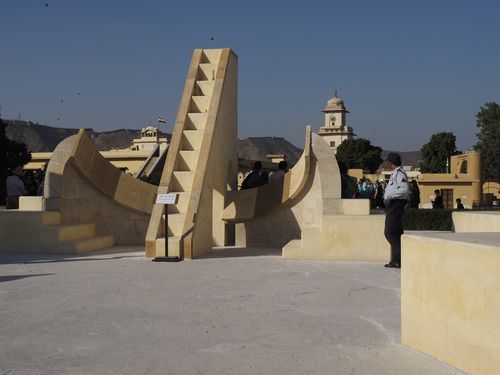
Among the structures at Jantar Mantar, the Samrat Yantra stands as the most prominent architectural element. This instrument takes the form of a massive triangular wall rising approximately twenty-seven meters above the ground. The hypotenuse of the triangle functions as a gnomon aligned with the Earth’s axis, casting a shadow onto two curved quadrants positioned on either side of the structure.
The geometry of the Samrat Yantra is carefully calculated to correspond with the latitude of Jaipur. The inclined surface of the triangular wall forms an angle equal to the local latitude, ensuring that the gnomon remains parallel to the Earth’s rotational axis. On both sides of the triangle, large semicircular arcs serve as graduated scales used to measure solar time. These arcs are divided into precise intervals that allow observers to determine the local time from the movement of the shadow.
A central staircase rises along the triangular plane, providing access to the upper levels of the structure. Observation platforms located along the sides of the instrument allow astronomers to read the markings on the curved surfaces. The monumental scale of the Samrat Yantra enhances the precision of its measurements by increasing the distance between divisions on the measuring surfaces.
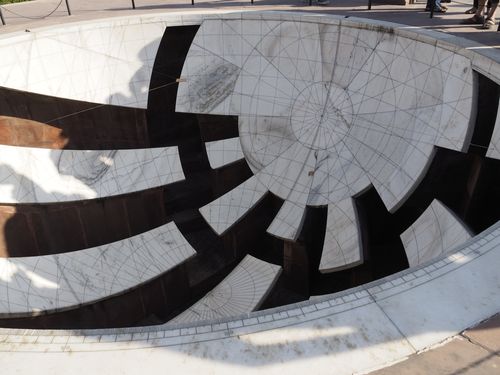
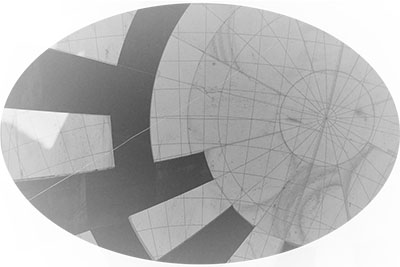
Nearby stands the Jai Prakash Yantra, a pair of hemispherical structures partially embedded in the ground. Each hemisphere forms a concave surface marked with a network of engraved lines representing celestial coordinates. The interior of these bowls is divided by stone ribs that correspond to astronomical reference lines. Suspended markers or observation points allowed astronomers to project the position of celestial bodies onto the engraved coordinate system.
The Ram Yantra consists of two cylindrical structures with open centers. Each cylinder contains vertical walls and horizontal surfaces marked with angular divisions. The configuration allows observers to measure both altitude and azimuth of celestial objects. The interior of each cylinder is accessible through narrow passageways and stairways integrated into the structure. The open center ensures direct visibility of the sky above the measuring surfaces.
These monumental instruments demonstrate a distinctive architectural approach in which astronomical measurement is embodied in large geometric forms. Triangles, cylinders, arcs, and hemispheres are used not merely as structural elements but as calibrated surfaces for scientific observation.
Secondary Instruments and Internal Architectural Variety
In addition to the large instruments that dominate the complex, the observatory contains numerous smaller devices distributed throughout the site. These instruments are designed to perform specialized measurements and are positioned so that they do not interfere with the observational functions of the larger structures.
Several instruments take the form of inclined planes equipped with graduated scales used to measure declination or celestial coordinates. Others consist of curved walls marked with angular divisions that allow observers to determine the position of celestial bodies relative to the horizon. Some structures resemble stepped platforms or truncated pyramids, incorporating narrow staircases that lead to observation points.
The Narivalaya Yantra is composed of two circular plates mounted in vertical positions aligned with the equatorial plane. One plate is oriented toward the northern hemisphere and the other toward the southern hemisphere. Each surface contains divisions used to measure solar time according to the position of the sun relative to the celestial equator.
The Digamsa Yantra is arranged as a circular platform surrounded by a low cylindrical wall marked with azimuthal divisions. At the center of the platform stands a vertical pillar that functions as a reference point for measuring the direction of celestial objects relative to the horizon.
These instruments contribute to the architectural diversity of the site by introducing a variety of geometric forms and scales. The spatial arrangement of these structures creates a dense configuration in which large and small instruments coexist within the same observational environment. Each structure retains a distinct form determined by the mathematical principles underlying its function.
Architectural Conservation and Structural Preservation
The instruments of the Jantar Mantar observatory have been exposed to environmental conditions for nearly three centuries, resulting in gradual erosion of masonry surfaces and plaster coatings. The preservation of the site requires ongoing maintenance to stabilize the structures and protect the measurement markings.
Conservation work has included the repair of cracks in masonry walls, replacement of deteriorated plaster layers, and restoration of engraved measurement divisions. These interventions aim to maintain the geometric integrity of the instruments while preserving their original appearance. Particular attention has been given to surfaces where measurement scales are engraved or inlaid, as these areas are essential for interpreting the function of the instruments.
Drainage systems around the instruments have been improved in order to prevent water accumulation near the foundations. Stabilization of the ground surface also plays a role in protecting the structural alignment of the instruments, which depends on precise orientation relative to the cardinal directions.
Today the architectural structures of the Jantar Mantar in Jaipur remain largely intact, allowing the instruments to be observed in their original spatial arrangement. The preservation of these large masonry devices ensures that the observatory continues to demonstrate the integration of architectural construction with astronomical measurement that defined its original design.