

 Français (France)
  Nederlands (nl-NL)
 The City Palace of Jaipur is one of the principal monumental complexes of Rajasthan and remains a central landmark in the historic layout of the city. Located in the eighteenth-century capital of Jaipur, it combined residential, ceremonial and administrative functions connected to the former ruling dynasty. The complex includes several courtyards, buildings and reception spaces reflecting the princely status of the state. Part of the site still retains institutional use, while other sections are open to visitors. The City Palace represents an important link between royal heritage, urban identity and cultural preservation in modern India.

Jaipur • City Palace
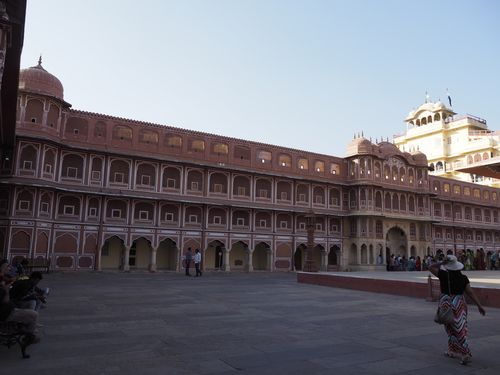
Jaipur • City Palace
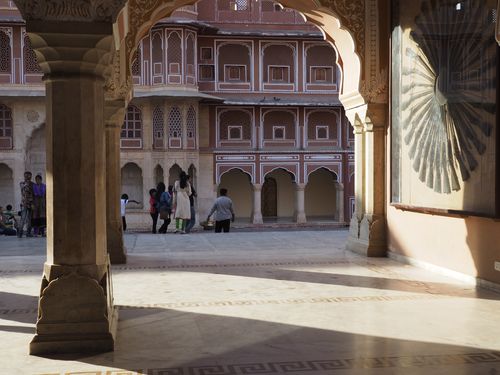
Jaipur • City Palace
Monument profile
City Palace
Monument category: Palace
Monument family: Palace and Annexes
Monument genre: Residential
Cultural heritage: Hindu
Geographic location: Jaipur • Rajasthan • India
Construction period: 18th century AD
This monument in Jaipur is inscribed on the UNESCO World Heritage List since 2019 and is part of the serial property "Jaipur City, Rajasthan".See the UNESCO monuments featured on this site
• Links to •
• Dynasties that contributed to the construction of the monument •


• List of videos about Jaipur on this site •
Jaipur, the pink city • Rajasthan, India
City Palace of Jaipur: Dynastic Residence and Centre of Princely Authority
Foundation of the Palace in the New Capital
The City Palace was established in the eighteenth century as part of the creation of Jaipur by Maharaja Sawai Jai Singh II. When the Kachwaha ruler transferred his capital from Amber in 1727, he planned a new city organized on a regular urban grid. The palace was placed in a central position, serving both practical and symbolic purposes. It represented the permanent presence of royal authority within the heart of the new capital.
The complex was not conceived as a single finished building, but as an evolving group of residences, audience halls, courtyards, ceremonial spaces and service structures. From the beginning, it functioned simultaneously as royal residence, administrative headquarters and setting for court ritual. Its location within the planned city linked ordered urban design with dynastic legitimacy.
The palace also structured relations between ruler and subjects. Successive entrances, controlled courtyards and graduated access zones reflected distinctions between public audiences, official business, noble privilege and private royal life.
Enlargement under Successive Rulers
After the death of Sawai Jai Singh II in 1743, later rulers continued to expand and modify the City Palace. Additional buildings were erected, while older sections were adapted to changing residential and ceremonial needs. The result was a composite complex in which eighteenth-century foundations coexist with later interventions.
Under rulers such as Sawai Pratap Singh and his successors, important sectors were embellished to reflect the prestige of Jaipur’s court. Reception areas hosted diplomatic visits, festivals, state ceremonies and dynastic celebrations. The palace remained the principal stage on which royal continuity was publicly expressed.
Its political role was not merely ceremonial. Administrative decisions, fiscal management and relations with regional elites were long coordinated from within the palace precinct. The monument therefore functioned as an active centre of governance rather than a symbolic residence alone.
As Jaipur developed economically and demographically, the palace retained its primacy through continual adaptation rather than static preservation.
The Palace in the Nineteenth Century
During the nineteenth century, Jaipur operated within the wider framework of British supremacy in India while preserving internal princely authority. In this context, the City Palace remained the seat of the ruling house and the key location for official representation.
Several maharajas introduced modernizing initiatives that affected palace life and architecture. Certain sections were refurbished or repurposed, while decorative additions reflected changing tastes and increasing contact with external influences. Receptions for British officials, Indian dignitaries and foreign visitors reinforced the diplomatic role of the complex.
The palace also became an important repository of dynastic memory. Portraits, ceremonial objects, arms, textiles and archives preserved within its buildings supported the historical identity of the ruling family. In an era of political transformation, the palace helped maintain continuity between past sovereignty and contemporary princely status.
Although administrative structures outside the palace grew more complex, the City Palace continued to embody Jaipur’s authority in visible and ceremonial form.
From Independence to Heritage Use
After 1947, when princely states acceded to the Indian Union, Jaipur ceased to be an independent polity. The City Palace no longer served as the centre of sovereign government, yet it remained closely associated with the former royal family. Parts of the complex continued in residential use, while other areas were gradually opened to the public.
This transition allowed the monument to acquire a new role as a heritage institution without losing its dynastic associations. Museums were established to display royal collections, manuscripts, textiles, weapons and objects linked to the history of Jaipur. The palace thus became a place where royal memory, tourism and civic identity intersect.
Conservation work has focused on maintaining buildings, painted surfaces, ceremonial interiors and collections. Growing visitor numbers require continuous management of circulation, security and preservation standards.
The City Palace stands within the historic walled city of Jaipur, inscribed in 2019 on the UNESCO World Heritage List under the official name Jaipur City, Rajasthan. Within that urban ensemble, the palace remains one of the most significant historic components.
Today it continues to serve as a cultural symbol of Jaipur and as a visible reminder of the city’s princely past.
Global Historical Context During the Main Building Phase
During the eighteenth century, when the City Palace was established and expanded, the Mughal Empire was undergoing political decline in India. In Europe, several monarchies were strengthening centralized administrations. The Qing dynasty ruled China. Atlantic and Indian Ocean trade networks were expanding rapidly. These developments were contemporary with the rise of Jaipur as a newly planned princely capital.
Palatial Composition and Monumental Organization of the City Palace of Jaipur
Position within the Planned City and General Layout
The City Palace occupies a strategic central position within the historic walled city of Jaipur, directly linked to the eighteenth-century urban plan established when the new capital was founded. Its location is neither peripheral nor detached. Instead, it is inserted into the regular street grid while remaining a reserved precinct distinct from surrounding commercial quarters. This placement expresses the political centrality of the ruling court within the city’s overall organization.
The complex is not a single building but an extensive enclosed ensemble composed of successive courtyards, audience halls, pavilions, gateways, gardens and residential sectors. Access is organized through a sequence of transitional spaces in which scale and ceremonial character gradually increase. The spatial arrangement creates a clear hierarchy between public zones, formal reception areas, administrative sectors and private royal quarters.
Internal walls and gates are essential components of the plan. They divide the palace into multiple functional units and regulate movement between them. Rather than one open compound, the palace is experienced as a progression through increasingly selective spaces.
The relationship between built masses and open courts is carefully balanced. Courtyards serve as circulation nodes, climatic regulators, ceremonial settings and sources of light for surrounding rooms.
Materials, Elevations and Decorative Language
The City Palace uses primarily local stone, plastered masonry and marble in selected prestigious areas. Painted and rendered surfaces play a major role in the visual identity of the complex. They create bright façades enriched by coloured borders, floral patterns, geometric ornament and carefully framed openings.
The elevations combine horizontal building ranges with vertical accents such as corner pavilions, rooftop kiosks, projecting balconies and slender towers. This composition avoids the appearance of a single heavy block and gives the palace a varied skyline suited to residential and ceremonial functions.
Openings are numerous but carefully controlled. Framed windows, arcaded galleries, screened openings and recessed loggias mediate the relationship between interior and exterior. These elements promote ventilation while filtering the intense light of Jaipur’s climate. Jharokha balconies, supported on carved brackets, function both as climatic devices and ceremonial viewing points overlooking courts or processional routes.
Decoration is concentrated in prestigious sectors. Monumental doors, painted ceilings, carved lintels, coloured surfaces and ornamental screens mark spaces of higher status. Variation in decorative density helps visitors read the hierarchy of the complex.
Marble is used selectively to emphasize thresholds, floors or elite interiors, creating contrast with plastered or sandstone surfaces elsewhere in the palace.
Courtyards, Major Buildings and Internal Landmarks
One of the defining spatial principles of the City Palace is the sequence of monumental courtyards. These open spaces structure circulation and distribute the principal buildings. They also provided settings for formal gatherings, court ritual and controlled public appearances.
The Mubarak Mahal, added in the nineteenth century, is notable for a lighter and more ornamental architectural character. Its façades display a dense arrangement of balconies, projecting windows and carved details that contrast with more restrained palace volumes nearby. The building reflects a later phase in which display and refined reception architecture became increasingly prominent.
The Chandra Mahal forms one of the principal residential cores of the complex. Rising through several storeys, it introduces a stronger vertical emphasis than many adjoining structures. Terraces, upper balconies and elevated chambers give it visual dominance within the palace precinct. Parts of the building remain associated with the former royal family.
The Diwan-i-Khas and Diwan-i-Am, private and public audience halls respectively, embody the distinction between restricted counsel and broader ceremonial reception. Their architecture privileges clear axial space, visible seating hierarchy and controlled approaches to the ruler’s position.
The celebrated gates of Pritam Niwas Chowk are among the most distinctive architectural elements of the palace. Richly painted and symbolically themed, they transform practical passageways into autonomous decorative compositions. Their colour, relief work and iconographic programs make them focal points within the internal sequence of courts.
Stylistic Synthesis and Climatic Adaptation
The City Palace presents a legible combination of Rajput, Mughal and, in later additions, European influences. This synthesis does not appear as a random mixture but as a selective integration of forms suited to specific functions.
Rajput traditions are visible in chhatri kiosks, projecting balconies, enclosed courts and the fragmented silhouette of rooflines. Mughal influence appears in symmetrical planning tendencies, arcaded spaces, formal garden relationships and the staging of audience architecture. Nineteenth-century interventions introduced occasional façade rhythms and details inspired by changing international tastes.
Climatic adaptation remains constant throughout the complex. Courtyards encourage air movement. Covered galleries create shade. Thick walls reduce thermal fluctuation. Rooftop terraces catch evening breezes. Perforated screens diminish glare while preserving privacy and ventilation.
The combination of these devices means that environmental performance is embedded in the architecture rather than added later through mechanical means.
Despite the diversity of construction phases, unity is maintained through recurring materials, proportional relationships and the repeated use of courts as organizing devices.
Alterations, Preservation and Present Reading
The City Palace has undergone many transformations without losing its primary identity. Residential extensions, ceremonial additions, museum conversions and successive restoration campaigns have modified portions of the complex while preserving the overall spatial logic.
Current conservation concerns include painted decoration, timber elements, coloured surfaces, plaster finishes and structural components exposed to seasonal weathering. Visitor circulation must also be managed carefully in areas originally designed for court protocol rather than heavy tourist traffic.
Today the palace is best understood as a stratified ensemble in which each courtyard, pavilion and façade corresponds to a specific historical function. Its architectural significance lies less in a single isolated monument than in the coherence of a complete palace system integrated into the historic city of Jaipur and still marked by institutional continuity.