Français (France)
  Nederlands (nl-NL)
 00:00 • intro | 01:20 • an ox cart | 01:42 • a village near Bagan | 02:21 • preparing a meal | 03:02 • at school | 03:25 • preparing the oxen's meal | 04:51 • another oxcart
Personal creation from visual material collected during my trip Myanmar • Burma (2016)
Map of places or practices in Bagan on this site
• Use the markers to explore the content •
Bagan, the People Between Villages, Work and Daily Life
Another Perspective on the Bagan Region
Bagan is usually associated with its vast temple plain, the silhouettes of brick monuments rising above the landscape, and the historical prestige of the Pagan Kingdom. Yet the region cannot be reduced to its sacred architecture alone. It is also a lived and working environment shaped by villages, farming communities, family routines and practical knowledge passed from one generation to the next. This video chooses to highlight that human dimension.
Through scenes of transport, food preparation, school life and rural activity, it presents a quieter but essential side of Bagan. Behind the famous monuments stand communities whose daily work has long sustained the region. The cultural identity of Bagan lies not only in temples and archaeology, but also in ordinary gestures, local relationships and the rhythms of village life.
The viewer therefore encounters a Bagan less monumental in appearance, yet equally important for understanding the place as a whole.
Bullock Carts and Traditional Mobility
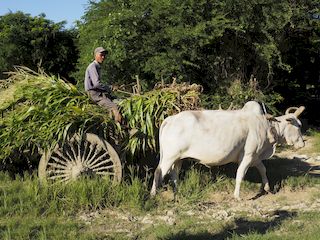
One of the recurring images in the video is the bullock cart. This form of transport was widespread for centuries across rural South and Southeast Asia and, in some regions, still retains practical use. Around Bagan it evokes a world of movement adapted to unpaved roads, agricultural needs and short-distance exchange.
Traditionally, bullock carts were used to carry crops, timber, water, household goods or passengers. Their wooden construction could often be repaired locally with available materials, while the animals themselves formed an important part of rural economies. The pace of transport was slower, but well suited to village networks and seasonal work.
Beyond utility, the bullock cart has become a strong visual symbol of countryside life in Myanmar. It reflects systems of mobility based on animal power, community labor and intimate knowledge of the land.
By showing carts at several moments, the video suggests continuity between older practices and present-day rural life rather than presenting them as relics of a vanished world.
Village Life and Domestic Organization
The scenes filmed in a village near Bagan broaden the focus from transport to settlement patterns and household life. Rural villages are often organized according to access to roads, water sources, cultivated land and family ties. Houses may be grouped loosely, leaving space for yards, storage, animals and communal movement.
Construction materials vary according to local resources and changing economic conditions. Timber, bamboo, brick, earth and sheet metal may all appear in different combinations. Homes often combine private rooms with open working areas used for cooking, repairs, storage or social interaction.
The preparation of a meal, another element shown in the video, offers insight into everyday cultural practice. Cooking reflects available ingredients, household organization and inherited techniques. Such scenes may seem modest, yet they often reveal more about a society than monumental buildings alone.
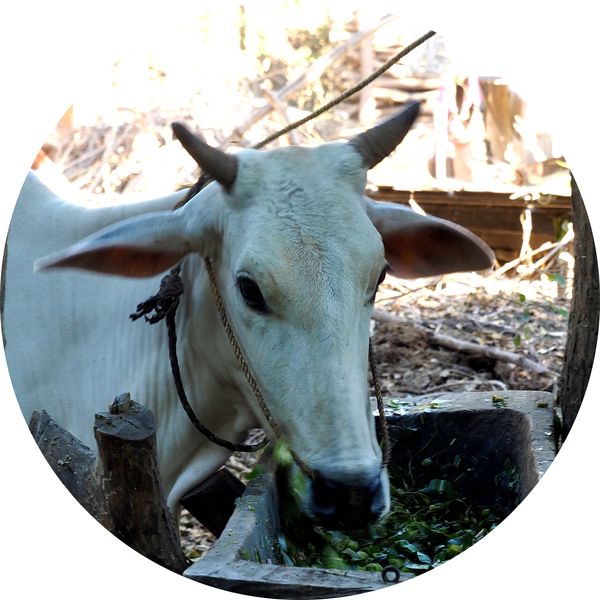
The preparation of food for the oxen adds another layer of meaning. In agrarian communities, animals are not separate from domestic life. Feeding and caring for working animals forms part of the daily cycle linking household management, transport and agriculture.
School, Community and Social Change
The sequence set at school introduces an important modern dimension. Rural areas are frequently imagined only through tradition, but they are also places of education, ambition and change. Access to schooling in Myanmar has historically depended on infrastructure, distance, family means and the role of religious or public institutions.
A school often functions as more than a teaching space. It is a social center that structures daily schedules, gathers families and connects younger generations to wider national life. In a region as historically charged as Bagan, the presence of children in school reminds viewers that the landscape belongs not only to the past, but also to the future.
This contrast between ancient monuments and contemporary learning is significant. It shows how historical regions continue to evolve while maintaining local identities.
Historical Background and Human Continuity
Bagan flourished between the eleventh and thirteenth centuries as the capital of the Pagan Kingdom. The monumental temple plain seen today was made possible by the labor of farmers, craftsmen, transporters, builders and village communities living across the surrounding countryside.
Religious foundations required bricks, timber, food supplies, draft animals and organized manpower. The famous sacred landscape therefore depended on ordinary human networks as much as on royal patronage.
That relationship between monument and village has not disappeared. Although tourism and modern economic change now influence the region, agriculture and rural settlement remain central parts of local life. Villages around Bagan continue a long pattern of human occupation shaped by climate, river systems and cultivated land.
Showing the people of Bagan is therefore a way of restoring balance to the historical narrative. Great monuments always stand within living societies.
What the Videos of This Site Make Especially Clear
The videos of travel-video.info, often created from carefully selected and animated photographs, are especially effective for subjects centered on daily life. They allow viewers to observe gestures, tools, textures and expressions with more patience than a rapid moving sequence often permits.
In rural scenes, this slower visual rhythm helps reveal the construction of a cart, the layout of a yard, the posture of animals or the stages of meal preparation. Details that might otherwise pass unnoticed become easier to read.
Transitions between images also connect different dimensions of the region: roads, homes, school, labor and transport. The viewer gradually understands that Bagan is not only a plain of temples, but a human territory where heritage and contemporary life continue side by side.
The Human Face of Bagan
Bagan fascinates through its sacred monuments, yet its identity is equally present in villages, daily routines and working traditions. This video reminds us that behind celebrated temples stand people, families and communities whose lives give meaning to the wider landscape. For those wishing to explore further, the detailed pages devoted to local traditions offer a deeper look at the human world surrounding Bagan.
Links to related pages




















Audio Commentary Transcript
Bagan, former capital classified as World Heritage by Unesco is known to tourists from all over the world for its astonishing temples by the thousands which it is impossible to escape.
But beyond this indisputable historical interest, Bagan is like other cities in Myanmar ... in addition to the temples, there are people who live there.
Here are some pictures of life in the surrounding countryside.
But it is also true that these images could have been taken anywhere in Myanmar.
Music:
- - YouTube video library - Air to the throne
- - YouTube video library - Beijaflor
Disclaimer: Despite its appropriateness, copyright issues prevent the use of burmese traditional music in "Bagan, the people • Myanmar ", hence the use of royalty-free music. Despite our careful selection, some might regret this decision, which is necessary to avoid potential lawsuits. Although difficult, this decision is the only viable solution.