

 Français (France)
  Nederlands (nl-NL)
 00:00 • intro | 01:03 • a small wooden monastery | 01:40 • various temples in Bagan | 03:22 • in one of the temples of Bagan | 04:04 • more temples | 06:20 • sunset over the temples of Bagan
Personal creation from visual material collected during my trip Myanmar • Burma (2016)
• Use the markers to explore the content •
Bagan, the Gods Between Sacred Temples and Evening Light
A Monumental Plain Shaped by Faith
Bagan is one of Asia’s great cultural landscapes. Across a vast plain near the Irrawaddy River, thousands of temples, stupas, monasteries and shrines bear witness to the historical importance of this former capital of medieval Myanmar. Few places offer such a dense concentration of religious monuments in a setting where architecture, spirituality and open landscape remain closely linked.
This video offers a complementary way to approach Bagan. Rather than presenting only famous silhouettes or panoramic views, it explores sacred spaces, devotional imagery and the atmosphere created by centuries of worship. Temples appear not merely as isolated buildings, but as parts of a living historical environment shaped by belief, artistic ambition and royal patronage.
Bagan emerges here as both an archaeological treasure and a place where sacred memory still defines the landscape.
Wooden Monastery and the Variety of Sacred Buildings
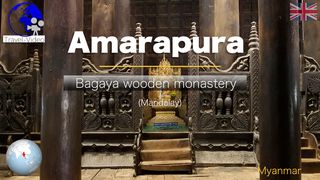
The appearance of a small wooden monastery introduces a dimension often overlooked by visitors. While Bagan is renowned for its brick temples and monumental stupas, timber architecture also played an important role in Burmese religious life. Wooden monasteries were commonly associated with monastic residence, teaching, communal activity and daily practice. Their lighter structures contrast with the permanence of masonry sanctuaries.
The video then moves through several temples of Bagan, revealing the remarkable diversity of forms across the plain. Some monuments rise as compact masses crowned by towers or stupas. Others are organized around terraces, porches, galleries and inner sanctuaries. Differences in scale, proportion and decorative treatment reflect centuries of experimentation.
This variety is one of Bagan’s defining qualities. The site is not the result of a single plan or one short historical period, but the accumulation of many religious foundations created over generations.
Inside the Temples: Images, Space and Devotion
Entering one of the temples helps explain the spiritual purpose of these monuments. Exterior grandeur was only one part of their meaning. Interiors were designed to house sacred images, guide ritual movement and create an atmosphere suited to contemplation.
Many temples contain seated or standing Buddha images placed in central chambers or aligned along corridors. Niches, altars and wall surfaces often carried painted or sculpted decoration illustrating religious themes. Light entering through carefully placed openings creates contrasts that emphasize statues and architectural volumes.
The title of the video evokes “the gods,” yet in Bagan the sacred world is primarily expressed through Buddhist imagery. These include representations of the Buddha, episodes from his life, protective figures and symbolic forms linked to cosmology and merit-making traditions. Such imagery gives the buildings their spiritual identity.
The viewer therefore discovers that Bagan is not only a landscape of towers and domes, but also a world of interior spaces shaped by devotion.
Historical Background and Artistic Importance
Bagan reached its height between the eleventh and thirteenth centuries under the Pagan Kingdom. During this period, rulers and wealthy donors sponsored an extraordinary number of religious monuments. Building a temple was both an act of faith and a visible expression of status, legitimacy and generosity.
The concentration of monuments seen today reflects this long era of construction. Bagan also became a major center of Buddhist learning, manuscript production and monastic organization. Religious institutions played an important role in society, while architecture became one of the clearest expressions of royal and spiritual authority.
The site later lost its political centrality, but many sanctuaries continued to function as places of worship. Earthquakes, repairs and restorations altered some structures over time, yet the plain retained its sacred character.
Today Bagan remains one of Myanmar’s most significant heritage sites, valued for its architecture, history and continuing cultural meaning.
What the Videos of This Site Make Especially Clear
The videos of travel-video.info, often created from carefully selected and animated photographs, are particularly effective for a site such as Bagan. A place containing so many monuments can be visually overwhelming during a rapid visit. This format allows a slower and more structured reading of the landscape.
Transitions between images help the viewer understand how isolated temples relate to one another across the plain. Changes of viewpoint reveal the rhythm of repeated forms, the differences between monuments and the scale of the overall setting.
Interior scenes benefit equally from this approach. Columns, vaulted spaces, Buddha images, painted surfaces and subtle lighting effects can be observed with more attention than during a brief passage on site.
The movement from monastery to temple, from exterior panorama to inner sanctuary, gradually builds an understanding of Bagan as a complete sacred environment rather than a collection of disconnected monuments.
Sunset Over a Sacred Horizon
The closing views of sunset over the temples capture one of Bagan’s most enduring qualities. As daylight fades, the silhouettes of shrines and towers emerge across the plain with unusual clarity. The landscape appears less like a group of separate buildings and more like the memory of an entire civilization still visible on the horizon.
Bagan unites religious art, monumental architecture, royal history and exceptional scenery in one place. For those wishing to go further, the detailed pages dedicated to the temples of Bagan offer a deeper exploration of their history, symbolism and architectural design.













Audio Commentary Transcript
Bagan is an old city located in Burma (or Myanmar) which is classified as a Unesco Cultural Heritage of Humanity.
It was the capital of the Pagan kingdom which was the first to unify the regions which were to constitute present-day Myanmar.
At the height of the Pagan reign between the 11th and 13th centuries, nearly 5,000 temples, pagodas and monasteries were built in Bagan. Almost 4000 of these buildings are still standing today.

Music :
- - YouTube video library - Air to the throne
- - YouTube video library - Bus Da Blockbuster
- - YouTube video library - Butterflies in Love
- - YouTube video library - Desert Catharsis
Disclaimer: Despite its appropriateness, copyright issues prevent the use of burmese traditional music in "Bagan, the gods • Myanmar ", hence the use of royalty-free music. Despite our careful selection, some might regret this decision, which is necessary to avoid potential lawsuits. Although difficult, this decision is the only viable solution.
Music :
- - YouTube video library - Air to the throne
- - YouTube video library - Bus Da Blockbuster
- - YouTube video library - Butterflies in Love
- - YouTube video library - Desert Catharsis
Disclaimer: Despite its appropriateness, copyright issues prevent the use of burmese traditional music in "Bagan, the gods • Myanmar ", hence the use of royalty-free music. Despite our careful selection, some might regret this decision, which is necessary to avoid potential lawsuits. Although difficult, this decision is the only viable solution.