

 Français (France)
  Nederlands (nl-NL)
 00:00 • intro | 00:34 • Village life and products | 03:40 • stupas in the countryside | 04:03 • workers going to the fields | 05:54 • peasants with their oxen | 06:38 • another village on a hill | 07:33 • a truck transports produce from the fields | 09:30 • at the bus stop | 10:04 • after harvest | 12:08 • other work in the village
Personal creation from visual material collected during my trip Myanmar • Burma (2016)
Map of places or practices in the countryside near Kalaw on this site
• Use the markers to explore the content •
Rural Landscapes and Agricultural Life in the Burmese Countryside
Villages, Farmland and Everyday Life in Rural Myanmar
This video explores several rural areas of Myanmar where agriculture, village life and Buddhist landmarks remain closely connected to the surrounding landscape. The scenes visible throughout the countryside reveal communities whose daily activities continue to follow seasonal rhythms shaped by the climate, the terrain of the Shan Plateau and long-established agricultural practices. Dirt roads, cultivated hillsides, village markets and scattered religious structures together form an environment where human activity remains deeply integrated into the rural setting.
The film also highlights the diversity of everyday life in the Burmese countryside. Agricultural transport, local trade, manual labour and small-scale craft activities all appear alongside scenes of ordinary village routines. Rather than focusing on a single monument or event, the video presents a broader view of rural organisation and the relationship between people, landscape and local traditions.
Rural Villages, Agricultural Work and Local Transport
Several sequences focus on farmers travelling to the fields, working with oxen or transporting agricultural products between villages. These scenes illustrate the continued importance of manual labour and animal traction in parts of rural Myanmar, particularly in hilly regions where large agricultural machinery remains difficult to use. Oxen and buffaloes still play a practical role in ploughing, transport and field preparation, while families and neighbouring villagers often work collectively during planting and harvest periods.
The appearance of trucks, small motorised vehicles and roadside transport points also reflects gradual changes in rural infrastructure. Agricultural products are moved between farms, villages and local markets through a network of roads that connects isolated communities to regional trade routes. Even a simple bus stop becomes part of the wider organisation of rural life, illustrating the circulation of workers, goods and services across the countryside.
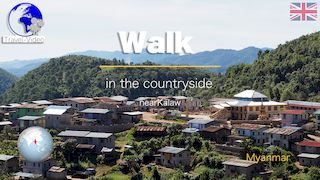
The hilltop village visible in the film further demonstrates how settlements adapt to the uneven topography of the Shan Highlands. Houses, cultivated plots and pathways are organised according to the relief, creating landscapes shaped as much by geography as by human activity.
Buddhist Stupas in the Agricultural Landscape
The video also shows several rural stupas standing beside roads, fields or village paths. Unlike the monumental religious complexes associated with former Burmese royal capitals, these smaller structures are integrated directly into the daily environment of agricultural communities. Their presence reflects the long-term spread of Theravāda Buddhism throughout rural Myanmar.
These stupas function both as places of devotion and as visual landmarks within the countryside. Some are connected to small monasteries or meditation areas, while others simply mark local routes and village boundaries. Their modest scale and scattered distribution create a distinctive Buddhist landscape closely associated with agricultural life and community organisation.
What the Videos on This Website Make Easier to Observe
The videos published on this site are largely built from carefully selected and animated photographs. This approach allows viewers to observe details that often remain difficult to notice in conventional moving footage. Slow transitions between images make it easier to understand the relationships between villages, cultivated land, roads and religious structures within the landscape.
This visual method also highlights textures, working gestures, architectural forms and spatial organisation. The progressive sequencing of images helps viewers follow how daily rural activities unfold across different locations while preserving a clear sense of the surrounding environment.
A Glimpse into Rural Myanmar
This journey through the Burmese countryside offers a detailed look at rural life shaped by agriculture, local trade and Buddhist traditions. The video provides a broader understanding of how villages, farmland and religious landmarks continue to interact within the landscapes of Myanmar. Additional pages linked to this topic allow visitors to explore several aspects of rural architecture, agricultural practices and traditional crafts in greater detail.

Music:
- - YouTube video library - Anamalie, (© Anamalie by Kevin MacLeod is licensed under a Creative Commons Attribution 4.0 license. https://creativecommons.org/licenses/by/4.0/
- Source: http://incompetech.com/music/royalty-free/index.html?isrc=USUAN1500007
- Artist: http://incompetech.com/)
- - YouTube video library - Automn Day, (© Autumn Day by Kevin MacLeod is licensed under a Creative Commons Attribution 4.0 license. https://creativecommons.org/licenses/by/4.0/
- Source: http://incompetech.com/music/royalty-free/index.html?isrc=USUAN1100765
- Artist: http://incompetech.com/)
- - YouTube video library - Becoming
- - YouTube video library - Breathing Planet
- - YouTube video library - Peaceful Mind - Astron
Disclaimer: Despite its appropriateness, copyright issues prevent the use of burmese traditional music in "A walk in the Burmese countryside • Myanmar", hence the use of royalty-free music. Despite our careful selection, some might regret this decision, which is necessary to avoid potential lawsuits. Although difficult, this decision is the only viable solution.
Links to related pages


















Audio Commentary Transcript
Near the town of Kalaw, in the hills of central Myanmar, one of the greatest pleasures is a walk in the fresh air. In this countryside with a tranquility of another age, we see almost as many stupas of all sizes (but especially small, even very small) as people. And when you see people, they are peasants busy planting or harvesting.


