Français (France)
  Nederlands (nl-NL)
 00:00 • intro | 00:33 • in the streets fo Yangon | 02:06 • the white elephants
Personal creation from visual material collected during my trip Myanmar • Burma (2016)
Map of places or practices in Yangon on this site
• Use the markers to explore the content •
Yangon Between Urban Life and Royal Symbols of Myanmar
An Former Capital Shaped by Daily Life
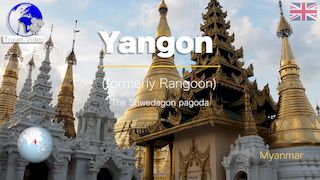
Yangon occupies a distinctive place in the modern history of Myanmar. Formerly the country’s capital before the transfer of administrative institutions to Naypyidaw in the early twenty-first century, the city remains Myanmar’s principal economic center and one of its most active urban environments. Colonial-era buildings, Buddhist traditions, markets, busy streets and residential neighborhoods coexist within a landscape where different historical periods remain visible in everyday life.
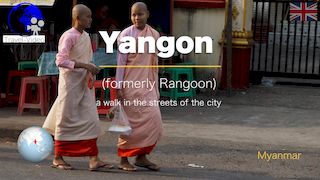
The video explores several dimensions of Yangon through scenes of the city’s streets and public spaces. Traffic, local commerce, façades and ordinary urban activity reveal the rhythm of a metropolis that continues to evolve while preserving traces of its colonial and cultural heritage. Alongside these urban scenes, the video also introduces a subject deeply linked to Burmese royal symbolism and religious traditions: the white elephants associated with power and legitimacy for centuries.
Streets of Yangon and the Symbolism of White Elephants
The sequences filmed in Yangon’s streets show a city marked by strong architectural contrasts. Colonial administrative buildings stand beside modern constructions, small shops and religious structures integrated into the urban fabric. The density of movement and commercial activity illustrates the importance of public space in the daily organization of the city.
Another important theme of the video concerns the white elephants kept in dedicated facilities in Yangon. In Burmese tradition, as in several other Southeast Asian cultures, white elephants are considered rare and highly symbolic animals. The expression does not necessarily refer to animals that are entirely white, but rather to elephants displaying unusual physical characteristics regarded as auspicious.
Historically, the possession of white elephants was associated with royal authority, prosperity and spiritual protection. Burmese kings who owned such animals strengthened their political prestige and reinforced their legitimacy. Even today, white elephants continue to occupy an important place in Myanmar’s symbolic culture and collective imagination.
Colonial Heritage and Traditional Beliefs
Yangon expanded considerably during British colonial rule, particularly from the nineteenth century onward. Several districts still preserve the urban organization introduced during that period, with wide streets, administrative buildings and commercial quarters reflecting the city’s role within the colonial economy of British Burma.
At the same time, the presence of white elephants connects Yangon to much older royal and religious traditions. In Theravāda Buddhist culture, elephants possess strong symbolic importance and frequently appear in religious narratives and royal ceremonies. The preservation of white elephants in Yangon demonstrates the continuity of cultural beliefs that remain influential in contemporary Myanmar.
This coexistence between colonial urban heritage, modern development and traditional symbolism contributes to the city’s complex identity. Yangon is not only an administrative and commercial center, but also a place where different layers of Burmese history continue to overlap within the urban landscape.
What the Videos on This Site Make Particularly Clear
The videos on this site make the relationships between urban spaces, architecture and cultural traditions particularly readable through the use of carefully selected and animated photographs. Gradual transitions allow viewers to observe details of façades, street perspectives, public spaces and the environments associated with the white elephants.
This visual approach also makes it easier to understand the contrasts between everyday urban activity and symbolic cultural elements that might receive less attention in rapidly filmed sequences. The combination of still photography and progressive movement encourages a more attentive reading of Yangon’s atmosphere and urban organization.
A City Between Modern Life and Historical Continuity
Yangon offers a particularly rich perspective on contemporary Myanmar, combining colonial heritage, urban dynamism and long-standing cultural traditions. Through its streets and the symbolism of the white elephants, the video highlights several complementary dimensions of Burmese identity and historical memory. The detailed pages linked to the subject also provide an opportunity to explore further historical and cultural aspects associated with the city and its traditions.
Links to related pages













Audio Commentary Transcript
Yangon (formerly Rangoon) is no longer the capital of Myanmar since fifteen years. However, it remains the most important city and one of the liveliest. It also has the privilege of welcoming 3 of the 9 white elephants, sacred elephants of Burmese Buddhism.
In Myanmar, white elephants are sacred. In 2016, during our trip there were 9 in the country, including 3 in Yangon.
When a Westerner hears "white elephant" he imagines a white elephant, but in Myanmar things are more nuanced.
The priests established a list of criteria that an elephant must meet in order to be entitled to the supreme honor, that of being chained but also of being considered a white elephant, and therefore a sacred elephant.
A few well-located spots may suffice ...

Music:
- - YouTube video library - Brain Trust
- - YouTube video library - You will know
Disclaimer: Despite its appropriateness, copyright issues prevent the use of burmese traditional music in "Yangon, a walk in the city • Myanmar", hence the use of royalty-free music. Despite our careful selection, some might regret this decision, which is necessary to avoid potential lawsuits. Although difficult, this decision is the only viable solution.