Français (France)
  Nederlands (nl-NL)
 00:00 • intro | 00:48 • the Mekong near Luang Prabang | 09:00 • Crossing the Mekong to the West Bank | 13:29 • Muang Khong, a village on the banks of the Mekong | 15:20 • The Mekong at the Cambodian border | 21:34 • On Don Khon island | 23:42 • Locomotive, vestige of the Mekong expedition 1866-1868 | 24:22 • Through the countryside | 25:44 • Li Phi Somphamit waterfalls | 27:27 • The temple of the sacred Manikhoth tree | 28:04 • Phappheng waterfalls
Personal creation from visual material collected during my trip Laos and Bangkok (2022)
Map of places or practices featured in the video
• Use the markers to explore the content •
The Mekong in Laos: between continuity and rupture along a major river
A structuring river across diverse landscapes
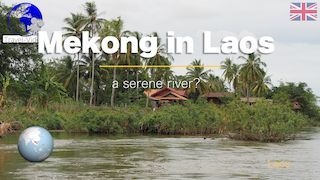
In Laos, the Mekong River is far more than a geographical feature. It acts as a structural axis that shapes landscapes, connects regions, and supports a wide range of human activities. From Luang Prabang to the southern border with Cambodia, the river reveals a sequence of contrasting environments that challenge the idea of a uniformly calm and predictable waterway.
The video follows this longitudinal perspective, moving through different sections of the river and highlighting both natural features and human presence. By combining rural scenes, historical traces, and dynamic landscapes, it provides a broader understanding of how the Mekong functions as both an environmental and cultural system.
From northern reaches to the southern plains
Near Luang Prabang, the Mekong appears relatively wide and calm, framed by hills and interspersed with settlements along its banks. These sections illustrate the river’s role as a corridor for movement and exchange. The crossing toward the western bank highlights the practical importance of the river as a means of connection, where boats remain essential for daily transport.
Further south, the river accompanies rural communities such as Muang Khong, where local life is closely tied to its presence. Housing, agriculture, and movement patterns all reflect a dependency on the river’s seasonal rhythms and resources. The landscape becomes more fragmented as the Mekong approaches the Cambodian border, dividing into multiple channels and forming a network of islands.
One of these, Don Khon, illustrates how human settlement adapts to this changing environment. The island setting reflects a way of life shaped by water, where accessibility and land use depend on fluctuating river conditions.
Historical traces and cultural expressions
Beyond its natural role, the Mekong also carries historical and symbolic significance. The presence of an old locomotive, a remnant of the Mekong expedition of 1866–1868, recalls attempts to navigate and explore the river during the colonial period. This isolated artifact stands as a reminder of both technological ambition and the physical challenges posed by the river’s discontinuities.
Cultural practices also remain closely connected to the river. The site associated with the sacred Manikhoth tree reflects a living spiritual tradition in which natural elements are invested with symbolic meaning. Such places illustrate how the river’s environment supports not only economic activity but also ritual practices and collective memory.
A river marked by contrasts
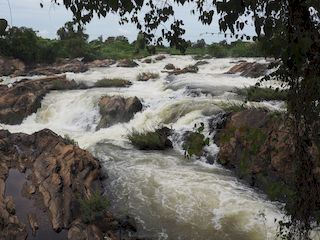
The idea of a “quiet river” becomes increasingly nuanced when reaching the southern sections. The Li Phi Somphamit Falls introduce a sudden break in the river’s flow. Here, rapids and cascades create a turbulent environment that interrupts navigation and transforms the visual character of the landscape.
Further downstream, the Pha Pheng Falls form one of the most powerful and extensive waterfall systems along the Mekong. Their width and force establish a natural boundary within the river’s course. These dramatic sections contrast sharply with the calmer stretches observed upstream, highlighting the diversity of hydraulic conditions.
Between these points, the river flows through agricultural areas and open countryside, where its surface appears more stable. This alternation between apparent calm and dynamic movement defines the Mekong’s character in Laos.
A dynamic system shaped by environment and use
The Mekong’s behavior is closely linked to seasonal variations, particularly the monsoon cycle. Changes in water level influence the shape of the banks, the fertility of the land, and the organization of human activities. Flooding, sediment deposition, and shifting channels require constant adaptation.
Communities along the river have developed practices that respond to these conditions. Fishing, agriculture, and transport are all shaped by the river’s rhythms. Villages are often located in positions that balance accessibility with protection from seasonal changes, while island settlements reflect a more direct interaction with fluctuating water levels.
This interplay between natural processes and human use creates a landscape that is both stable in its long-term patterns and constantly evolving in its details.
What the visual construction makes particularly clear
The video, built from carefully selected and animated photographs, provides a clear and structured reading of these varied environments. The transitions between locations emphasize the continuity of the river while also making visible the shifts in landscape and function.
Each sequence isolates specific aspects, whether related to water movement, settlement patterns, or human activity. This approach enhances the visibility of details that might otherwise be overlooked, such as the texture of the water, the configuration of riverbanks, or the traces of historical presence.
By slowing down the progression, the visual structure allows for a more analytical observation of the Mekong, making it possible to understand both its overall trajectory and its local variations.
A river of multiple identities
In Laos, the Mekong cannot be reduced to a single image. It is simultaneously a route of circulation, a source of livelihood, a complex natural system, and a repository of historical and spiritual meanings.
The exploration presented in the video highlights this diversity, showing how the river connects different environments while maintaining a distinct identity shaped by contrasts. The related detailed pages provide further insight into the specific sites and themes encountered along the way, extending the understanding of this major river system.

Music:
- - YouTube video library - Hitman, (© Hitman by Kevin MacLeod is licensed under a Creative Commons Attribution 4.0 license. https://creativecommons.org/licenses/by/4.0/
- Source: http://incompetech.com/music/royalty-free/index.html?isrc=USUAN1300013
- Artist: http://incompetech.com/)
- - YouTube video library - Hopeless - Jimena Contreras
- - YouTube video library - Keith
- - YouTube video library - Lost Love Song
- - YouTube video library - Moonlight Heartbreak Bass Choir - John Patitucci
- - YouTube video library - No.9_Estherâs Waltz - Esther Abrami
- - YouTube video library - Sweetly My Heart - Asher Fulero
Disclaimer: Despite its appropriateness, copyright issues prevent the use of laotian traditional music in "The Mekong: A Serene River? • Laos", hence the use of royalty-free music. Despite our careful selection, some might regret this decision, which is necessary to avoid potential lawsuits. Although difficult, this decision is the only viable solution.
Links to related pages







Audio Commentary Transcript
The Mekong, one of Asia's largest rivers, is a vital artery that winds through six countries, providing essential support to millions of people and a rich, diverse habitat for a myriad of species. This mythical river, a source of life and culture, carves out landscapes of extraordinary beauty, from the Tibetan plateaus to the lush deltas of Southeast Asia. Its powerful flow and nourishing waters tell an ancient tale of civilizations, commerce, and community.
In the perpetual rhythm of the seasons, the riverbanks present a stunning spectacle of transformation. During the dry season, makeshift shelters spring up and terraces are meticulously arranged for agriculture. However, with the arrival of the monsoon, these ephemeral constructions and crops are submerged under several meters of water, reminding us of the power and relentlessness of nature.
And to cope with the excessive floods of the Mekong, more permanent structures are slightly set back and built on higher ground, thus remaining safe from the tumultuous waters.
During the dry season, the water level recedes to reveal beaches where children love to play, when they are not at work or navigating on small boats.
The muddy color of the Mekong is characteristic of the alluvium it carries, a testament to its long journey through mountains and valleys. These sediments, rich in nutrients, are essential for the fertility of the soils along its banks. Annually, they enrich the farmlands, thus supporting the economy of the riverside communities. This fertile mud makes the Mekong a vital artery, not only for agriculture but also for fishing, thereby nourishing the economic life of the populations that depend on it.
The banks of the Mekong, bustling with life during the dry season, are transformed into cultivated lands by the locals. Yet, away from these flood-prone plains, villagers have preferred the heights to establish their villages. Among these steep refuges lies Ban Xang Hai, also known as the 'whisky village'. To reach it, one must climb an impressive staircase, a journey well worth it to discover this unique place where tradition and nature harmoniously meet.
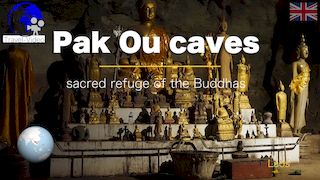
The banks of the Mekong are not only home to farms and villages. They also host spiritual sanctuaries, including Buddhist temples and notable sites such as the Pak Ou Caves, which house hundreds of Buddha statues accumulated over the centuries.
The Mekong, a major river of Southeast Asia, exhibits different characteristics along its course through Laos. In Luang Prabang, the river is calm and serves as a focal point for local activities, including fishing. Moving south to Champasak, the Mekong widens and becomes wilder, bordering ancient sites like Wat Phou. Further south, near the Cambodian border, lie the Khong Islands, where the river disperses its waters around multiple islands, supporting rich biodiversity and local communities that rely on it for their livelihood.
Crossing the Mekong from the Champassak East terminal to the West terminal offers a striking glimpse into the contrasts between the two banks. The east bank, more developed, is a hub of activity with vibrant markets and modern infrastructure. Here, daily life is paced by commerce and tourism, providing visitors with a multitude of conveniences and attractions.
In contrast, the west bank embodies rural tranquility. Less touched by modern development, it offers a more peaceful setting with its expansive rice fields and traditional village communities. This bank is ideal for those looking to experience authentic Laos, away from the hustle and bustle of tourism. Exploring this side reveals a way of life that has changed little over the years, rooted in traditions and agriculture.
Crossing the Mekong is not just moving from one bank to another; it's a journey through two distinct worlds, each offering a unique perspective on Laotian culture and landscape.
On the west bank of the Mekong, the village of Muang Khong exemplifies the serene life of Laotian rural communities. This primarily agricultural village thrives on fishing and rice farming. A notable aspect of Muang Khong is its numerous places of worship, reflecting the area's spiritual richness. These temples and sanctuaries serve as community gathering spots, bearing witness to the enduring traditions of the village. Muang Khong thus offers an authentic glimpse into the heritage and customs of the Mekong's west bank.
At the Cambodian border, the Mekong significantly widens, marking a key transition in its journey through Southeast Asia. This section of the river is crucial for local ecosystems, featuring a rich abundance of wildlife and plant life. The islands scattered across the river are vital centers of biodiversity. The Mekong plays a central role in the economy of riverside communities, primarily through fishing, which is a major food and economic resource. The landscape is characterized by extensive agricultural areas, benefiting from fertile soils enriched by the river's sediments. Seasonal water level fluctuations directly influence the lifestyles and agricultural activities in the region.
On Don Khon Island, a path winds through rural landscapes, connecting small villages to the island's famed attraction, the Li Phi Somphamit waterfalls. Along this route, one can see traditional Laotian houses and agricultural lands primarily used for growing rice. The Li Phi Somphamit waterfalls, located in the southern part of the island, are accessible via this path, providing an authentic glimpse into the daily life in this region of the Mekong.
Near the Li Phi Somphamit waterfalls lies an unexpected relic of the colonial era: an old French locomotive. Intended for a railway network to complement the Mekong's waterways, this unfinished project left the locomotive as a witness to industrial development efforts in the region. Today, it captivates visitors, unveiling a slice of European history in the heart of Southeast Asia.
The Li Phi falls, also known as Somphamit, are located in the Si Phan Don region of Laos, where the Mekong splits into numerous branches, creating an archipelago of thousands of islands. These falls are among the most significant natural barriers on the Mekong, making navigation challenging. They play a crucial ecological role by acting as a natural barrier to fish migration, making them a point of interest for local biodiversity. The Li Phi falls are not only a site of great natural beauty but also a place of importance for the Mekong’s riverine ecosystem.
The Manikhoth, a sacred tree once located in the middle of the Khone Phapheng Falls, was destroyed by a storm in 2012. Following its destruction, a temple was specifically built to venerate it, where the tree is now preserved and displayed. Each year, a festival is dedicated to it where locals bring white flowers and prayers in tribute to the tree, underscoring its ongoing importance as a cornerstone of local spirituality and culture.
Among the world's most imposing waterfalls, the Khone Phapheng Falls stand out for their monumental scale. Located on the Mekong in Laos, they even surpass the famous Niagara Falls in terms of water volume discharged, making them the largest falls in Southeast Asia. While Niagara Falls are known for their iconic shape, Khone Phapheng is celebrated for its wild expanse and raw power, reflecting the untamed force of the Mekong.
On the Khone Phapheng Falls, local fishermen daily defy the power of nature. Without the aid of boats, they stand directly on the steep rocks, in the heart of the tumultuous falls. Armed with long nets handled with acrobatic precision, they dip their tools into the violently churning water, hoping to capture the few fish that still remain despite the upstream dams. This risky and ancient fishing technique is a poignant testament to the exceptional skill and courage of the locals who derive their livelihood from the increasingly capricious waters of the Mekong.