

 Français (France)
  Nederlands (nl-NL)
 The former French locomotive displayed on Don Khon Island, in the Si Phan Don archipelago in southern Laos, is a visible reminder of French colonial presence and the development of transport infrastructure in the Mekong region during the late nineteenth and early twentieth centuries. Located on Don Khon, the locomotive commemorates the railway line once built to bypass the Mekong rapids that made navigation difficult in this section of the river. Today, it is preserved as a historical object and attracts visitors interested in the history of transportation and in the colonial period of French Indochina in southern Laos.
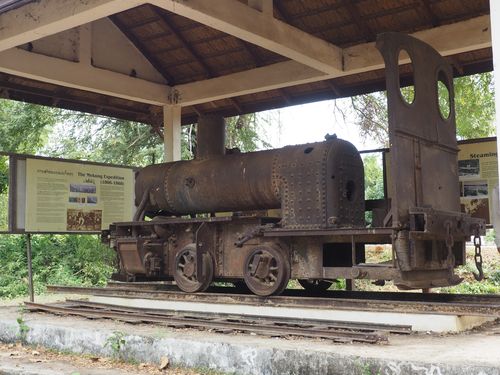
Don Khon • Old French locomotive
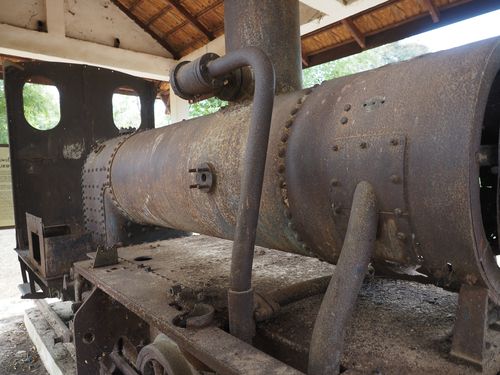
Don Khon • Old French locomotive
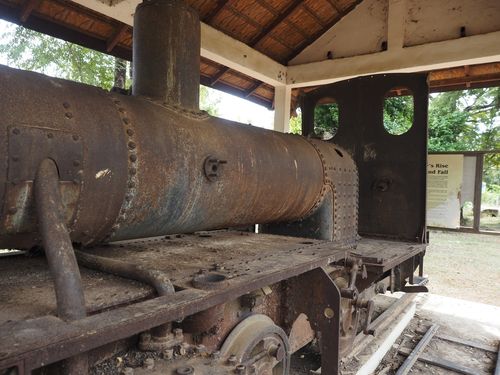
Don Khon • Old French locomotive
Monument profile
Old French locomotive
Monument category: Steam train
Monument family: Civil engineering structures (bridges, wells, etc.) and factories
Monument genre: Economic
Geographic location: Don Khon • Laos
Construction period: 19th century AD
• Links to •
• List of videos about Mekong near Muang Champassak, Mekong near Luang Prabang, Mekong from Nakasong to Li Phi Somphamit on this site •
The Mekong: A Serene River? • Laos
History of the Former French Locomotive of Don Khon
Construction of the Mekong Island Railway
The former French locomotive preserved on Don Khon Island represents a surviving element of the railway built by the French colonial administration in the Si Phan Don region of southern Laos. This railway formed part of an infrastructure project designed specifically to overcome a geographical obstacle on the Mekong River: the Khone Falls and the series of powerful rapids that prevented continuous navigation between Cambodia and the upstream regions of Laos.
During the late nineteenth century, French colonial authorities sought to establish a reliable transport corridor along the Mekong River. Explorations conducted by French expeditions had revealed that navigation along the river was interrupted in the Khone Falls area, where steep gradients and strong currents made passage impossible for river vessels.
To bypass this obstacle, colonial engineers designed a short railway linking navigable sections of the river. The railway was first constructed in the 1890s between Don Det and Don Khon islands. Its primary function was to transfer cargo, passengers, and equipment between riverboats operating upstream and downstream of the falls.
The locomotive now displayed on Don Khon formed part of the equipment used on this line. It hauled wagons carrying goods unloaded from river vessels, allowing cargo to be transported across the islands and reloaded onto boats below the rapids. The machine therefore played a direct role in maintaining the continuity of river transport through a region where navigation alone was impossible.
Operation and logistical function of the railway
The railway system established on Don Khon functioned as a practical transport link within a larger riverine logistics network. Goods transported along the Mekong were transferred from boats onto rail wagons at the upper landing points above the falls. The locomotive then pulled these wagons across the islands to another river port located below the rapids.
The railway was relatively short, extending only a few kilometers, but it represented a key logistical solution for moving cargo across the natural barrier formed by the falls. The locomotive used on this line was designed for narrow-gauge tracks and for operating on a limited infrastructure. Its compact size and mechanical configuration allowed it to function efficiently on a lightweight railway built primarily for transport rather than long-distance travel.
In addition to transporting goods, the railway occasionally carried passengers and equipment used in river navigation. Boats that were disassembled for transport could also be moved across the railway before being reassembled and launched again in the downstream section of the Mekong.
The locomotive was therefore integrated into a system combining river navigation and rail transport. Its use was closely tied to the functioning of the colonial trade route along the Mekong River, which relied on coordinated transfers between boats and railway wagons.
Decline of the railway and abandonment of the locomotive
The railway across the Khone Islands remained in operation during the early decades of the twentieth century. However, changes in regional transport infrastructure gradually reduced the importance of this logistical route. Improvements in road networks and shifts in trade patterns diminished the strategic role of the Mekong corridor that had originally justified the construction of the railway.
Following the Second World War and the weakening of French colonial control in Indochina, maintenance of the railway infrastructure declined. The line was eventually abandoned as transport priorities shifted toward other routes and technologies.
When railway operations ceased, locomotives and rolling stock were left on the islands. Some equipment was dismantled or removed, while other machines remained in place near the former railway tracks or loading areas. The locomotive preserved today on Don Khon is one of the few surviving pieces of this infrastructure.
Over time the locomotive lost its operational function and gradually became a static object within the landscape. The surrounding railway infrastructure largely disappeared or deteriorated, leaving the locomotive as one of the most visible remnants of the system that once connected the river transport routes across the islands.
Global historical context at the time of construction
The construction of the Khone Islands railway occurred during the late nineteenth century, a period marked by the expansion of European colonial influence in Southeast Asia. In 1887 the French administration established the Union of French Indochina, consolidating its control over several territories in the region. At the same time the British Empire strengthened its presence in Burma following the Third Anglo-Burmese War of 1885. In Europe and North America, the same period was characterized by rapid expansion of railway networks and industrial transport systems.
Present condition and heritage significance
Today the former French locomotive on Don Khon is preserved as a historical artifact representing the railway once built to bypass the Khone Falls. Although no longer operational, the machine remains an identifiable element of the transport system established during the colonial period.
The locomotive is displayed near the former railway route, allowing visitors to recognize its relationship to the infrastructure that once operated across the islands. Its presence provides physical evidence of the engineering solution implemented by the colonial administration to overcome the navigational barrier created by the Mekong rapids.
The surrounding landscape still contains traces of the railway, including fragments of track, bridge remains, and the alignments of the former transport route. These remnants help contextualize the locomotive within the broader system of river and rail transport that functioned in the region.
The locomotive itself is not included on the UNESCO World Heritage List. Nevertheless, it remains an important historical marker of the transport infrastructure developed in southern Laos during the period of French Indochina. As a preserved mechanical object, it offers a direct material reference to the railway that once connected navigable sections of the Mekong River across the Khone Islands.
Architecture of the Former French Locomotive of Don Khon
Positioning within the railway landscape
The former French locomotive preserved on Don Khon Island is displayed in direct association with the remains of the colonial railway that once crossed the islands of the Si Phan Don region. Its position corresponds closely to the former alignment of the track that connected the river landing points above and below the Khone Falls. The machine is oriented parallel to the historical direction of the railway, allowing observers to understand the spatial relationship between the locomotive and the route along which it originally operated.
The locomotive is generally placed on or beside a short section of rails that recreates or preserves part of the former track structure. This arrangement emphasizes the functional link between the locomotive and the transport infrastructure used during the colonial period. The surrounding area still contains fragments of the railway system, including metal rails, wooden or concrete sleepers, and the embankment that supported the line.
The machine appears relatively compact when compared with locomotives designed for long-distance railway networks. Its dimensions correspond to the requirements of a narrow-gauge railway built for short transport distances across the islands. The scale of the locomotive reflects the logistical constraints of the infrastructure: lightweight tracks, modest gradients, and a railway route designed specifically for cargo transfer between river vessels.
The positioning of the locomotive within this landscape makes the mechanical structure easily observable from multiple angles. Its preserved orientation allows the relationship between the locomotive body, the wheels, and the track system to be clearly understood.
Structural framework and mechanical composition
The locomotive is organized around a rigid metal chassis that forms the structural foundation of the machine. This frame supports the principal mechanical components and distributes their weight onto the wheel assemblies. The chassis extends longitudinally from the front of the locomotive to the rear platform and defines the overall length of the machine.
Mounted above this base structure is the cylindrical boiler, which forms the largest visible volume of the locomotive. The boiler is positioned horizontally along the axis of the machine and occupies the central section of the vehicle. Its cylindrical form is composed of curved metal plates joined together through riveted seams that remain visible on the exterior surface.
At the front of the boiler is the smokebox, a cylindrical chamber that collects exhaust gases before they exit through the chimney. The smokebox is typically distinguishable from the main boiler section by its slightly different proportions and by the presence of a circular front plate. Rising above this chamber is the vertical chimney, a prominent element that originally served to evacuate combustion gases.
Behind the boiler stands the driver’s cab. This compartment contains the control space from which the locomotive was operated. The cab structure is partially open, allowing ventilation and visibility. Metal supports define the frame of the cab, while the roof provides protection for the crew from weather conditions.
These components form a continuous mechanical sequence from front to rear: smokebox, boiler, cab, and rear platform. The alignment of these elements along a single longitudinal axis produces the compact silhouette characteristic of locomotives designed for secondary railway lines.
Materials and industrial construction techniques
The locomotive is primarily constructed from iron and steel components produced through industrial manufacturing processes typical of the late nineteenth and early twentieth centuries. The principal structural elements—chassis, boiler, cylinders, and wheel assemblies—are fabricated from heavy metal components designed to withstand the pressure generated by steam propulsion and the mechanical stress of railway operation.
The exterior plates of the boiler are joined through riveted construction. Rows of rivets remain visible along the seams where the metal plates meet. These rivets were essential for maintaining structural integrity and pressure resistance within the boiler. Riveted construction also allowed damaged plates to be replaced when necessary.
The wheel assemblies consist of steel wheels mounted on solid axles. Each wheel includes a flanged edge designed to guide the locomotive along the rails. The axles are connected to the chassis through suspension components that distribute weight evenly across the track.
Additional metal components include handrails, footplates, support brackets, and mechanical linkages. Many of these elements remain visible on the preserved locomotive and reveal the functional arrangement of the machine. Certain parts of the cab floor and auxiliary structures may originally have incorporated wooden elements, although these components often deteriorate over time and may no longer be present.
The durability of the metal framework explains why the locomotive remains structurally identifiable even after decades of exposure to tropical environmental conditions.
Functional mechanical elements and visible technical features
Several mechanical components on the locomotive illustrate the process by which steam power was converted into movement. Near the front wheel assemblies are the steam cylinders, which originally housed pistons driven by pressurized steam from the boiler. These pistons generated linear motion that was transferred to the wheels through connecting rods.
The connecting rods form one of the most distinctive visible features of the locomotive. These elongated metal bars link the cylinders to the driving wheels and transform the back-and-forth motion of the pistons into rotational movement. The articulation points and mechanical joints of these rods remain visible on the preserved machine.
The driving wheels are slightly larger than the other wheels and were responsible for transmitting traction to the rails. Their diameter and spacing correspond to the narrow-gauge railway configuration used on the Don Khon line.
Within the cab area, the structural supports for the control mechanisms are still identifiable. These supports originally held the levers and valves used by the driver to regulate steam pressure, speed, and braking. Although some of these mechanical instruments may no longer be present, their mounting points remain visible.
Additional elements associated with the functioning of the locomotive include water tanks and compartments used for storing fuel. These components are integrated into the locomotive’s structure and illustrate how the machine was designed to operate autonomously over short transport routes.
Alterations, deterioration, and preservation
Since the railway on the Khone Islands ceased operation during the twentieth century, the locomotive has remained exposed to environmental conditions characteristic of a tropical climate. The most visible effect of this exposure is the oxidation of metal surfaces, which has produced extensive rust on many components of the machine.
Certain mechanical parts have been lost or heavily degraded over time, particularly smaller moving elements that were more vulnerable to corrosion or removal. Despite these losses, the principal structural components of the locomotive—the chassis, boiler, wheels, and cab—remain largely intact and continue to define the overall configuration of the machine.
Conservation measures have been undertaken to stabilize the locomotive and prevent further structural deterioration. These interventions generally involve securing the machine in a stable position and limiting damage caused by environmental exposure. In some cases protective coatings or basic maintenance procedures have been applied to slow the corrosion process.
The locomotive now functions as a preserved artifact representing the railway system once built across the Khone Islands. Its structural configuration continues to display the essential engineering principles of small steam locomotives used on narrow colonial railway lines.