Français (France)
  Nederlands (nl-NL)
 00:00 • intro | 00:32 • On the Yen river | 02:58 • The temples
Personal creation from visual material collected during my trip Vietnam & Cambodia (2014)
Map of places or practices in Huang Tich mountains on this site
• Use the markers to explore the content •
Perfume Pagoda and the Yen River: Pilgrimage Landscape in Northern Vietnam
A sacred complex shaped by water and limestone mountains
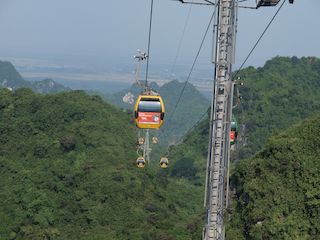
The Perfume Pagoda, located south of Hanoi in a region of limestone hills and cultivated valleys, is one of Vietnam’s most important religious destinations. Rather than a single monument, it is a broad sacred complex made up of temples, shrines, caves and pilgrimage routes spread across a dramatic natural setting. Forested slopes, rocky cliffs and waterways all play an essential role in the identity of the site.
This video reveals how heritage, landscape and devotion are closely connected here. The Yen River serves as the traditional gateway to the sanctuary area. Visitors travel by boat through calm waters and rural scenery before reaching the paths and temple zones hidden among the mountains. The journey itself has long been part of the spiritual meaning of the place. Movement through nature gradually prepares the visitor for arrival at the sacred spaces beyond.
From the Yen River to the temple sanctuaries
One of the most memorable aspects of the site is the passage along the Yen River. Narrow boats glide between rice fields, reeds and limestone formations, creating a slow and reflective approach unlike the entrance to an urban monument. The surrounding scenery helps explain why the area became associated with contemplation and retreat.
Beyond the river route, the temple complex unfolds in successive stages. The name “Perfume Pagoda” can be misleading, as it refers to an entire network of religious places rather than one isolated structure. Some temples stand in the lower valley, while others are reached by climbing paths or ascending toward cave sanctuaries in the hills.
Among the best known sites is Huong Tich Cave, often regarded as the spiritual heart of the complex. Natural caverns have long held symbolic value in many Asian religious traditions, and here the cave was transformed into a place of worship with altars, statues and devotional spaces. The descent into the cavern and the encounter with its stone forms create a powerful contrast with the open landscapes outside. Certain rock shapes are traditionally linked with wishes for prosperity, fertility or protection.
Historical and cultural significance
The development of the Perfume Pagoda is closely connected with the history of Buddhism in Vietnam. Over centuries, Buddhist beliefs arriving through regional exchanges were adapted to local traditions, producing distinct Vietnamese forms of worship and temple culture. The sanctuary expanded through successive periods, with restorations and additions carried out under different ruling dynasties and later authorities.
The complex is especially famous for its annual pilgrimage season following the Lunar New Year. During this period, large numbers of worshippers come to pray, make offerings and seek blessings for the year ahead. This seasonal movement shows that the site is not only a preserved monument, but also a living religious center where historical continuity remains visible in present-day practice.
Architecturally, many structures display features associated with Vietnamese sacred buildings: curved roofs, timber traditions, ceremonial gateways, courtyards and spaces for incense and offerings. Yet the greatest originality of the site lies less in individual buildings than in the way architecture is woven into the terrain. Stairways, terraces, pathways and resting points create a ritual geography in which the natural landscape becomes part of the sanctuary.
What the videos on this site make especially clear
Videos built largely from carefully selected and animated photographs are particularly effective for a place such as the Perfume Pagoda. They allow the viewer to follow the sequence of spaces step by step, from the river approach to the inner temple areas, in a clear and coherent way.
Slow visual transitions help reveal scale and structure. The width of the river, the enclosure of valleys, the steepness of limestone slopes and the placement of shrines within vegetation become easier to understand than during a crowded on-site visit. Architectural details such as rooflines, entrances, stairways and devotional interiors can also be observed with greater attention.
This format is equally valuable for explaining relationships. Rather than showing isolated scenes, it clarifies how water routes, paths, temples and mountains connect to form a unified pilgrimage landscape. The viewer gains a progressive understanding of how movement through the site shapes both practical access and symbolic experience.
A place where the journey is part of the sanctuary
The Perfume Pagoda and the Yen River illustrate a tradition in which architecture, nature and devotion are inseparable. The destination matters, but so does the path leading to it. This combination of sacred spaces and carefully staged landscape makes the site one of Vietnam’s most distinctive cultural experiences. Visitors wishing to explore further can continue with the detailed pages dedicated to the monuments and natural settings linked to this remarkable sanctuary.
Links to related pages

Audio Commentary Transcript
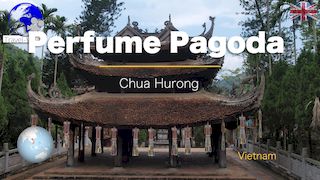
The Perfume Pagoda in Vietnam, in the Hanoi region, is a collection of temples that can only be accessed by boats sailing on the Yen River. Oddly enough, it is always women who are at the helm. And the spectacle on the 3 kilometers which separate the pier from the temples is majestic.

Music:
- - YouTube video library - At Odds
- - YouTube video library - Carol of the Bells
- - YouTube video library - March to Victory
Disclaimer: Despite its appropriateness, copyright issues prevent the use of vietnamese traditional music in "The Perfume Pagoda and the Yen River • Vietnam", hence the use of royalty-free music. Despite our careful selection, some might regret this decision, which is necessary to avoid potential lawsuits. Although difficult, this decision is the only viable solution.