

 Français (France)
  Nederlands (nl-NL)
 Huong Tich Cave is located in the mountainous area associated with the Huong religious complex in northern Vietnam. It represents one of the main points of interest within the cultural landscape of this region, attracting both visitors and pilgrims. Access to the cave involves a route crossing a limestone terrain characteristic of this part of the country. The site is known for its significance within the heritage ensemble of the Huong Tich Mountains and for its role in religious and cultural activities taking place there. Today, the cave is visited for its spiritual, scenic and cultural importance, as well as for its place within tourism routes in northern Vietnam.
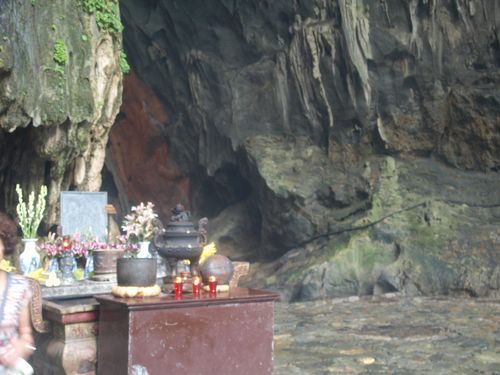
Huang Tich mountains • Huong Tich cave

Huang Tich mountains • Huong Tich cave

Huang Tich mountains • Huong Tich cave
Monument profile
Huong Tich cave
Monument categories: Pilgrimage site, Rock Sanctuary
Monument families: Pilgrimage site or memorial • Rock Sanctuary and Monumental Bas-reliefs
Monument genres: Religious
Cultural heritage: Buddhist
Geographic location: Huang Tich mountains • Vietnam
Construction period: 17th century AD
• Links to •
• List of videos about Huang Tich mountains on this site •
The Perfume Pagoda and the Yen River • Vietnam
History of Huong Tich Cave, Huong Tich Mountains, Vietnam
Discovery and Early Religious Recognition
Huong Tich Cave lies within the Huong Tich mountain range, part of the wider Huong Pagoda complex located southwest of present-day Hanoi. The cave forms the central sanctuary of this religious landscape, which consists of several temples, shrines, and natural sites distributed across limestone mountains and valleys. Historical records associate the recognition of the cave as a sacred site with Buddhist activity during the seventeenth century.
According to Vietnamese religious tradition, the cave was identified as a place of meditation and spiritual practice by the monk Trần Đạo Viên. The natural cavern was subsequently incorporated into local Buddhist devotion and gradually became a focal point of worship dedicated to Quan Âm, the bodhisattva of compassion in East Asian Buddhist traditions. The cavern’s interior space provided a natural setting for ritual activity, and religious objects and altars were introduced without significant alteration of the geological environment.
A decisive moment in the historical recognition of the cave occurred in 1770 during the visit of the lord Trịnh Sâm, a powerful political figure of the Trịnh regime that governed northern Vietnam at the time. After visiting the cavern, he ordered an inscription carved into the rock at the entrance. The inscription reads “Nam Thiên Đệ Nhất Động,” commonly translated as “The foremost cave under the southern sky.” This inscription formalized the symbolic status of the cave and reinforced its reputation as a major religious site.
Integration into the Huong Pagoda Pilgrimage Network
Following its recognition in the eighteenth century, Huong Tich Cave became the central destination within the Huong Pagoda pilgrimage network. The surrounding mountainous area gradually developed into a complex religious landscape composed of temples, shrines, and paths leading to the cave. These structures were arranged to guide pilgrims through a sequence of religious spaces before reaching the cavern itself.
The cave functioned as the culminating point of the pilgrimage. Devotional practices focused on altars dedicated to Quan Âm placed inside the cavern. Pilgrims traveled along river routes and mountain paths before entering the cave, transforming the journey itself into a ritual progression toward the sacred interior space.
During this period, the religious importance of the site increased as the pilgrimage attracted a growing number of devotees. The cave’s status as a sacred destination was reinforced by inscriptions, religious installations, and the continued patronage of local religious communities. Despite these developments, the interior of the cave remained largely unmodified, and the sacred character of the site continued to rely primarily on its natural features.
Damage and Reconstruction during the Twentieth Century
The Huong Pagoda complex, including Huong Tich Cave, experienced disruption during the conflicts that affected Vietnam during the twentieth century. While the cave itself remained structurally intact due to its geological nature, several structures in the surrounding pilgrimage complex suffered damage during the First Indochina War in the mid-twentieth century.
Following the end of major military conflicts, restoration efforts were undertaken to rebuild damaged temples and to reestablish pilgrimage routes leading to the cave. These interventions focused mainly on access paths, religious buildings near the cave, and infrastructure required to accommodate pilgrims and visitors.
During the later decades of the twentieth century, the Vietnamese authorities introduced additional improvements to facilitate access. These included the reinforcement of stairways, improvements to transportation routes within the valley system, and the installation of basic facilities for visitors. These modifications aimed to stabilize the site while preserving the central role of the cave in religious practice.
Contemporary Religious Role and Cultural Significance
Huong Tich Cave remains the principal sanctuary within the Huong Pagoda complex and continues to serve as the final destination of the annual Huong pilgrimage festival. The festival takes place during the early months of the lunar year and attracts large numbers of pilgrims from across Vietnam.
The ritual journey typically involves travel by boat along waterways leading into the Huong valley, followed by a climb through mountainous terrain to reach the cave. Inside the cavern, pilgrims perform offerings and prayers directed toward the statues and altars associated with Quan Âm. The natural rock formations within the cave have acquired symbolic interpretations and are integrated into the devotional practices of visitors.
In addition to its religious function, the cave has become an important cultural and tourism site. Visitors who are not participating in pilgrimage activities frequently travel to the cave as part of broader travel routes in northern Vietnam. The dual role of the site as a religious sanctuary and a tourism destination has led to ongoing efforts to manage visitor flows and maintain the integrity of the cave environment.
Conservation measures have been implemented to limit the impact of large visitor numbers, particularly during pilgrimage periods. These measures include the management of access routes, maintenance of pathways, and protection of vulnerable geological formations within the cavern.
Global Historical Context
The formal recognition of Huong Tich Cave in 1770 took place during a period of major transformations in several parts of the world. In Europe, the eighteenth century was marked by the intellectual movement of the Enlightenment, which influenced political and scientific thought. The American Revolution was unfolding in North America during the 1770s, leading to the independence of the United States in 1776. In East Asia, the Qing dynasty governed China while Japan remained under the Tokugawa shogunate. These developments formed the broader global context during the period in which Huong Tich Cave gained official recognition as a prominent religious site in northern Vietnam.
Architecture of Huong Tich Cave, Huong Tich Mountains, Vietnam
Topographical Setting and Spatial Organization of the Cave Sanctuary
Huong Tich Cave forms the central sanctuary of the Huong Pagoda religious complex located within the limestone mountains southwest of Hanoi. The cavern occupies a natural hollow within a karst formation whose steep slopes and irregular relief define the approach to the site. Access to the cave is achieved through a descending sequence of stone stairways cut into the mountainside, which gradually guide visitors from the surrounding landscape toward the entrance. This approach path establishes a clear spatial transition from the external environment to the subterranean sacred space.
The entrance opening appears as a wide irregular aperture in the limestone cliff. The threshold is marked by a set of stone steps that descend directly into the cavern. Unlike constructed temples, the organization of the sanctuary relies primarily on the natural geometry of the cave. The floor slopes downward toward the central chamber, creating a gradual interior descent that structures circulation routes.
The interior volume consists of a large main chamber with several secondary recesses extending from its perimeter. The ceiling height varies considerably throughout the cavern, with certain sections rising into large vaulted spaces created by the erosion of the limestone. This variation in elevation defines zones of gathering, movement, and ritual placement within the cave.
The spatial arrangement of devotional areas follows the natural contours of the rock floor. Platforms, altars, and ritual objects are positioned along the central axis of the cavern, while circulation paths remain aligned with the slope of the terrain. This configuration produces a spatial sequence in which visitors progressively descend deeper into the sanctuary.
Entrance Composition and Inscribed Architectural Elements
The architectural identity of Huong Tich Cave begins at the entrance zone, where the natural rock opening is framed by carved stone steps and a large inscription engraved directly into the limestone wall. The inscription “Nam Thiên Đệ Nhất Động,” carved during the eighteenth century under the authority of Trịnh Sâm, forms one of the most prominent architectural elements associated with the cave.
The engraved characters occupy a visible section of the rock surface near the entrance and serve both a commemorative and spatial function. Their placement establishes the threshold between the exterior landscape and the sacred interior of the cave. The inscription is carved directly into the limestone rather than mounted as a separate element, integrating it permanently into the geological structure.
At the entrance level, small architectural installations such as stone terraces and resting platforms organize the transition between the outdoor stairways and the interior chamber. These surfaces stabilize the ground and provide space for the congregation of visitors before entering the cavern.
The combination of carved inscriptions, steps, and terraces produces an architectural threshold that merges natural rock formations with minimal constructed elements. The entrance therefore acts as a defined spatial boundary without altering the original morphology of the limestone opening.
Interior Circulation and Ritual Spatial Arrangement
Inside the cave, circulation follows the descending slope of the floor. Stone steps have been inserted at specific points where the natural terrain becomes uneven or slippery. These stairways are generally narrow and follow the contours of the rock surface rather than forming straight structural alignments.
Several leveled platforms have been constructed to create stable surfaces for devotional activities. These platforms support altars, statues, and ritual objects placed throughout the cavern. Their distribution follows the natural layout of the cave rather than an imposed architectural symmetry.
The central chamber serves as the primary gathering area within the cavern. This space contains the most significant devotional installations, including statues associated with the bodhisattva Quan Âm. The placement of these statues takes advantage of the height and openness of the chamber, allowing them to remain visible from multiple points within the interior.
Side recesses within the cave contain smaller devotional areas formed by localized clusters of rock formations. These areas function as secondary ritual spaces where visitors can place offerings or perform prayers. The distribution of these spaces produces a spatial hierarchy centered on the main chamber.
Lighting installations have been introduced to illuminate the cave interior. Artificial lighting is mounted discreetly along pathways and near altars, highlighting rock formations and facilitating movement within the dark environment.
Geological Formations as Structural and Symbolic Elements
The architecture of Huong Tich Cave relies extensively on the integration of natural geological formations into the sacred layout. Stalactites descending from the ceiling and stalagmites rising from the floor form the most prominent visual elements of the cavern interior.
Many of these formations have acquired symbolic interpretations within local religious practice. Certain stalagmites are associated with representations of fertility, prosperity, or spiritual protection. These formations are frequently positioned near altars or integrated directly into devotional arrangements.
The surfaces of the cave walls and ceilings display irregular textures created by mineral deposits and long-term water infiltration. These surfaces contribute to the visual identity of the interior environment and influence the placement of ritual installations.
Water infiltration has produced mineral deposits along several sections of the cave. These deposits create smooth or layered surfaces that reflect artificial lighting and accentuate the natural relief of the limestone. The resulting visual composition combines geological forms with religious artifacts in a continuous spatial arrangement.
Unlike conventional temples where structural columns or architectural ornamentation dominate the interior, the structural rhythm of Huong Tich Cave is defined by the distribution of stalactites and stalagmites. These formations function as natural vertical markers that organize visual perspectives throughout the cavern.
Architectural Interventions, Materials, and Conservation Measures
Human architectural intervention within Huong Tich Cave remains limited and primarily serves to stabilize circulation and protect the natural environment. Stone and concrete have been used for stairways and leveled platforms due to their durability in humid conditions. These materials are applied selectively to avoid altering the appearance of the cave interior.
Metal railings have been installed along certain staircases and slopes to provide support for visitors. These railings follow the irregular contours of the terrain and are anchored into the rock surface with minimal structural intrusion.
Electrical lighting systems represent another significant architectural addition. These installations are designed to provide sufficient visibility while avoiding excessive heat or condensation that could affect the cave’s geological formations. Lighting fixtures are typically mounted along pathways or embedded discreetly in rock surfaces.
The growing number of visitors during pilgrimage periods has required additional structural adjustments to circulation routes. Certain pathways have been reinforced or widened slightly to reduce erosion of the cave floor. Protective barriers have been introduced in areas where fragile stalactites or stalagmites are particularly vulnerable.
Conservation policies implemented by local authorities emphasize the preservation of the cave’s natural structure. Interventions focus on preventing physical damage to geological formations and managing visitor flow during peak pilgrimage seasons. Maintenance programs also monitor humidity levels, lighting systems, and the stability of stairways to ensure that the cave remains accessible while maintaining its geological integrity.