

 Français (France)
  Nederlands (nl-NL)
 The Perfume Pagoda, located in the Huong Tich Mountains in Vietnam, refers to an extensive complex of religious sanctuaries, temples, and caves distributed across a mountainous landscape southwest of Hanoi. The site represents one of the most important Buddhist pilgrimage destinations in the country. The complex is composed of several places of worship connected by paths, stairways, and waterways that organize the movement of pilgrims and visitors. Each year, the Perfume Pagoda attracts large numbers of participants during a major seasonal religious festival. Today the area combines spiritual activity, tourism, and heritage management within a protected mountain environment.

Monument profile
Perfume Pagoda
Monument categories: Pagoda, Pilgrimage site
Monument families: Pilgrimage site or memorial • Pagoda or stupa
Monument genres: Religious
Cultural heritage: Buddhist
Geographic location: Huang Tich mountains • Vietnam
Construction period: 17th century AD
• Links to •
• List of videos about Huang Tich mountains on this site •
The Perfume Pagoda and the Yen River • Vietnam
History of the Perfume Pagoda, Huong Tich Mountains, Vietnam
Foundation of the Religious Complex
The Perfume Pagoda, known in Vietnamese as Chùa Hương, designates a large religious complex located in the limestone mountains of Huong Tich, southwest of present-day Hanoi. The site consists of numerous temples, shrines, and sacred caves distributed across a mountainous karst landscape. The historical development of the complex began during the late seventeenth century, when Buddhist monks established places of worship in the area.
Historical accounts attribute the foundation of the first sanctuary to the monk Trần Đạo Viên. During this period, the mountainous region was identified as a suitable environment for religious retreat and meditation. The monk is believed to have recognized the spiritual significance of the caves and natural formations of the mountains and initiated the establishment of the earliest temple structures in the valley.
The natural cave of Huong Tich became the focal point of the emerging religious landscape. The earliest structures built in the surrounding area served as resting places and devotional spaces for monks and pilgrims traveling toward the cave. These temples formed the foundation of a pilgrimage network structured around the mountainous terrain.
From its earliest phase, the Perfume Pagoda complex combined built religious architecture with natural sacred spaces. The caves were regarded as spiritually significant locations, while the constructed temples organized the movement of visitors and provided spaces for ritual practice.
Recognition and Expansion in the Eighteenth Century
The importance of the Perfume Pagoda increased significantly during the eighteenth century. A decisive moment occurred in 1770 when the lord Trịnh Sâm, a powerful ruler of the Trịnh regime that controlled northern Vietnam, visited the Huong Tich Mountains.
During his visit, Trịnh Sâm entered the Huong Tich cave and ordered a commemorative inscription to be carved into the limestone at the entrance of the cavern. The inscription reads “Nam Thiên Đệ Nhất Động,” commonly translated as “The foremost cave under the southern sky.” This inscription formally recognized the cave as a site of exceptional religious importance.
Following this recognition, the religious complex expanded. Additional temples and pavilions were constructed in the valleys and along the mountain slopes leading toward the cave. Stairways were built to connect different levels of the mountain, creating a structured pilgrimage route.
These developments transformed the Perfume Pagoda from a small monastic retreat into a major pilgrimage destination. The complex began attracting increasing numbers of devotees who traveled to the mountains to perform rituals associated with the bodhisattva Quan Âm, whose presence was symbolically linked to the Huong Tich cave.
The expansion of the site during the eighteenth century established the spatial structure that continues to define the complex today, with temples located at different stages along the path toward the main cave sanctuary.
Damage and Reconstruction in the Twentieth Century
The Perfume Pagoda complex experienced disruption during the twentieth century as a result of the political and military conflicts that affected Vietnam. Although the natural cave formations themselves were largely unaffected, several temple structures within the complex suffered damage.
During the First Indochina War in the mid-twentieth century, certain buildings within the complex were destroyed or severely damaged. The temples located in the more accessible areas of the valley were particularly vulnerable during this period.
After the end of the conflict, restoration programs were initiated to rebuild the damaged structures and restore the pilgrimage routes. Reconstruction efforts focused on repairing temples, stabilizing stairways, and restoring religious buildings that had been destroyed.
Later in the twentieth century, additional improvements were introduced to accommodate growing numbers of visitors. These included reinforcement of pathways, improvements to access routes, and the introduction of infrastructure necessary for managing pilgrim and tourist traffic.
Despite these changes, the overall layout of the complex remained largely consistent with its earlier historical development, with the Huong Tich cave continuing to serve as the principal sanctuary.
Contemporary Religious Function and Cultural Significance
The Perfume Pagoda remains one of the most important Buddhist pilgrimage destinations in Vietnam. The complex hosts an annual pilgrimage festival that begins shortly after the Lunar New Year and continues for several months. During this period, large numbers of pilgrims travel to the Huong Tich Mountains to participate in religious ceremonies.
The pilgrimage traditionally follows a structured route that begins with travel by boat along waterways leading into the valley. Visitors then proceed along mountain paths and stairways that connect the various temples of the complex. The final stage of the pilgrimage leads to the Huong Tich cave, where devotees perform rituals of prayer and offering.
Within the cave, altars and statues associated with Quan Âm serve as the focus of religious devotion. Pilgrims often place offerings and incense at these altars while praying for prosperity, health, or family well-being.
In addition to its religious role, the Perfume Pagoda has become an important cultural and tourism destination. Visitors from across Vietnam and from abroad travel to the site to experience its religious atmosphere and mountainous landscape.
Authorities have introduced management policies aimed at preserving the natural and architectural integrity of the complex. Measures have been implemented to regulate visitor numbers, maintain infrastructure, and protect the fragile limestone formations of the caves.
Global Historical Context
The formal recognition of the Huong Tich cave by Trịnh Sâm in 1770 occurred during a period of significant global transformation. In Europe, Enlightenment ideas were reshaping political and intellectual life. In North America, the American Revolution began in the 1770s and resulted in the creation of the United States in 1776. In East Asia, the Qing dynasty ruled China while Japan remained under the Tokugawa shogunate. These developments formed the wider historical context during the period in which the Perfume Pagoda complex gained official prominence in northern Vietnam.
Architecture of the Perfume Pagoda Complex, Huong Tich Mountains, Vietnam
Topographical Setting and Spatial Organization of the Complex
The Perfume Pagoda complex, known in Vietnamese as Chùa Hương, occupies a mountainous karst landscape in the Huong Tich Mountains southwest of Hanoi. Rather than consisting of a single temple, the complex forms an extended architectural ensemble composed of multiple temples, shrines, terraces, stairways, and cave sanctuaries distributed across valleys and steep limestone slopes. The architectural organization of the site follows the natural structure of the terrain, with buildings positioned at different elevations and connected through a continuous network of paths and staircases.
The lower portion of the complex is located in a relatively wide valley where several temples are constructed on leveled ground near waterways. From this point, the spatial arrangement progresses upward into the surrounding mountains. Stone stairways carved into the slopes connect successive architectural stages of the pilgrimage route. This ascending sequence culminates in the sacred cavern of Huong Tich, located higher within the limestone massif.
Terraces created through stone retaining walls allow buildings to be installed on steep slopes without extensive modification of the natural landscape. These terraces provide horizontal surfaces for temple courtyards and halls while stabilizing the surrounding terrain. The complex therefore functions as a vertically organized architectural landscape in which the progression through space corresponds to both physical elevation and ritual movement.
Circulation routes form the structural framework of the site. Pathways, staircases, and landings organize the movement of visitors between the valley temples and the cave sanctuaries above. These routes also determine the visual sequence of architectural elements encountered along the pilgrimage path.
Architectural Composition of the Thien Tru Temple
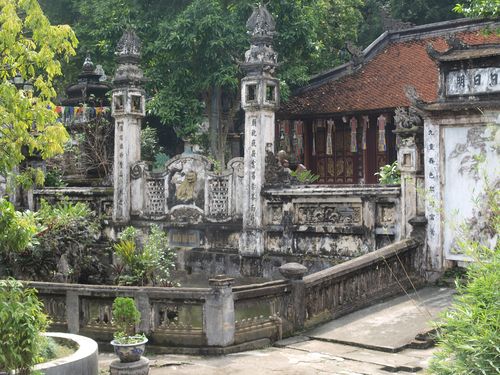
One of the most prominent architectural structures within the Perfume Pagoda complex is Thien Tru Temple. This temple is located on a relatively open plateau within the valley, providing sufficient space for the construction of courtyards and surrounding structures. The temple complex is organized around a central courtyard that functions as the principal gathering space for visitors.
The main hall of the temple is positioned along the central axis of the courtyard. The structure rests on stone foundations and consists of a timber frame supporting a tiled roof. The wooden columns are arranged in parallel rows that divide the interior into several bays. These columns rest on stone bases that protect the wood from direct contact with the ground.
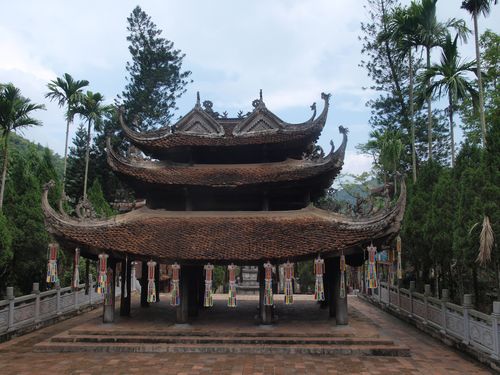
The roof structure is characterized by steeply sloping surfaces covered with ceramic tiles. The edges of the roof extend outward to form deep eaves that protect the wooden walls and structural elements from rainfall. The corners of the roof curve slightly upward, a feature commonly found in traditional Vietnamese temple architecture.
Within the courtyard, additional architectural elements include subsidiary halls, gateways, and small pavilions used for ritual functions. These buildings frame the central open space and create a sequence of enclosed and semi-enclosed areas that organize movement toward the main hall. Decorative elements appear on roof ridges and structural beams, though ornamentation remains relatively restrained compared with large imperial temples.
Near the temple complex stands a distinctive stone tower, often identified as a stupa-like structure. This vertical element contrasts with the horizontal lines of the surrounding buildings and acts as a visual marker within the valley landscape.
Construction Techniques and Structural Materials
The buildings of the Perfume Pagoda complex rely primarily on traditional Vietnamese construction techniques adapted to mountainous terrain. Timber frames constitute the principal structural system of the temples. The wooden beams and columns are assembled through mortise-and-tenon joints that allow the structures to remain stable without extensive use of metal fasteners.
Stone foundations form the base of most buildings. These foundations are composed of large stone blocks arranged to create elevated platforms. The platforms prevent moisture infiltration and provide stable surfaces for the timber frames. In areas where slopes are steep, additional retaining walls reinforce the foundations.
Roof structures consist of wooden rafters supporting layers of clay tiles. These tiles are arranged in overlapping rows that facilitate water drainage during heavy rainfall. The curvature of the roof edges improves water runoff and reduces the impact of wind on the structure.
Stone is widely used for circulation infrastructure within the complex. Stairways, pathways, and terrace walls are constructed from locally sourced stone blocks. These elements provide durability and resistance to erosion in the humid environment of the mountains.
Decorative architectural features include carved wooden panels and sculpted roof ornaments. These elements are integrated into the structural framework of the buildings rather than applied as separate decorative layers. The resulting architectural language combines functional structural systems with modest ornamental expression.
Integration of Natural Caves into the Architectural System
A defining characteristic of the Perfume Pagoda complex is the incorporation of natural limestone caves into the architectural composition of the site. Among these caves, Huong Tich Cave functions as the principal sanctuary and final destination of the pilgrimage route.
The entrance to the cave is located high within the mountain and is accessed through a descending sequence of stone steps. These steps follow the contours of the rock surface and lead visitors from the exterior landscape into the cavern interior. The threshold between the outside environment and the cave is marked by carved inscriptions and stone landings that frame the entrance.
Inside the cave, the spatial organization is determined by the natural topography of the limestone formation. The interior consists of a large central chamber with irregular floor levels and varying ceiling heights. Instead of introducing large structural constructions, the architectural arrangement adapts ritual installations to the natural surfaces of the cave.
Altars and statues are placed on leveled stone platforms constructed between stalagmites and rock outcrops. Lighting installations highlight the natural textures of the limestone walls and emphasize the vertical formations of stalactites descending from the ceiling.
The cave therefore functions simultaneously as a natural geological structure and as an architectural sanctuary. Its spatial configuration integrates natural rock formations with minimal built interventions designed to facilitate circulation and ritual use.
Architectural Modifications and Conservation Measures
Throughout the twentieth century, several architectural interventions were undertaken to repair damage to the complex and improve accessibility. Restoration projects focused primarily on rebuilding temple structures that had deteriorated and reinforcing stairways used by large numbers of visitors.
Stone pathways and staircases have been strengthened in areas where erosion threatened the stability of the routes. In certain sections, additional retaining walls were constructed to support the terraces on which temples are built. These structural measures ensure the long-term stability of the buildings and the circulation network connecting them.
Modern infrastructure has been introduced with the objective of improving safety while maintaining the traditional architectural character of the site. Metal railings have been installed along steep staircases, and discreet lighting systems illuminate pathways during periods of heavy visitation.
Conservation policies implemented by Vietnamese authorities aim to preserve both the built structures and the geological environment of the Huong Tich Mountains. Protective barriers limit access to fragile limestone formations inside the caves, and maintenance programs monitor structural stability and environmental conditions.
The architectural management of the Perfume Pagoda complex therefore balances three priorities: preservation of traditional temple structures, protection of the surrounding karst landscape, and accommodation of large numbers of pilgrims and visitors who travel to the site each year.