Français (France)
  Nederlands (nl-NL)
 00:00 • intro | 01:17 • The Pyramid of Khufu | 03:51 • The Pyramid of Khafre | 05:50 • The Pyramid of Menkaure | 07:06 • The Queens’ Pyramids | 08:41 • The Great Sphinx | 10:44 • The Valley Temple of Khafre
Personal creation from visual material collected during my trip Egypt (2024)
Map of places or practices in Giza on this site
• Use the markers to explore the content •
Giza, Royal Necropolis of the Old Kingdom
A funerary landscape of global importance
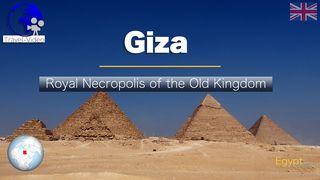
The plateau of Giza contains one of the most influential archaeological ensembles in human history. Rising between the desert edge and the Nile valley, close to modern Cairo, this site preserves the great royal pyramids of Egypt’s Fourth Dynasty, subsidiary monuments, ceremonial temples, and the celebrated Great Sphinx of Giza. The video offers a progressive reading of a landscape where architecture, kingship, religion, and topography were deliberately combined.
Giza was not created as a group of isolated monuments. It was planned as a royal necropolis intended to accompany deceased rulers into the afterlife while proclaiming their authority on earth. The pyramids visible today once stood within a wider network of causeways, enclosure walls, chapels, workers’ zones, and elite cemeteries. Even after the loss of some outer casing stones and ancillary structures, the original logic of the site remains strikingly clear.
The principal monuments shown in the video
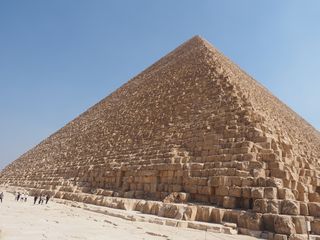
The Great Pyramid of Khufu dominates the northern part of the plateau. It is the largest pyramid ever built in Egypt and the only surviving Wonder of the Ancient World. Its scale alone explains its fame, yet its precision of planning and construction is equally remarkable. The monument still defines the skyline of Giza more than four millennia after its completion.
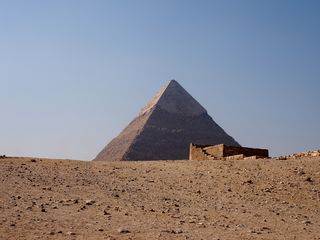
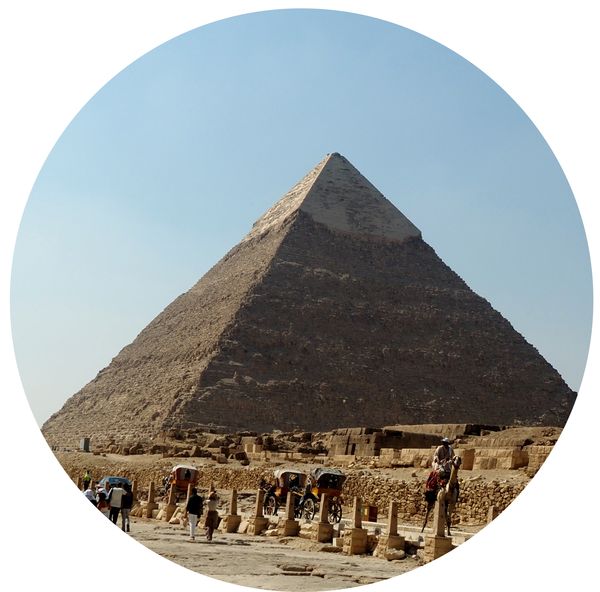
Nearby stands the Pyramid of Khafre. Built on higher natural ground, it often appears taller than Khufu’s pyramid despite being slightly smaller. Near its summit, sections of the original smooth casing remain in place, offering rare evidence of how the great pyramids once looked when their outer surfaces were intact.
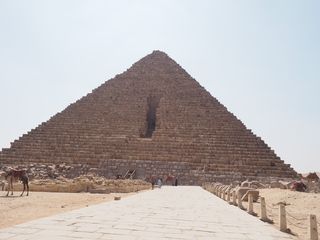
The Pyramid of Menkaure completes the main royal triad. More modest in size, it remains essential for understanding the continuity of dynastic planning at Giza. Its position shows that the plateau developed as a coherent ceremonial zone rather than as separate building episodes.
The Queens’ Pyramids at Giza add another dimension to the necropolis. These smaller monuments reflect the place of royal women within the funerary and political structure of the court.
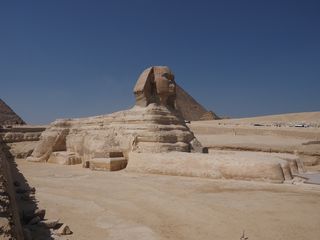
The Great Sphinx of Giza introduces an entirely different monumental language. Combining lion body and royal head, it stands beside the Valley Temple of Khafre, one of the key ceremonial buildings of the plateau. Together they illustrate how sculpture, ritual architecture, and royal symbolism were closely linked.
Historical and architectural context
The main monuments of Giza were constructed during the Old Kingdom, especially under the rulers of the Fourth Dynasty. This period saw strong political centralization and a state administration capable of organizing large labor forces, quarrying operations, transport systems, and long-term construction projects. The pyramids therefore reflect not only funerary beliefs but also administrative sophistication and royal power.
Each pyramid complex followed a structured ceremonial sequence. At the lower edge of the plateau stood a valley temple, connected by a causeway to the mortuary temple beside the pyramid itself. The pyramid rose above this processional axis as the symbolic and physical culmination of the complex. Surrounding mastaba tombs for officials and relatives extended the prestige of royal proximity.
The architecture of Giza is based on controlled geometry. Precisely oriented square plans, sharply inclined faces, carefully laid masonry courses, and large open sightlines create a sense of order and permanence. The natural setting was part of the design: desert horizons, strong sunlight, and elevated bedrock enhanced the monumental effect.
Over time, casing stones were removed, some structures collapsed, and interiors were entered by ancient and later visitors. Yet the essential framework remains readable. The relationships between pyramids, temples, routes, and landscape still explain why Giza continues to be one of the most studied archaeological sites in the world.
What the videos on this site make especially clear
Videos built largely from carefully selected and animated photographs are particularly effective for a place like Giza. They allow viewers to examine proportions, alignments, and relative scale more calmly than a hurried on-site visit often permits. The contrast between the three main pyramids, the elevated position of Khafre’s monument, and the smaller surrounding structures becomes easier to understand through gradual visual sequencing.
This format also clarifies spatial relationships. The connection between the Sphinx, the Valley Temple, and the neighboring pyramid complex can be followed step by step. Distances that seem abstract on a map become visually coherent when images progress through the site.
Architectural details also benefit from this approach. Stone courses, surviving casing blocks, weathered surfaces, edges, and changing perspectives can be observed with precision. Moderate animation guides attention without overwhelming the viewer, making the reading of mass and form more accessible.
A key site for understanding ancient Egypt
Giza remains one of the essential places for understanding the political ambition, religious thought, and architectural mastery of pharaonic Egypt. The pyramids, the Sphinx, and their associated temples form a rare ensemble whose original purpose can still be understood today. For a deeper exploration, the detailed pages linked to each monument offer further insight into one of the world’s most enduring royal necropolises.
Music:
- - YouTube video library - Forest Lullabye - Asher Fulero
- - YouTube video library - Hovering Thoughts - Spence
- - YouTube video library - Pastorale - Joel Cummins
Disclaimer: Despite its appropriateness, copyright issues prevent the use of egyptian traditional music in "Giza, Royal Necropolis of the Old Kingdom • Egypt", hence the use of royalty-free music. Despite our careful selection, some might regret this decision, which is necessary to avoid potential lawsuits. Although difficult, this decision is the only viable solution.


Audio Commentary Transcript
Today a sprawling suburb of the vast and bustling metropolis of Cairo, the Giza Plateau was, in the time of Ancient Egypt's Old Kingdom, a serenely blessed place of the gods. This majestic site became the spiritual and funerary heart of Egyptian royalty, where pharaohs chose to rest for eternity. The impressive pyramids of Khufu, Khafre, and Menkaure, surrounded by their temples and subsidiary pyramids, bear witness to the extraordinary architectural mastery and cosmic vision of the Egyptians. Alongside these monuments, the iconic Great Sphinx and the valley temples enhance the sacred nature of this site, reflecting the connection between humans and the divine in their quest for immortality.
Pyramid of Khufu
Among the three great pyramids of Giza, that of Khufu is the largest, originally measuring 146 meters in height with a base of 230 meters on each side. Built over 4300 years ago, it remains a symbol of the engineering and architecture of the Old Kingdom of Egypt. Its structure was originally covered in polished limestone, shining under the sun. However, over the centuries, many stones have been extracted, among others to contribute to the construction of Cairo, leaving visible today only a fraction of its former brilliance, yet still evoking the magnificence of this monument at the time of Khufu's funeral.
The interior of the Pyramid of Khufu, a masterpiece of ancient engineering, is a labyrinth of narrow passages leading to the grand burial chamber, located at the heart of the pyramid. Designed to house the pharaoh's sarcophagus, this chamber is accessed via the Grand Gallery, an ascending passageway that, like the other passages, was originally blocked by massive granite blocks to deter looters. These security measures also included blind alleys and false chambers intended to mislead or discourage intruders. Khufu, considered the sole royal occupant of this colossal structure, rests in imposing solitude, surrounded by these impressive architectural defenses. Though intended for a single sovereign, the grandeur of the pyramid testifies to the magnificence and determination of a reign that aspired to immortality.
Pyramid of Khafre
Distinguished from other pyramids in the necropolis by its summit still clad in polished limestone, the Pyramid of Khafre, though smaller than that of his father Khufu, never fails to impress. Its architecture, slightly modest in size, incorporates advanced astronomical knowledge, as demonstrated by the precise alignment of its north axis with Dubhe, a star in the Big Dipper constellation. This architectural detail, both functional and symbolic, underscores the significance of astronomy in the design of royal monuments, affirming the pharaohs' connection with the divine and the eternal.
Pyramid of Menkaure
The Pyramid of Menkaure, the smallest of the three great pyramids at Giza, was built by the fifth king of the Fourth Dynasty, Menkaure, succeeding Khafre and descending from Khufu. Standing about 65 meters tall, this structure is distinguished by the precision of its construction and the use of high-quality materials, such as red granite for the funeral complex. A large vertical slit, the result of a medieval break-in attempt, marks one of its faces, bearing witness to the centuries of disturbances this monument has endured, well beyond its initial funerary purpose.
Queen's pyramides
In the shadow of two of the great pyramids of Giza, those of Khufu and Menkaure, small pyramids stand as silent witnesses to the funerary customs of ancient Egypt. Near Menkaure's pyramid, three such pyramids have been discovered. These smaller structures were intended for the burials of royal wives and female members of the pharaonic family. Curiously, Khafre's pyramid does not include such structures at its base, marking a notable exception that raises questions about variations in funerary practices of the time. Although modest in size compared to the pharaohs' pyramids, these are built with equal meticulousness, reflecting the importance of these women in the social and spiritual structure of the era. The burial of these royal women near their husbands' tombs illustrates the Egyptian belief in a communal afterlife and continuous family support, even after death.
Great Sphinx
Majestic guardian of the Giza Plateau, the Great Sphinx is an extraordinary monolithic masterpiece from antiquity, carved directly from the plateau's natural limestone. Measuring 20 meters in height and 73 meters in length, it combines a lion’s body with a human head, likely representing Pharaoh Khafre. For over 4,500 years, it has stood watch over the pyramids, symbolizing divine power and royal wisdom.
Among the many mysteries surrounding it, the absence of its nose remains particularly intriguing. According to historical accounts, notably those of Al-Maqrizi, a 15th-century Arab historian, the nose was destroyed in the 14th century by Mohammed Sa’im al-Dahr, a Sufi iconoclast. Al-Dahr is said to have regarded the Sphinx as a pagan idol and, as reported in chronicles, sought to break the spiritual connection between local farmers and the monument, which they revered in hopes of securing bountiful harvests.
However, other theories persist. Some researchers suggest that an earthquake may have caused structural damage, although visible marks on the face indicate a likely deliberate mutilation with tools. These uncertainties only add to the allure and legends surrounding this unique monument.
A silent witness to civilizations through the ages, the Sphinx has endured centuries of erosion and human actions. Timeless and enigmatic, it remains a source of endless fascination, combining architectural prowess, history, and mystery.
Valley Temple of Khafre
Built around 2500 BC, the Valley Temple of Khafre in Giza was used for the pharaoh's funeral rituals before his burial in the adjacent pyramid. Made from limestone and granite, this temple is one of the oldest religious buildings still standing in the world. Its remarkable preservation showcases the architectural advancements of ancient Egypt and the durability of its materials.