Français (France)
  Nederlands (nl-NL)
 00:00 • intro | 00:05 • Kom Ombo, one temple, two deities | 01:26 • a shared sacrificial altar | 01:50 • marks of time | 02:34 • inside the temple | 04:22 • the bas-reliefs | 05:15 • other infractures | 06:13 • the nilometer | 07:09 • the crodcdile musium
Personal creation from visual material collected during my trip Egypt (2024)
Map of places or practices in Kom Ombo on this site
• Use the markers to explore the content •
The Temple of Kom Ombo: A Historical and Geographical Marvel
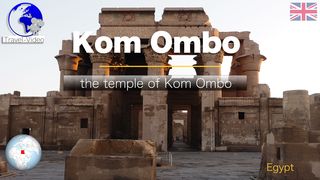
Situated along the eastern bank of the Nile River, approximately 50 kilometers north of Aswan, the Temple of Kom Ombo stands as a remarkable testament to the cultural and religious heritage of ancient Egypt. Dating back to the Greco-Roman period, this unique site is dedicated to two prominent deities: Sobek, the crocodile god, and Horus the Elder (Haroeris). Complementing the temple is the Crocodile Museum, which further sheds light on the fascinating spiritual significance of the region.
Strategic Location on the Nile
Kom Ombo, which translates to "the hill of Ombo" in ancient Egyptian, is strategically located in Upper Egypt. During antiquity, this area served as a vital crossroads for trade and communication between the Nile Valley and regions further south in Africa. Its position on the Nile made it an essential stop for merchants and travelers navigating the river, underscoring the importance of Kom Ombo as both a cultural and logistical hub.
The temple’s elevated position overlooking the river provided not only a vantage point for observing the surrounding landscape but also imbued the site with spiritual significance. In ancient Egyptian belief, the Nile was seen as a source of life and renewal, and its proximity to sacred sites was often intentional.
Sobek and Horus the Elder: A Dual Dedication
The Temple of Kom Ombo is unique in its dual dedication to Sobek and Horus the Elder, symbolizing a balance between contrasting yet complementary forces. Sobek, associated with the crocodile, represented fertility, power, and the strength of the Nile’s waters. His connection to the river and its life-giving floods made him a deity of immense importance in this region, where the prosperity of agricultural societies depended on the Nile.
On the other hand, Horus the Elder, often depicted as a falcon, was a god of protection, order, and kingship. He embodied celestial stability and was revered as a guardian of the pharaohs. The temple’s dual dedication reflects the ancient Egyptians’ ability to harmonize seemingly opposing concepts, celebrating both the unpredictable nature of the Nile and the protective order symbolized by Horus.
The Crocodile Museum: Insights into Sobek’s Worship
Adjacent to the temple, the Crocodile Museum offers a captivating glimpse into the religious practices surrounding Sobek. The museum houses an array of crocodile mummies, many of which were found in the vicinity of Kom Ombo. These mummified reptiles were considered sacred embodiments of Sobek and were often prepared with the same reverence as human remains.
In addition to the mummies, the museum displays artifacts and relics associated with the crocodile cult, including carvings, statues, and ritual items. These exhibits illustrate the close connection between the natural environment and the spiritual life of ancient Egyptians, particularly their respect for the Nile’s crocodiles as both revered creatures and symbols of divine power.
A Gateway to Understanding Ancient Egypt
The Temple of Kom Ombo and the accompanying Crocodile Museum together provide a profound introduction to the historical and geographical significance of the site. They reveal how the ancient Egyptians perceived their world, intertwining their environment, religion, and daily life into a cohesive cultural framework.
As a unique dual temple dedicated to two contrasting deities, Kom Ombo stands out as a symbol of balance and coexistence. Its connection to the Nile and its role in ancient trade routes underline its importance not only as a religious center but also as a key location in the broader context of Egyptian civilization.
about the place, Kom Ombo
Kom Ombo, located on the east bank of the Nile in Upper Egypt, is famous for its unique temple dedicated to two deities: Sobek, the crocodile god, and Horus, the falcon god. Built during the Ptolemaic period (around 180-47 BCE), the temple is notable for its symmetry, with each half devoted to one of the two gods. Kom Ombo also served as a medical center, as evidenced by the medical carvings on its walls. The proximity to the Nile adds a special charm to this historical site. Today, Kom Ombo attracts many visitors for its fascinating history and intricately detailed reliefs.
Spoken comments in the film:
A double temple
The Temple of Kom Ombo, located on the eastern bank of the Nile in Egypt, is a unique example of religious architecture from the Ptolemaic period. This remarkable sanctuary is dedicated to two main deities, Sobek and Horus the Elder (Haroeris), who embody diametrically opposed forces. Sobek, depicted with a crocodile head, is associated with water, fertility, and raw power, while Horus the Elder, with a falcon head, symbolizes light, cosmic order, and protection.
This duality is reflected in the very structure of the temple, which is divided into two symmetrical sections, each dedicated to one of the deities. Each section has its own halls, sanctuaries, and corridors, allowing worshippers to venerate either god in a distinct yet unified space.

Audio Commentary Transcript
A double temple
The Temple of Kom Ombo, located on the eastern bank of the Nile in Egypt, is a unique example of religious architecture from the Ptolemaic period. This remarkable sanctuary is dedicated to two main deities, Sobek and Horus the Elder (Haroeris), who embody diametrically opposed forces. Sobek, depicted with a crocodile head, is associated with water, fertility, and raw power, while Horus the Elder, with a falcon head, symbolizes light, cosmic order, and protection.
This duality is reflected in the very structure of the temple, which is divided into two symmetrical sections, each dedicated to one of the deities. Each section has its own halls, sanctuaries, and corridors, allowing worshippers to venerate either god in a distinct yet unified space.
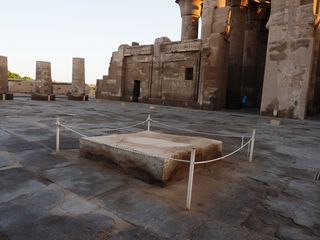
A common altar
This large square stone in the center of the esplanade, in front of the entrance to both temples, was likely a sacrificial altar. It represents the only shared element between the two cults, that of Horus the Elder and Sobek, bringing worshippers together in their offerings to the deities.
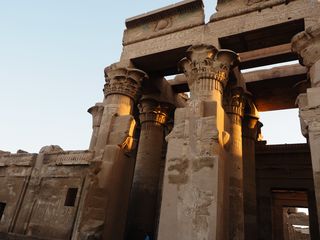
Preservation of the temple
Although Kom Ombo is slightly more recent than the Ptolemaic temple at Edfu, it has endured greater damage over the centuries. This is due to natural factors, such as its proximity to the Nile, which made it more vulnerable to flooding, as well as cultural factors, such as the erasure of idols by early Christians. Despite this, some parts of the temple have retained their original colors, a testament to its former splendor.
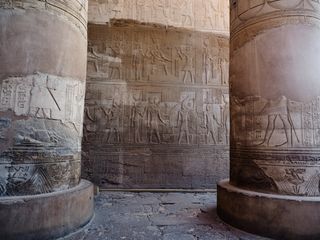
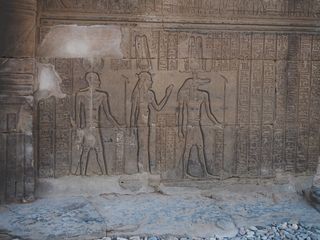
Bas-reliefs
The bas-reliefs of the Temple of Kom Ombo reflect the distinctive features of Ptolemaic art, blending Egyptian traditions with Hellenistic influences. In contrast to older temples, these reliefs are notable for their refinement and detailed scenes. Some were defaced by early Christians to erase depictions of pagan deities.
Chapels and other buildings
At the rear of the Kom Ombo temple lies the Chapel of the Hearing Ear, an intimate and symbolic space where worshippers came to offer their prayers to the gods. This chapel embodies the deep spirituality of ancient Egypt, where deities were believed to attentively listen to human needs. Sobek and Haroeris, the temple’s principal gods, received offerings and supplications here in an atmosphere of reverence.
At Kom Ombo, the nilometer and well form a single structure connected to the Nile by an underground channel. The stairs within the well allowed water levels to be measured, crucial for predicting floods and performing religious rituals. This setup highlights the Nile's significance in the spiritual and agricultural life of ancient Egyptians.
The site of Kom Ombo also contains the ruins of smaller, less prominent temples, reflecting the secondary religious activity of the time. Nearby, a crocodile museum has recently been opened, showcasing crocodile mummies among other artifacts, in tribute to Sobek, the crocodile deity worshipped here.

Music:
- - YouTube video library - English Country Garden - Aaron Kenny
- - YouTube video library - For Originz, (© For Originz by Kevin MacLeod is licensed under a Creative Commons Attribution 4.0 license. https://creativecommons.org/licenses/by/4.0/
- Source: http://incompetech.com/music/royalty-free/index.html?isrc=USUAN1100700
- Artist: http://incompetech.com/)
Disclaimer: Despite its appropriateness, copyright issues prevent the use of egyptian traditional music in "Kom Ombo • Temple and Crocodile Museum in Egypt", hence the use of royalty-free music. Despite our careful selection, some might regret this decision, which is necessary to avoid potential lawsuits. Although difficult, this decision is the only viable solution.