Français (France)
  Nederlands (nl-NL)
 00:00 • intro | 00:05 • the temple of Amon | 03:18 • the court of Ramses II | 06:18 • the Great Colonnade Hall | 08:06 • the Sanctuary of the Sacred Barque | 10:13 • the Avenue of the Sphinxes
Personal creation from visual material collected during my trip Egypt (2024)
Map of places or practices in Luxor on this site
• Use the markers to explore the content •
Luxor and the Temple of Amun, Monument of Pharaonic Grandeur
A major sanctuary of ancient Thebes
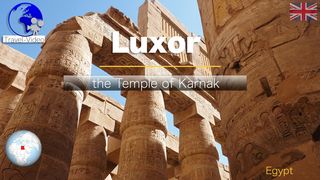
In the center of modern Luxor, on the east bank of the Nile, the Temple of Amun stands among the most celebrated monuments of ancient Egypt. Built within the sacred city of Thebes, it reflects the political and religious importance of the god Amun during some of the greatest periods of pharaonic history. This video follows several key areas of the complex: the great temple itself, the court of Ramesses II, the monumental colonnaded hall, the Sanctuary of the Sacred Barque, and the restored Avenue of Sphinxes.
The site was never an isolated building. It formed part of a larger ceremonial landscape linked to other temples, river access points and processional routes. Its significance lies not only in its architecture, but also in its role within royal ritual and urban identity.
The principal spaces shown in the video
The approach to the temple leads first into the court of Ramesses II, a large open enclosure designed for ceremonial movement and public visibility. Ramesses II marked this area with colossal statues, inscriptions and monumental architectural additions that projected royal authority. The court functions as a threshold between the outer world and the progressively more restricted sacred zones inside the complex.
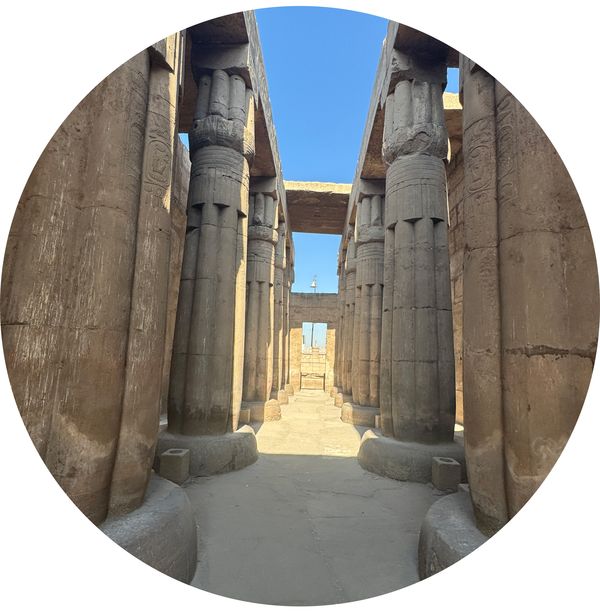
The Great Colonnade Hall is one of the most striking parts of the monument. Massive columns arranged in ordered lines create a sense of scale, rhythm and controlled perspective. Their height, carved surfaces and papyrus-inspired capitals demonstrate the technical and artistic confidence of New Kingdom builders.
Further within lies the Sanctuary of the Sacred Barque, a more enclosed and symbolically charged space. Here the ceremonial barque of Amun was housed during important rituals. Compared with the open courts and processional passages, this chamber reveals the inner hierarchy of temple space.
The Avenue of Sphinxes extends the monument into the wider city. Lined with guardian statues, it once connected Luxor Temple with Karnak Temple in a formal ceremonial axis. Its modern restoration has made the sacred urban planning of ancient Thebes easier to understand.
Historical, religious and architectural context
The temple developed over several centuries, mainly during the New Kingdom between the sixteenth and eleventh centuries BCE. Pharaohs such as Amenhotep III, Tutankhamun, Horemheb and Ramesses II all contributed building phases, decoration or structural additions. This long sequence explains the richness of the monument, where successive reigns left visible marks while maintaining overall coherence.
Amun, chief god of Thebes, became closely associated with kingship, divine legitimacy and cosmic order. Luxor Temple played a central role in the Opet Festival, one of the most important annual celebrations of ancient Egypt. During this ceremony, divine statues traveled from Karnak to Luxor, where rituals renewed the symbolic power of the pharaoh.
Architecturally, the temple follows a deliberate spatial progression: monumental entrance, open court, colonnaded spaces, darker inner rooms and central sanctuary. This movement from public visibility toward sacred intimacy reflects Egyptian ritual logic. Reliefs carved on walls and columns depict offerings, royal ceremonies and historical episodes.
Later centuries also left traces on the site. Greek, Roman, Christian and Islamic occupations introduced modifications that testify to the exceptional continuity of Luxor as a living historical landscape.
What the videos of this site make especially clear
Videos built largely from carefully selected and animated photographs are especially effective for monuments of this kind. They allow viewers to follow architectural sequences slowly, understand spatial transitions, and appreciate the relationship between scale and detail.
Gentle motion across images highlights the height of the columns, the alignment of ceremonial spaces and the contrast between open courts and enclosed sanctuaries. These visual transitions help explain how the temple was designed as a processional experience rather than a single static structure.
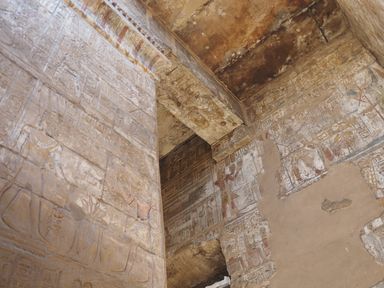
Close framing can reveal relief carving, inscriptions and surface textures that are often overlooked during a quick visit. Wider views restore the monument to its broader setting in Luxor and clarify its connection with the Avenue of Sphinxes and the sacred geography of ancient Thebes.
A lasting symbol of Egyptian civilization
The Temple of Amun at Luxor remains one of the clearest monumental expressions of ancient Egypt: royal power, religious belief, architectural mastery and historical continuity are all present within its walls. This video offers a structured and accessible reading of the site, while the related detailed pages provide further insight into its history and design.


Audio Commentary Transcript
the temple of Amon
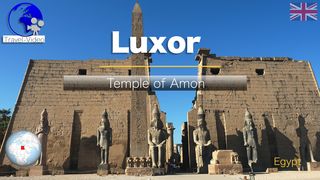
The Temple of Amun in Luxor, a gem of ancient Thebes, was erected in the heart of what is now modern central Luxor in Egypt. Primarily dedicated to Amun, the god of the sun and fertility, this site stands as one of the most significant in ancient Egypt. Its construction began around 1400 BCE under the reign of Amenhotep III and continued through the dynasties, with each pharaoh adding their own enhancements. This temple is distinguished not only by its monumental architecture but also by its central role in religious festivities, including the famous Opet Festival, which symbolized the regeneration of the king and the gods.
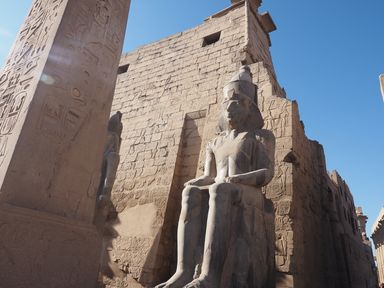
The majestic facade of the Temple of Amun in Luxor features six colossal statues of Ramses II, with four standing and two seated on either side of the main entrance. These statues signify the pharaoh's divine power and authority. To the left of the entrance stands a pink granite obelisk, intricately engraved, which originally formed a pair. The twin obelisk was gifted to France in the 19th century and now stands at the Place de la Concorde in Paris. The base of this obelisk, still present at the site, bears witness to this historical transfer and the cultural connections between Egypt and France. Initiated by Amenhotep III and expanded by Ramses II, the temple remains a poignant testament to the religious architecture and art of ancient Egypt.
Overlooking the peristyle square, the Abu al-Haggag Mosque was erected in the 13th century within the precincts of the Temple of Amun at Luxor. This construction exemplifies the harmonious integration of new structures within ancient sites.
The Great Colonnade Hall
The Great Colonnade Hall of Luxor, originally designed as an enclosed space, is now open to the sky due to medieval quarrying of its roof and a significant portion of its side walls. With its fourteen monumental columns and architraves, reaching a total height of twenty-one meters, this hall remains an architectural masterpiece. Historically, this majestic hall served as a transitional space towards the sanctuary, guiding priests and the faithful through sacred rituals to the temple’s most intimate areas, where the divine and the earthly converge. Despite the centuries, it continues to be one of the most impressive and beautiful sites in Egypt, bearing witness to the grandeur and spirituality of ancient Egyptian architecture.
the Avenue of the Sphinxes
Spanning 2.7 kilometers, the Avenue of the Sphinxes connects the temples of Luxor and Karnak, lined with over 1,350 mystical sphinx statues. This sacred way is a testament to the architectural grandeur of the ancient Egyptians and a key element in religious processions. A replica of the sacred barque of Amun highlights the divine journeys between the temples during key festivities.
Music:
- - YouTube video library - Beijaflor
- - YouTube video library - Home for the Holidays - TrackTribe
- - YouTube video library - Los Encinos - Quincas Moreira
Disclaimer: Despite its appropriateness, copyright issues prevent the use of egyptian traditional music in "Luxor • The Majestic Temple of Amun, Egypt", hence the use of royalty-free music. Despite our careful selection, some might regret this decision, which is necessary to avoid potential lawsuits. Although difficult, this decision is the only viable solution.